


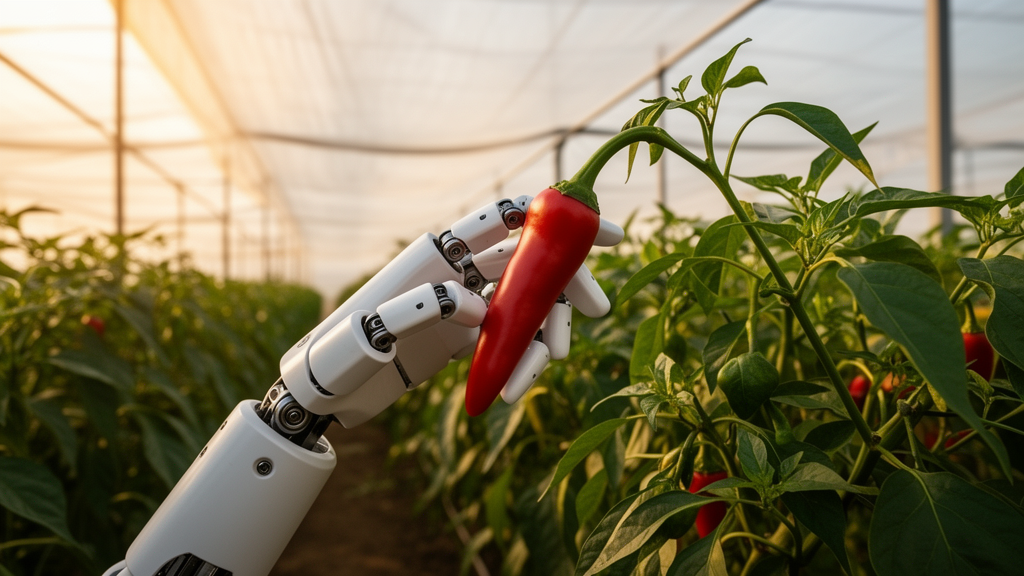
Engineers in China have built a robotic end effector that harvests chili peppers the way a person does: it clamps the fruit, pulls along the stem, and folds it sideways until the stem snaps cleanly at its natural break point. The device, described in Smart Agricultural Technology, pairs soft silicone gripping fingers with a rigid frame and a coordinated pulling-and-bending mechanism, and in laboratory tests it picked peppers of two different sizes with a 100 percent success rate, taking 3.5 seconds for smaller fruits and 4 seconds for larger ones.
The team, led by Zhiyuan Tan of the research group behind the study, set out to solve a stubborn problem in agricultural robotics. Chili peppers are among the world’s most valuable vegetable crops, and according to the latest figures from the United Nations Food and Agriculture Organization, China produced roughly 17.31 million tons of green peppers and peppers in 2024, about 38.6 percent of global output. Yet most fresh peppers are still picked by hand, a job that is slow, seasonal, and hazardous: workers’ fingers are easily cut, labor costs account for more than 60 percent of total production costs, and manual crews cannot always distinguish fully mature fruits from those still developing.
Harvesting a single fresh pepper is harder than it sounds. The plants grow in dense, upward-facing clusters, with reddening fruits piling up on the same horizontal plane and blocking one another, so a robotic gripper has little room to maneuver and can easily knock down unripe neighbors. The stems are thin and mechanically weak, which means a single clumsy force can snap the stem in the wrong place, bruise the skin, or tear the branch. Earlier designs illustrate the difficulty. A flexible clamping device for tomatoes took about 4.8 seconds per fruit but risked scratching nearby fruits with its blade. A two-finger silicone gripper for peppers achieved a 90 percent gripping rate, yet because it could apply force in only one direction, the final harvesting rate fell below 80 percent. A biomimetic compliant gripper that lifted peppers upward suffered a 5.2 percent loss rate because stems broke prematurely. Cutting devices reached harvesting success rates of 91.3 to 93.3 percent with a reported damage rate of 1.6 percent, but they depend on precisely locating the pedicel and having enough space to cut, and blades can spread pathogens between plants.
The researchers’ solution began with close observation of how people actually pick peppers. A human harvester holds the lower half of the fruit, applies a modest clamping force, then pulls gently along the stem’s direction while bending it laterally to one side. The fruit separates at the abscission layer, the specialized tissue where the stem naturally wants to break. Three forces act together at that layer: the clamping force that keeps the fruit from slipping, axial tension that transmits the separation load, and lateral bending that concentrates stress asymmetrically on one side of the stem. The team decomposed this manual sequence into three stages—holding, pulling, and bending—and used it as the kinematic blueprint for their machine, while noting that their pre-observation of human pickers did not constitute a formal quantitative experiment with measured forces or sample statistics.
The resulting end effector is compact, measuring 185 millimeters long and 80 millimeters wide, small enough to reach into a dense cluster without touching neighboring fruits. Flexible silicone clamping fingers sit on both sides; a pulling mechanism and a folding mechanism occupy the third side; and a control module orchestrates the sequence. The device grips only a quarter to a third of the fruit’s surface, which reduces collisions with adjacent peppers, and the silicone pads passively deform to conform to the fruit’s contours, enlarging the contact area and easing local stress concentrations. After the visual system locates the target, the robotic arm brings the fingers to the lower part of the fruit, the linear electric cylinder closes the grippers, and once the grip is stable the effector pulls along the stem’s axis while a motor-driven rotating disk bends it sideways. Notably, the clamping force is a preset value rather than a real-time feedback signal: the researchers reserved a position for an array tactile sensor on the fingertip but did not connect it to the control loop in this study.
To understand what happens inside the stem during this maneuver, the team built a multibody dynamics simulation of the whole fruit-stalk-branch-end effector system. The fruit was modeled as an ellipsoid with a low elastic modulus close to incompressible behavior, the stalk and branch as flexible beams with variable cross-sections, and the silicone pads as hyperelastic Mooney-Rivlin material. Material parameters came from compression tests on mature fresh peppers, density measurements by the drainage method, and calibration against published data on similar solanaceous fruits, expressed as ranges to cover variation in fruit size, maturity, and moisture content. The junction between the fruit stalk and the branch was designated a potential failure zone, and the distal end of the branch was fixed as a constraint, mirroring the physical setup.
The simulations compared three strategies: pulling alone, bending alone, and the combined clamp-pull-fold action. Pulling by itself requires a large, continuously accumulating tensile force to break the stem, and any slight slippage between fruit and gripper wastes part of that load. Bending alone concentrates stress effectively—one side of the stem stretches while the other compresses, encouraging cracks to start at the abscission point—but demands a large swing angle that risks knocking nearby fruits and branches. The combined action proved superior: clamping transmits the force, tension provides an axial preload, and bending creates stress concentration exactly where the stem is weakest, so the stem reaches its critical stress faster and with smaller movements. In the simulation, contact force between fruit and gripper peaked at 10.36 newtons just before separation, the pedicel carried a peak axial force of 5.18 newtons and a peak bending moment of 19.06 newton-millimeters, and the stem fractured at 3.61 seconds. Branch-tip disturbance stayed modest, with maximum displacements of 1.89, 4.91, and 2.83 millimeters in the X, Y, and Z directions respectively, the largest swing occurring along the principal bending direction.
Because five operating parameters—clamping force, pulling speed, pulling displacement, bending angle, and bending angular velocity—interact in complicated ways, the researchers ran an L16 orthogonal simulation experiment with four levels of each factor. They scored each run with a composite index weighting harvesting success at 0.35, fruit damage at 0.25, stem breakage time at 0.15, fruit slippage at 0.10, and energy consumption at 0.15. The analysis showed that clamping force and bending angle had the strongest influence on performance: too little clamping force caused slippage failures, too much increased fruit deformation, larger bending angles improved separation probability but intensified branch swinging and energy use. The exercise was purely computational, with no residual degrees of freedom for statistical error estimation, so the team framed the results as a screening of main effects rather than a significance test. From the ranking they settled on a favorable range—clamping force near 7 newtons, pulling speed of 30 to 60 millimeters per second, pulling displacement of 5 to 10 millimeters, bending angle of 30 to 45 degrees, and bending angular velocity of 60 to 120 degrees per second—and then selected nominal working parameters of 40 millimeters per second, 8 millimeters, 35 degrees, and 90 degrees per second for the prototype.
The laboratory verification put the simulation to the test on an indoor platform with a robotic arm, visual positioning, and fixed plants under stable lighting. Two representative pepper specimens anchored the size check: a larger fruit 12.80 millimeters in maximum diameter and 97.54 millimeters long with a 52.86-millimeter stalk, and a smaller fruit 9.26 millimeters in diameter, 62.52 millimeters long, with a 31.84-millimeter stalk. The prototype picked both successfully, with average picking times of 3.5 seconds for the smaller peppers and 4 seconds for the larger ones and a 100 percent success rate. The simulated fracture time of 3.61 seconds fell within the measured 3.50-to-4.00-second harvesting window, which the authors cite as evidence that the model captures the timing of stem separation—though they caution that the physical tests did not measure contact forces, bending moments, or branch displacements, so the validation covers only timing and separation outcome, not the full dynamic load picture.
The team is candid about the limits of what they have shown. The robustness analysis used preset allowable boundaries of plus-or-minus 2 millimeters in position error and plus-or-minus 8 degrees in posture error, beyond which the gripping point drifts away from the fruit’s lower-middle region and the pulling direction deviates from the stem axis, raising the risk of slippage or failure to break at the abscission layer. Without sequential random disturbance records, the researchers could not report success probabilities under perturbation with confidence intervals. The clamping force reference range of 7 to 12 newtons applies only to the material parameters and boundary conditions they tested, not to every chili variety or maturity level, and the entire study took place in a laboratory without wind, rain, variable sunlight, or uneven field terrain. Still, the core result stands: by copying the three-force choreography of a human hand, a compact rigid-flexible gripper can detach a pepper quickly, cleanly, and gently—and the next step, the authors say, is to expand the sample size, test multiple varieties across growth stages, and see whether the same clamp-pull-fold rhythm survives the mess of a real field.
Subject of Research: A biomimetic clamp-pull-fold robotic end effector for harvesting fresh chili peppers with low fruit damage
Article Title: Analysis of a “Clamp-Pull-Fold” composite end effector for a chili pepper harvesting robot
Article References: Tan, Z., Zhu, Y., Chen, J., Wu, C., Yu, C., & Yao, K. (2026). Analysis of a “Clamp-Pull-Fold” composite end effector for a chili pepper harvesting robot. Smart Agricultural Technology, 15, Article 102630. https://doi.org/10.1016/j.atech.2026.102630
Image Credits: AI Generated
DOI: 10.1016/j.atech.2026.102630
Keywords: agricultural robotics, chili pepper harvesting, end effector, soft gripper, abscission layer, multibody dynamics simulation, orthogonal experiment, fruit damage, harvesting robot, biomimetic design, laboratory prototype test, Analysis
News Source: Denise Maddox. (October 30, 2026). Robot Hand Mimics Human Fingers to Pick Chili Peppers Without Damage. Scienmag.



