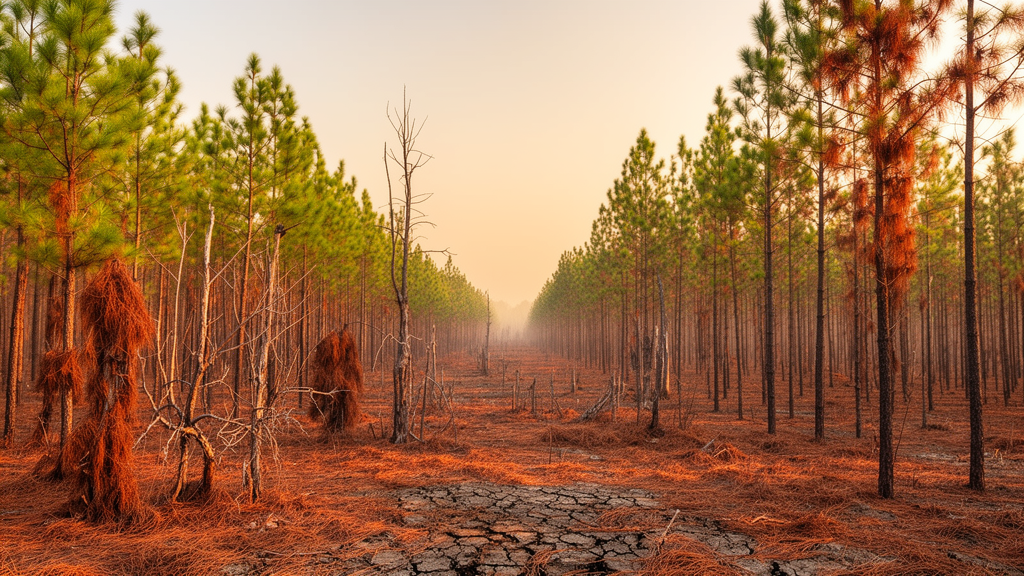
In the Landes de Gascogne forest of southwestern France, the options available to a landowner deciding how to manage a maritime pine stand are quietly disappearing. A new study published in Annals of Forest Science shows that climate change consistently reduces the services this million-hectare planted landscape can deliver, and that under the harshest scenarios the survival of regional timber and carbon goals depends on how well local management regimes can limit damage from drought, fire, storms and bark beetles. Beyond certain thresholds of acceptable timber loss, no currently practiced management regime remains viable at all. The research, led by Clémence Labarre with Babooshka Shavazipour, Denis Loustau and Jean-Christophe Domec, introduces a flexibility-based optimization framework designed to bridge the gap between what individual forest owners can realistically decide and what regional planners need the landscape as a whole to deliver.
The study area is not an ordinary forest. The Landes de Gascogne stretches over one million hectares, of which 786,000 hectares are maritime pine plantations, with an annual productivity estimated between 6 and 7 cubic meters per hectare per year. The region produces 17 percent of France’s wood volume and sustains more than 30,000 jobs. It is also a major carbon pool, holding an estimated 151 million tons of CO2 in standing stock, with an additional 65.5 million tons stored in harvested products. Yet productivity is far from uniform: variation in soils, water, climate and social context shapes growth across the region, and recent work has identified particularly productive sub-regions in the southwest. This heterogeneity matters because day-to-day management decisions in France are made at the stand and forest level, often by private owners, while sustainability is monitored regionally.
To capture that mismatch in scale, the researchers coupled process-based forest simulations with multi-objective optimization. They used the GO+ model, which projects forest growth under evolving climate conditions including hourly variations in temperature, irradiance and precipitation, and whose growth predictions have been validated against observed flux measurements and long-term stand growth records. A connected carbon allocation tool then tracked the fate of harvested carbon through seven product categories, from packaging and pallets to construction timber, pellets and furniture, following each product’s life cycle until the carbon eventually returns to the atmosphere as CO2. Climate projections under RCP4.5 and RCP8.5 were downscaled to a resolution of 8 by 8 kilometers, dividing the territory into 206 sub-regions of 6,400 hectares each. The authors restricted the analysis to these two pathways because observed drying in the Aquitaine region already exceeds what the low-emissions RCP2.6 scenario projects, making that pathway implausible under current emission trajectories.
The simulations compared four management regimes currently applied to pine plantations. Classic management follows conventional harvest and thinning schedules. Short management accelerates the harvest timeline, producing closely timed final cuts suited to energy production. Long management extends harvest intervals to enhance on-site carbon sequestration and extend the lifespan of wood products, since trees with larger circumference are harvested. Drought-risk management resembles the classic approach but adds preventive thinning designed to reduce drought stress on remaining trees. Each regime was simulated over 100 years for all combinations of four age classes and three soil types, and outputs were aggregated for each grid cell using age-class proportions from the national forest inventory and soil-type proportions from a 100-meter resolution soil map.
Risk entered the framework through annual estimates of potential timber losses. Tree growth in the model responds directly to heat waves and drought through a stress index, but fire, storm and bark beetle damages were calculated separately: storm probabilities came from the ForestGales model applied to standing trees, fire probabilities from the SPITFIRE model based on forest structure and potential fire intensity, and bark beetle damage from climatic parameters and damage percentages in the literature. The authors are careful to note that this mean annual loss indicator is additive, ignores interactions among disturbances, is not dynamically fed back into the growth simulations, and should therefore be interpreted as relative patterns for comparing strategies under consistent assumptions rather than as precise predictions of damage.
The optimization itself treated each of the 206 grid cells as a decision point. Binary variables selected one of the four management regimes per cell across four contrasting allocation strategies, and three objective functions were pursued simultaneously: carbon sequestered in standing biomass and soil over 30 years, carbon stored in wood products over the same period, and a flexibility score. That score counts how many management alternatives remain feasible in each cell, ranging from 0, when no alternative is viable anywhere, to 824, when all four options survive in every one of the 206 cells. Rather than prescribing a minimum service level in advance, the framework explores trade-offs between regional provision and the diversity of feasible local options, using weighted sum and Tchebycheff-based scalarization methods to guarantee Pareto optimality, with roughly 411 non-dominated solutions identified per run.
The results carry a stark message about the future of this working landscape. Climate change reduced service provision across all scenarios tested. In the first 30-year period, the achievable range of carbon exported shifted from 2.5 to 3.3 times ten million tons of carbon per 30 years under RCP4.5 to 2.3 to 5.2 under RCP8.5, while the range of carbon sequestered moved from 2.4 to 5.1 to 2.7 to 6.7. But when all three periods, running from 2006 to 2100, were analyzed jointly with management continuity enforced across them, those ranges collapsed to between 0.01 and 0.8 for RCP4.5 and 0.01 and 1.2 for RCP8.5, revealing how limited the possibility of long-term carbon sequestration becomes for both scenarios. The highest carbon sequestration and export levels were consistently found at low flexibility scores of roughly 200 to 400 feasible options, meaning each grid cell retained on average only one to two of the four possible regimes. Maximizing carbon supply, whether through export or sequestration, therefore relied on highly specific allocation strategies with few comparable alternatives, and strategies optimized for sequestration appeared less robust to changing conditions than those for export.
Risk tolerance proved to be a decisive lever. When the maximum acceptable timber loss was held high, flexibility scores stayed elevated during the first climate period, but once tolerance dropped below 20 percent the scores fell sharply as many regimes were filtered out. In the second and third periods the decline came earlier and steeper, and at low tolerance levels no feasible solutions existed at all. Scenario differences were subtle but real: during the second period, RCP4.5 allowed up to 100 more local management alternatives than RCP8.5 at the same tolerance level, indicating a narrower decision space under the harsher climate. The highest carbon provisions occurred only under the most risk-tolerant settings, showing that the forest’s sequestration potential depends not only on climate but on how much damage owners are willing to accept. Balancing the two carbon objectives came at a regional cost ranging from 20 percent under no risk aversion to 66 percent under high risk aversion for RCP4.5, and from 10 to 64 percent for RCP8.5, relative to maximum achievable levels.
The spatial maps add a geographic dimension to these trade-offs. Under no risk aversion, optimal allocations were dominated by short management, while high risk aversion pushed the landscape toward long management, which demonstrated the greatest capacity to limit biomass loss at regional scale, likely because older stand structures resist fire, which damages young trees, and because bark beetles first attack weakened wood while storm losses depend on tree diameter and stand age. Under RCP8.5, short management concentrated in the southwest while central and southeastern areas retained more flexible or long-rotation strategies; under RCP4.5 the pattern appeared more random. Strikingly, during the final period analyzed at least 60 to 70 of the 206 sub-regions had no feasible management alternative at all due to excessive exposure to timber-damage risk, appearing as blank cells on the maps. Drought-risk management, previously excluded from optimal solutions, emerged in specific cells where short and classic regimes prevailed.
The authors frame the flexibility score as a practical planning tool rather than a prescription. It quantifies the alignment between local practices and regional objectives, helping identify where flexible, low-risk regimes can still sustain carbon sequestration and where alternative land use might eventually need consideration. They acknowledge limits: the growth model is specialized for mono-specific, even-aged coniferous forests, the simulations assumed balanced age-class structures that may not reflect real forests, nitrogen and soil fertility effects are not explicitly represented, and the score captures what is feasible in principle but not what owners will actually implement. About 75 percent of French forested land is privately and often jointly owned, so aligning regional goals with local room for maneuver remains essential. The framework itself, the authors argue, is transferable to other regions and species, offering decision-makers a way to design strategies that are both climate-robust and socially grounded as ecological pressures on Europe’s plantation forests intensify.
Subject of Research: A flexibility-based optimization framework linking local maritime pine management decisions to regional carbon and timber strategies under climate change in the Landes de Gascogne forest.
Article Title: Bridging local decisions and regional forest strategies under climate risks: a flexibility-based optimization framework
Article References: Labarre, C., Shavazipour, B., Loustau, D., & Domec, J.-C. (2026). Bridging local decisions and regional forest strategies under climate risks: a flexibility-based optimization framework. Annals of Forest Science, 83(1), Article 32. https://doi.org/10.1186/s13595-026-01355-5
Image Credits: AI Generated
DOI: 10.1186/s13595-026-01355-5
Keywords: Landes de Gascogne, maritime pine, climate change, forest management, carbon sequestration, multi-objective optimization, RCP scenarios, timber damage risk, drought, wildfire, bark beetles, forest planning
News Source: Sloane Callahan. (October 30, 2026). Climate Risks Shrink the Menu of Viable Options in Europe’s Largest Pine Plantation Forest. Scienmag.