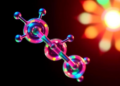
Credit: Paul Scherrer Institute/Mahir Dzambegovic
Through a unique combination of computer simulations and laboratory experiments, researchers at the Paul Scherrer Institute PSI have discovered new binding sites for active agents – against cancer, for example – on a vital protein of the cell cytoskeleton. Eleven of the sites hadn’t been known before. The study appears today in the journal Angewandte Chemie International Edition.
The protein tubulin is an essential building block of the so-called cell cytoskeleton. In cells, tubulin molecules arrange themselves into tube-like structures, the microtubule filaments. These give cells their shape, aid in transporting proteins and larger cellular components, and play a crucial role in cell division.
Thus tubulin performs diverse functions in the cell and in doing so interacts with numerous other substances. “Tubulin can bind an astonishing number of different proteins and small molecules, several hundred for sure,” says Tobias Mühlethaler, a doctoral candidate in the PSI Laboratory of Biomolecular Research and first author of the study. The functions of the protein are guided by means of such bonds. Also, many drugs dock on tubulin and take effect, for example, by preventing cell division in tumours.
“In this project, we addressed the fundamental question of how many binding sites in total exist on this vital protein,” Mühlethaler explains. “If we discover new ones, these could possibly be used therapeutically.”
From the virtual to the laboratory
In computer simulations conducted in collaboration with the Italian Institute of Technology in Genoa, the researchers combed through the structure of the protein: They identified places where other molecules could dock particularly well to tubulin. These are the so-called binding pockets.
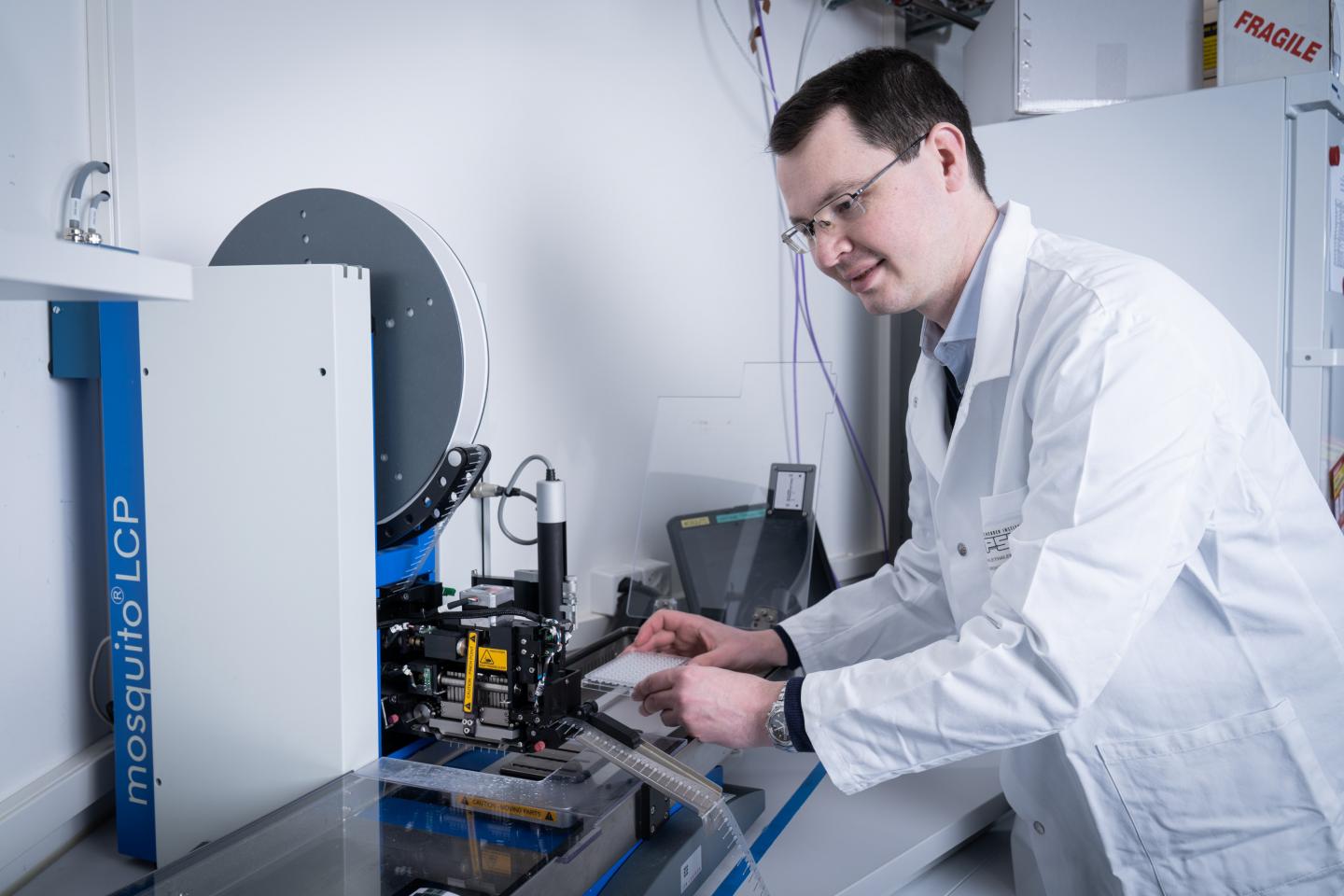
Subsequently, in an actual laboratory experiment, the researchers sought to verify such sites. For this, they used a method called fragment screening: Starting with hundreds of crystals of tubulin, the researchers added individual solutions containing fragments of molecules that are typical precursors for promising active agents. Within an hour, the tubulin crystals were able to soak up as much of the fragment solution as they could hold. Finally the crystals were fished out of the liquid and exposed to synchrotron X-ray radiation. On the basis of the resulting diffraction pattern, the researchers are able to infer the structure of the crystal. Thus it could be determined if and where the molecule fragments have bound to the protein.
“Both methods, computer simulations and fragment screening, have their respective strengths and weaknesses,” says Michel Steinmetz, head of the Laboratory of Biomolecular Research. “By combining them, we ensure that no binding site on the protein escapes our search.”
Eleven new ones
Overall, the researchers found 27 binding sites on tubulin where molecules or other proteins can dock. “Eleven of them had never been described before,” says Mühlethaler. In addition, the researchers identified 56 fragments that bind to tubulin and might be suitable for developing new active agents.
As the researchers stress, their approach is also transferable to other proteins. “Here we have developed a method for early discovery of so-called lead molecules and, with that, new starting points for the development of active agents,” says Michel Steinmetz. It should be possible to apply this method successfully to all proteins for which high quality crystals can be obtained.
“The search for potential new lead molecules is a focus of the Swiss Light Source SLS,” Steinmetz adds. “This will gain increasing significance after the upgrade to SLS 2.0, planned for the coming years, has taken place.”
###
Text: Paul Scherrer Institute/Brigitte Osterath
About PSI
The Paul Scherrer Institute PSI develops, builds and operates large, complex research facilities and makes them available to the national and international research community. The institute’s own key research priorities are in the fields of matter and materials, energy and environment and human health. PSI is committed to the training of future generations. Therefore about one quarter of our staff are post-docs, post-graduates or apprentices. Altogether PSI employs 2100 people, thus being the largest research institute in Switzerland. The annual budget amounts to approximately CHF 400 million. PSI is part of the ETH Domain, with the other members being the two Swiss Federal Institutes of Technology, ETH Zurich and EPFL Lausanne, as well as Eawag (Swiss Federal Institute of Aquatic Science and Technology), Empa (Swiss Federal Laboratories for Materials Science and Technology) and WSL (Swiss Federal Institute for Forest, Snow and Landscape Research).
Contact
Tobias Mühlethaler
Laboratory of Biomolecular Research
Paul Scherrer Institute, Forschungsstrasse 111, 5232 Villigen PSI, Switzerland
Telephone: +41 56 310 41 62; e-mail: [email protected] [German, English]
Prof. Dr. Michel Steinmetz
Head of the Laboratory of Biomolecular Research
Paul Scherrer Institute, Forschungsstrasse 111, 5232 Villigen PSI, Switzerland
Telephone: +41 56 310 47 54; e-mail: [email protected] [German, English]
Original publication
Comprehensive analysis of binding sites in tubulin
T. Mühlethaler, D. Gioia, A. E. Prota, M. E. Sharpe, A. Cavalli, M. Steinmetz
Angewandte Chemie International Edition, 5.5.2021 (online)
DOI: 10.1002/anie.202100273
Further information
A question of binding – in search of drugs against Covid-19
https:/
Watching receptor proteins changing shape
http://psi.
PSI equips the Swiss Light Source SLS for the future
https:/
Media Contact
Mirjam van Daalen
41-563-102-111
Original Source
https:/
Related Journal Article
http://dx.