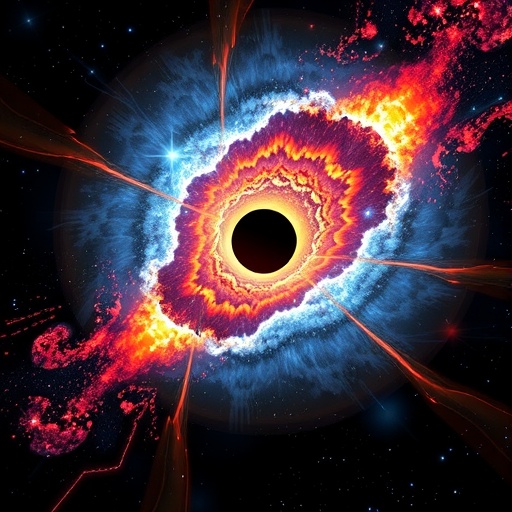
When two black holes spiral together and merge in a cataclysmic collision, the universe briefly trembles with gravitational waves that carry away a torrent of energy. The final product of this violence is a single, larger black hole, a remnant that appears to have forgotten almost everything about its parents—except for its total mass and spin. Predicting those two numbers has traditionally demanded solving the brutally complex equations of Einstein’s general relativity on supercomputers, a task that can take weeks for a single event. Now, a team led by physicists at Penn State has shown that an entirely different, far simpler language can capture the outcome: thermodynamics. In a paper published July 2 in Physical Review Letters and selected as an Editors’ Suggestion, they propose a “maximum entropy conjecture” that allows the mass and spin of a merger remnant to be estimated with stunning accuracy—just a few percent—using only concepts borrowed from the physics of heat, disorder and gases.
The idea that black holes obey thermodynamic laws is not new. In the 1970s, Stephen Hawking and Jacob Bekenstein famously demonstrated that a black hole possesses an entropy proportional to its event horizon area, and that it radiates with a temperature. Yet these laws were formulated for stationary black holes in equilibrium. A pair of inspiraling, merging black holes is anything but stationary; it is a violently dynamical system that emits enormous fluxes of gravitational radiation. Extending thermodynamic reasoning to such a transient, far-from-equilibrium process has been a formidable challenge. The Penn State group built on a recent advance from their institution that overcame a key limitation of Hawking’s original framework, making it applicable to black holes that form, coalesce and evaporate.
“The final black hole after a merger is ringing like a struck bell, and it radiates away more gravitational waves until it settles into a calm, stable state described by just two numbers—its final mass and spin,” said Monica Rincon-Ramirez, a postdoctoral scholar in physics at Penn State and the paper’s first author. “The question we asked is: Can we predict what that final state looks like using arguments from thermodynamics?” The answer, the team discovered, appears to be a resounding yes.
At the heart of their conjecture lies entropy, often described as the measure of disorder or the number of microscopic arrangements that give rise to the same macroscopic appearance. In ordinary thermodynamics, when two gases at different temperatures are brought into contact, they do not require tracking every molecular collision to predict the final, uniform temperature; maximizing the total entropy while conserving energy yields the answer. The researchers asked whether black hole mergers might follow an analogous principle. If one properly accounts for the energy and angular momentum—the rotational motion—swept away by gravitational waves during the inspiral and ringdown, the remnant black hole seems to settle into precisely the state that maximizes the entropy of the system.
To test this, the team constructed a sequence of hypothetical rotating black holes that represent possible remnants consistent with the system’s initial total mass and angular momentum, minus the amounts radiated to infinity. They then computed the entropy for each candidate remnant using the Bekenstein-Hawking area law. Remarkably, the entropy exhibited a clear maximum, and the mass and spin at that maximum fell within a few percent of the values obtained from full-blown numerical relativity simulations—the gold standard that solves Einstein’s equations on supercomputers. “We observe that the entropy of this sequence reaches a maximum at values strikingly close to the mass and angular momentum of the actual final remnant,” Rincon-Ramirez explained. “The agreement is within a few percent.”
This success suggests that black hole mergers, despite their extreme complexity, are governed by a universal drive toward disorder. Vaishak Prasad, a postdoctoral researcher in astronomy and astrophysics at Penn State and a co-author, offered an everyday analogy: “A messy room has high entropy—there are countless ways things can be strewn about. A perfectly tidy room has low entropy—there are only a few arrangements that count as ‘tidy.’ Nature tends to drift toward high-entropy states simply because there are more of them. Our results suggest that black hole mergers do something similar.” The remnant effectively selects the most probable configuration compatible with the conserved quantities and the radiation losses.
The conjecture represents a profound conceptual shift. For decades, the end state of a black hole collision had to be extracted laboriously from numerical relativity. Now, an entropy maximization principle can provide an immediate and physically transparent estimate. It also implies that the information “forgotten” in the merger—the details of the progenitor masses, spins and orbital dynamics—is exactly what gets swallowed up in the transition to a maximum-entropy final state, a notion with deep echoes in the black hole information paradox.
The research team included Eugenio Bianchi, professor of physics at Penn State, Nathan K. Johnson-McDaniel of the University of Mississippi, Ish Gupta of the University of California, Berkeley, and B.S. Sathyaprakash, Elsbach Professor of Physics and Astronomy and Astrophysics at Penn State, who led the group. The work was funded by the U.S. National Science Foundation.
Perhaps the most tantalizing implication is the possibility that entropy maximization might serve as a foundational organizing principle for black hole interactions across the universe. “This work explores a surprising possibility at the intersection of gravity, black hole physics and thermodynamics that goes beyond the established laws of black hole mechanics,” said Sathyaprakash. If the conjecture continues to hold for more exotic mergers and in more complete treatments, it could reveal a hidden layer of simplicity beneath the fabric of spacetime, uniting the cosmic and the chaotic in a single thermodynamic imperative.
Subject of Research: Maximum entropy conjecture predicting the mass and spin of black hole merger remnants
Article Title: Maximum Entropy Conjecture for Black Hole Mergers
News Publication Date: July 2, 2025
Web References: https://doi.org/10.1103/hvp6-ydbq
References: M. Rincon-Ramirez et al., Phys. Rev. Lett. (2025), DOI: 10.1103/hvp6-ydbq
Image Credits: LIGO/Caltech/MIT/R. Hurt (IPAC)
Keywords
Black holes, Thermodynamics, Entropy, General relativity, Gravitational waves, Astrophysics, Theoretical astrophysics, Theoretical physics