Ferulic acid is one of the most abundant aromatic compounds locked inside lignocellulosic biomass, and microbes that can withstand high concentrations of it are valuable for converting plant waste into products such as vanillin. A new study has now mapped, in detail, how the yeast Komagataella phaffii copes with this toxic compound, and it has identified specific genes that, when overexpressed, dramatically improve the yeast’s survival. The work, published in Biotechnology for Biofuels and Bioproducts, combined transcriptomic profiling with a genome-scale metabolic model to pinpoint tolerance targets that were then validated experimentally.
The researchers worked with an engineered strain of K. phaffii carrying a heterologous pathway that converts ferulic acid into vanillin. This strain was exposed to 20 millimolar ferulic acid under two different conditions: one in which the pathway was not induced (FE–NI) and one in which it was induced with methanol (FE-I). Both engineered conditions showed higher growth rates and higher final cell densities than the wild-type strain under ferulic acid stress. The methanol-induced condition also displayed active catabolism of ferulic acid and a transient accumulation of vanillin, confirming that the engineered pathway was functioning.
Perhaps the most striking result came from the non-induced condition. Even without detectable consumption of ferulic acid, the FE–NI strain achieved tolerance comparable to the induced one. This observation led the authors to conclude that metabolic reprogramming of the host cell itself, rather than conversion of the toxic compound, contributes substantially to ferulic acid tolerance. In other words, the engineered yeast appears to have rewired its own metabolism in a way that makes it more resilient, independent of whether the added pathway is actively turning ferulic acid into vanillin.
Transcriptomic profiling revealed that the two conditions triggered distinct stress-response programs. Under non-induced conditions, the host activated a program involving reinforcement of the cell surface, support of mitochondrial energy and redox balance, and remodeling of central carbon metabolism. Under methanol-induced conditions, where ferulic acid was being actively converted, the response instead coupled enhanced aldehyde detoxification with remodeling of sugar metabolism. These condition-dependent differences suggest that tolerance in this yeast is not a single uniform mechanism but a set of overlapping strategies that shift depending on whether the cell is merely exposed to the compound or actively metabolizing it.
To move from observation to engineering, the team integrated the transcriptome data with a genome-scale metabolic model using an E-Flux approach. This method constrains the flux capacity of reactions in the model according to gene-expression levels, allowing the researchers to prioritize candidate targets whose upregulation might plausibly increase tolerance. The integration produced a ranked list of genes whose enhanced expression was predicted to support growth under ferulic acid stress.
Functional validation followed in the wild-type strain, where individual candidate genes were overexpressed and the resulting strains were tested for their ability to grow in the presence of ferulic acid. Two targets stood out. Overexpression of AGC1 produced the strongest effect under non-induced conditions, increasing colony number 7.4-fold relative to the control. Overexpression of PAS_chr3_0834 was the most effective under methanol-induced conditions, raising colony number 4.0-fold relative to the control. These fold changes were measured by counting colonies, a standard proxy for tolerance in yeast stress assays.
The researchers also tested whether combining the two best targets would produce an additive benefit. Co-expression of AGC1 and PAS_chr3_0834 did increase biomass accumulation relative to the wild type, but the combined effect did not exceed that of AGC1 alone under the condition tested. This result indicates that the two genes likely act through overlapping or non-additive mechanisms, and that stacking them does not automatically yield a stronger tolerance phenotype than the single best target.
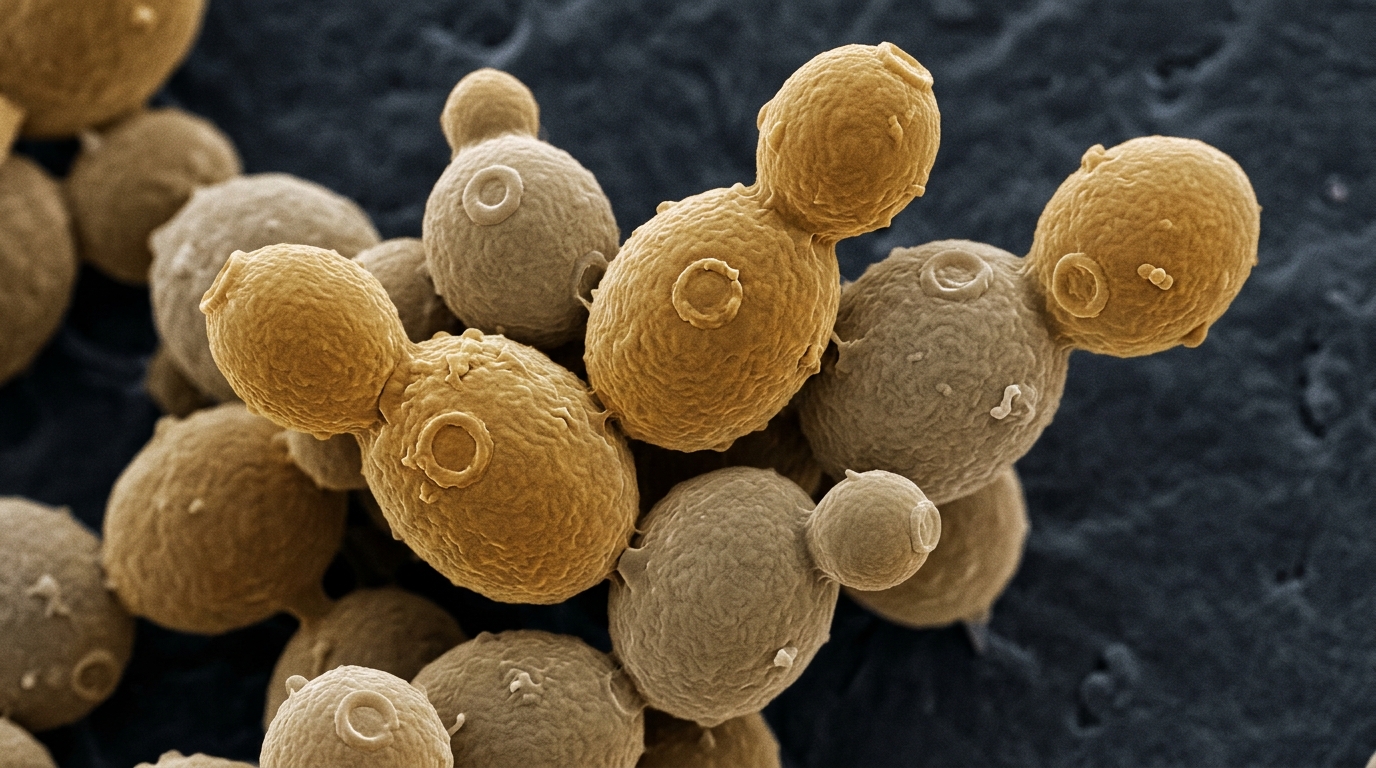
Komagataella phaffii, formerly known as Pichia pastoris, is a widely used non-conventional yeast cell factory with favorable properties for aromatic compound production. Because ferulic acid toxicity limits microbial conversion at elevated concentrations, identifying tolerance targets in this host has direct practical value for industrial bioprocesses that aim to convert plant-derived aromatics into higher-value molecules such as vanillin. The validated targets identified here, AGC1 and PAS_chr3_0834, represent engineering options for improving the robustness of K. phaffii strains employed in ferulic-acid-based bioconversion.
The study’s broader significance lies in its methodological approach. By integrating condition-specific transcriptomic data with a constraint-based metabolic model, the researchers were able to narrow a genome-wide set of differentially expressed genes down to a small number of actionable targets, two of which proved effective when tested experimentally. The authors note that the validated targets are valuable engineering options for improving the robustness of K. phaffii cell factories used in ferulic-acid-based aromatic compound bioconversion, and that the combined transcriptomics-modeling workflow can facilitate the identification of tolerance targets more broadly.
Because the work was carried out in a single yeast species under laboratory conditions, further validation in industrial settings and at larger scales would be needed before the targets are deployed in production strains. Nevertheless, the study provides a clear demonstration that condition-dependent tolerance programs can be disentangled in a non-conventional yeast, and that pairing transcriptomics with genome-scale metabolic modeling is a practical route to finding the genes that matter most when microbes face toxic biomass-derived compounds.
Subject of Research: Identification of ferulic acid tolerance genes in engineered Komagataella phaffii using transcriptomics and genome-scale metabolic modeling
Article Title: Identification of ferulic acid tolerance targets in engineered Komagataella phaffii by transcriptomics-integrated genome-scale metabolic modeling
Article References: Shao, Y., Zhou, D., Gong, Q., Liu, M., Xin, F., & Li, Z. (2026). Identification of ferulic acid tolerance targets in engineered Komagataella phaffii by transcriptomics-integrated genome-scale metabolic modeling. Biotechnology for Biofuels and Bioproducts. https://doi.org/10.1186/s13068-026-02836-5
Image Credits: AI Generated
DOI: 10.1186/s13068-026-02836-5
Keywords: ferulic acid, Komagataella phaffii, transcriptomics, genome-scale metabolic model, E-Flux, vanillin, yeast tolerance, metabolic engineering, lignocellulosic biomass, aldehyde detoxification, AGC1, cell factory
News Source: Brooke Gardner. (November 5, 2026). Yeast Tolerance to Ferulic Acid Mapped by Transcriptomics and Metabolic Modeling. Scienmag.