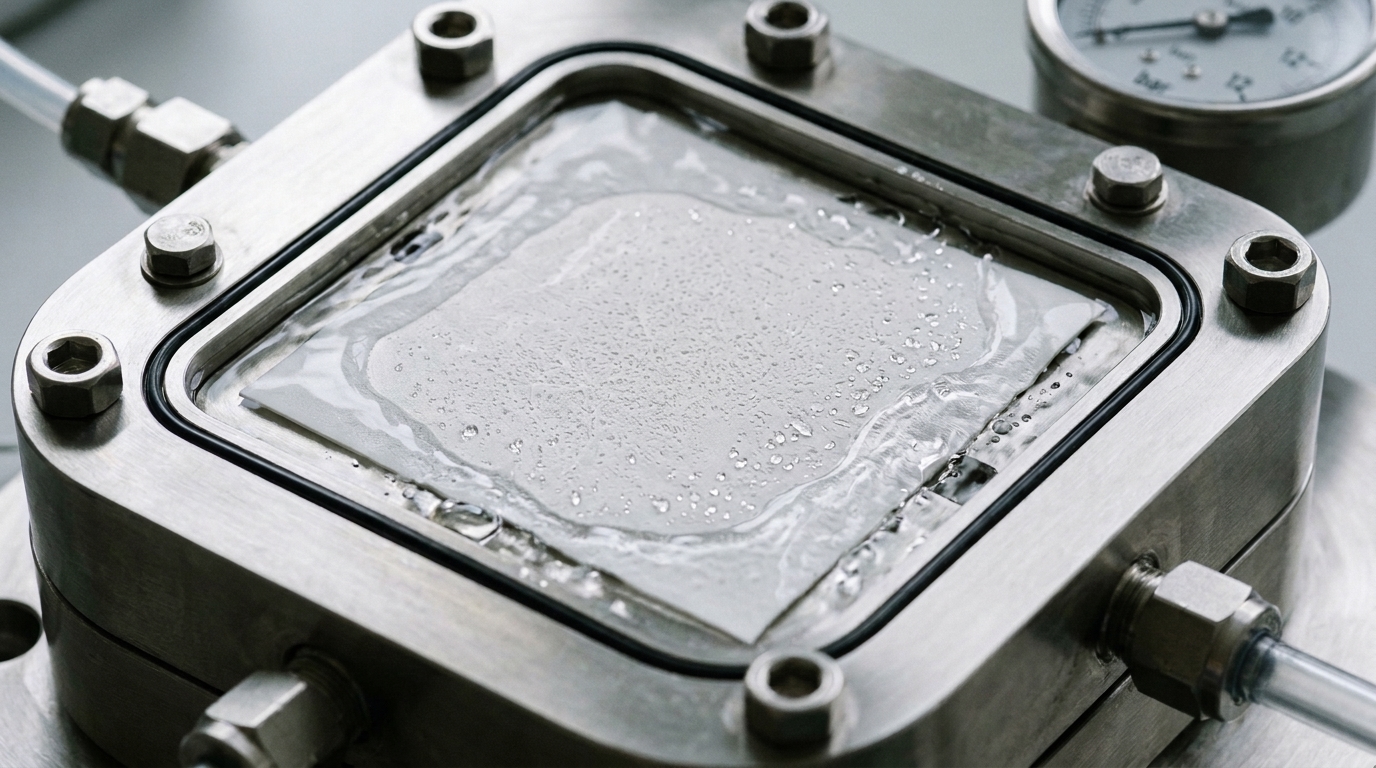
Engineers in China have built nanofiltration membranes that carry fixed electrical charges in both their porous support and their thin selective skin, a design that lets them reject more than 95 percent of multivalent salts while passing water at rates far above those of commercial membranes. The membranes, described in Frontiers in Membrane Science and Technology, also removed over 99.9 percent of lead ions, virus surrogates, and Escherichia coli in household filtration tests run at roughly 0.1 megapascals, a pressure comparable to municipal tap water. The work was carried out by Jiang Wei, Chulong Chen, and Wei Feng of Zhejiang Mey Membrane Technology in Hangzhou.
Conventional thin-film composite nanofiltration membranes are built in three layers: a non-woven fabric backing for mechanical strength, a porous polysulfone or polyethersulfone intermediate, and an ultrathin polyamide selective layer formed by interfacial polymerization. In that architecture, the support is essentially uncharged, and the polyamide layer carries only a modest density of residual carboxylate or amine groups, leaving the surface near-neutral or weakly negative around neutral pH. Because salt rejection in nanofiltration depends on the interplay of steric hindrance and electrostatic Donnan exclusion, that limited fixed-charge density constrains selectivity, particularly at high flux. The dense non-woven backing also adds hydraulic resistance: commercial membranes typically exceed 100 to 150 micrometers in total thickness, which raises the structural parameter, lowers water flux, and pushes operating pressures to several bar or higher.
The new design attacks both problems at once. The researchers incorporated charged functional groups into the porous support matrix as well as the selective layer, so that fixed ionic sites exist throughout a much larger fraction of the membrane thickness. Their hypothesis is that the overlapping electrical double layers generate a continuous electrostatic exclusion field, so that ions which slip through local defects in the selective layer still encounter a secondary electrostatic barrier within the charged support. At the same time, eliminating the non-woven backing reduced total membrane thickness to roughly 30 to 80 micrometers, sharply lowering hydraulic resistance and allowing operation under standard municipal tap pressure without booster pumps.
The team fabricated charged supports from sulfonated polyvinylidene fluoride, sulfonated polyethersulfone, and quaternized polysulfone using phase-separation casting, and in some variants thermally induced phase separation followed by biaxial stretching to open interconnected pores. Selective layers were deposited either as sulfonated polymer coatings or, for polyamide systems, by interfacial polymerization with a charged amine precursor in the aqueous phase and trimesoyl chloride in the organic phase. Depending on the configuration, the supports carried either negatively charged sulfonate groups or positively charged quaternary ammonium groups, matching the charge polarity of the skin above them.
Surface-charge measurements underscored the stability of the design. Streaming-potential tests across pH 1 to 13 showed that the dual-negatively charged sPVDF-N/sPVDF membrane held zeta potentials between roughly −74 and −77 millivolts at every pH tested, from −75.5 ± 1.1 mV at pH 1 to −73.9 ± 0.6 mV at pH 13. Conventional polyamide nanofiltration membranes often show strong pH dependence and can undergo charge reversal near their isoelectric point. The near-constant negative charge is attributed to sulfonate groups, which, unlike weak carboxylic acid groups, remain strongly dissociated across a broad pH range. The authors note that streaming-potential measurements characterize surfaces and accessible pore walls rather than the full interior of the support, so the existence of internal fixed charges is inferred from the fabrication chemistry rather than directly mapped.
Desalination results varied with configuration. The self-standing sPVDF-N/sPVDF membrane rejected 95.6 ± 0.5 percent of sodium sulfate at a flux of 317 ± 9 liters per square meter per hour, while the non-woven-free sPE-T/sPDA membrane, whose selective layer was formed by interfacial polymerization on a stretched support, reached 99.3 ± 0.2 percent sodium sulfate rejection at 367 ± 12 LMH, equivalent to a pure-water permeance near 37 liters per square meter per hour per bar. The positively charged qPSU-NW/qPSU membrane rejected 94.8 ± 0.3 percent of magnesium chloride at 209 ± 11 LMH, and the sPVDF-NW/sPES variant posted the weakest numbers, 92.2 ± 0.3 percent rejection at 217 ± 7 LMH. Because different salts were used for differently charged membranes, the authors caution that direct quantitative comparison among the configurations is complicated, and the weaker sPVDF-NW/sPES result shows that performance depends on support morphology, selective-layer chemistry, interfacial compatibility, and fixed-charge density, not merely on the absence of a backing layer.
Benchmarked against commercial nanofiltration membranes, which typically show pure-water permeances of about 5 to 15 liters per square meter per hour per bar while maintaining high sulfate rejection, the dual-charged membranes exceeded 30 LMH/bar while keeping multivalent-salt rejection above 95 percent. The authors attribute this to two complementary factors: increased volumetric charge density from the dual-charged design and reduced hydraulic resistance from eliminating the non-woven backing. They also note that rejection likely reflects the combined effects of Donnan exclusion, dielectric exclusion, and steric hindrance, since ions entering nanometer-scale pores face an energetic penalty from the mismatch between bulk water and confined-pore dielectric properties. Importantly, the study did not directly measure the spatial distribution of fixed charges through the support, so the dual-EDL mechanism is presented as a physically reasonable interpretation rather than definitive proof.
The household-scale tests compared the sPVDF-N/sPVDF membrane against commercial microfiltration and ultrafiltration cartridges, all run at 0.1 megapascals. The nanofiltration membrane delivered a water flux of 59 ± 8 LMH while rejecting more than 99.9 percent of Pb2+ ions, norovirus surrogates, and E. coli. The microfiltration cartridge, at 201 LMH, rejected only about 1 percent of lead ions and 9 percent of norovirus, and the ultrafiltration cartridge, at 92 LMH, managed roughly 3 percent and 31 percent respectively. All three rejected monovalent salts poorly or not at all, with the nanofiltration membrane rejecting about 16 percent of monovalent salt. That selectivity profile may suit drinking-water applications where beneficial mineral content should be retained while toxic contaminants are removed. The authors stress that these were short-term proof-of-concept demonstrations; fouling behavior, flux decline, cleaning efficiency, and membrane lifetime under realistic water matrices were not assessed.
Significant hurdles remain before the technology could reach practical use. Mechanical durability, burst-pressure resistance, backwashing tolerance, long-term fouling, and chlorine stability were not evaluated, and the chemical stability of sulfonated and quaternized groups under prolonged chlorine exposure is unknown. Direct verification of charge distribution within the support, quantification of dielectric exclusion, pilot-scale testing, manufacturing-scale assessment, and techno-economic analysis are all listed as future work. The authors frame the non-woven-free architecture’s advantages as preliminary until comprehensive durability testing is complete, positioning the platform as a laboratory-scale demonstration of a design strategy rather than a validated commercial membrane.
Even with those caveats, the study offers a concrete demonstration that charging the entire membrane, not just its skin, can shift the permeability–selectivity trade-off that has long constrained nanofiltration. If subsequent durability and pilot testing hold up, membranes that run on tap pressure alone could open low-energy water purification to household filtration, municipal treatment, wastewater reclamation, and decentralized rural supply, settings where booster pumps and the energy they consume are the main barriers to adoption.
Subject of Research: Dual-charged composite nanofiltration membranes with electrical double layer architectures for low-pressure water purification
Article Title: High-flux dual-charged composite nanofiltration membranes with electrical double layer architectures for efficient low-pressure water purification
Article References: Wei, J., Chen, C., & Feng, W. (2026). High-flux dual-charged composite nanofiltration membranes with electrical double layer architectures for efficient low-pressure water purification. Frontiers in Membrane Science and Technology, 5, Article 1982341. https://doi.org/10.3389/frmst.2026.1982341
Image Credits: AI Generated
DOI: 10.3389/frmst.2026.1982341
Keywords: nanofiltration, electrical double layer, Donnan exclusion, water purification, membrane technology, low-pressure filtration, heavy-metal removal, desalination, sulfonated polymers, zeta potential, lead removal, virus rejection
News Source: Denise Maddox. (November 5, 2026). Dual-charged nanofiltration membranes strip lead and viruses at tap pressure. Scienmag.