Across the African continent, a profound energy paradox persists alongside rapid renewable energy expansion: despite generating hundreds of millions of tonnes of agricultural, forestry, municipal, and marine residues annually, the modern energy mix remains largely divorced from this immense organic bounty. In 2023, approximately 2.1 billion people worldwide lacked access to clean cooking solutions, and around 565 million individuals across sub-Saharan Africa lived entirely without electrical grid power. Within this region, roughly 75 percent of the population still relies on traditional biomass combustion for baseline cooking and space heating. These conventional practices operate at dismal thermodynamic efficiencies between 10 and 20 percent while driving catastrophic environmental and human tolls, including severe deforestation, indoor air pollution, and roughly 500,000 deaths annually on a global scale. Modern bioenergy provides heat, electricity, and liquid fuels from diverse residual feedstocks, yet it accounts for only about 3 percent of Africa’s installed renewable power capacity. This modest fraction lags substantially behind Latin America’s 8 to 10 percent share and Southeast Asian benchmarks exceeding 10 percent. While solar capacity across Africa reached 23 percent of renewable power at 15.5 gigawatts in 2023, modern biomass valorization remains strikingly marginalized, exposing an urgent imperative to deploy advanced bioconversion pathways capable of transforming neglected bio-residues into clean, dispatchable power.
Morocco serves as an empirical case study illustrating this stark divergence between natural feedstock endowment and industrial deployment. Although the Kingdom has achieved near-universal rural electrification through extensive grid programs, its primary energy architecture remains heavily burdened by foreign hydrocarbon imports that supply between 90 and 95 percent of national consumption. Mid-2010s electrical demand data underscores the heavy consumption footprint of productive activities, led by industrial operations at 43.6 percent, domestic households at 32.8 percent, and agricultural and commercial activities at 22.4 percent. The nation yields approximately 23 million tonnes of agricultural and crop residues each year, yet less than 2 percent of this organic stream is integrated into modern bioenergy systems. Prominent agricultural pillars such as olive processing, citrus production, and cereal cropping generate voluminous organic by-products, including roughly 38,700 tonnes of citrus processing residues annually in the Souss-Massa region alongside mountains of solid olive pomace and liquid olive mill wastewater. Although Morocco’s net primary biomass productivity is estimated by international agencies at 1.5 tonnes of carbon per hectare annually, which falls below global averages, its combined terrestrial agricultural output, Alfa-grass steppe covering 3.2 million hectares, and over 600 documented marine macroalgae species present an enormous untapped reservoir for bio-based energy generation.
Data retrieved from the Scopus database using dedicated bioenergy strings demonstrate that while global academic publications exhibited steady linear expansion, African research output climbed at a markedly steeper relative trajectory. Within Africa’s academic network, South Africa, Egypt, Nigeria, and Ethiopia emerged as pivotal continental hubs, maintaining dense international research partnerships with institutions across China, India, France, Malaysia, and Saudi Arabia. However, cross-referencing this scholarly vigor against international patent filings from the World Intellectual Property Organization PATENTSCOPE registry reveals a severe institutional disconnect. Global bioenergy patent filings accelerated dramatically after 2018, concentrating heavily within International Patent Classification subclasses C12M for bioreactor engineering and C12P for enzymatic fermentation and bioconversion. While filing leadership was commanded by China, the United States, the European Patent Office, and the Republic of Korea, African nations demonstrated almost negligible patent representation. Because modern biochemical bioconversion pathways are already mature on the global stage, this patenting void confirms that Africa faces an innovation ecosystem deficit rather than a fundamental scientific or technological knowledge deficit.
A primary technological hurdle obstructing the large-scale industrialization of lignocellulosic feedstocks across Africa is the extreme physicochemical heterogeneity of raw biomass. Biomass composition, including cellulose crystallinity, lignin content, moisture fractions, and inorganic ash loads, fluctuates unpredictably across crop cultivars, seasonal harvests, geographic origins, and post-harvest storage regimens. High lignin concentrations severely impede cellulase accessibility, moisture surges inflate thermal drying energy demands, and silica-rich ash fractions cause catastrophic furnace and reactor scaling. Overcoming these inherent structural bottlenecks requires customized physical, chemical, or biological pretreatments. Physical milling, extrusion, and steam explosion diminish particle dimensions and alter crystallinity, whereas chemical pretreatments such as dilute-acid hydrolysis solubilize hemicellulose, and alkaline reagents like sodium hydroxide or lime selectively break lignin-carbohydrate ester linkages. Biological pretreatments employing ligninolytic fungal enzymes offer environmentally benign, low-energy delignification, albeit across extended time horizons. Aligning processing severity with feedstock chemistry is paramount, transforming lignin from an industrial waste stream into high-value aromatic coproducts that significantly reinforce the economic viability of integrated biorefineries.
In the liquid biofuel domain, bioethanol and biodiesel provide concrete opportunities to decarbonize transportation systems while mitigating hazardous emissions. Compared with standard fossil gasoline, bioethanol reduces greenhouse gas emissions by 30 to 80 percent and cuts particulate exhaust by up to 50 percent. Advanced bioprocessing has dramatically upgraded biochemical yields: hybrid hydrolysis and fermentation designs reach up to 48.5 grams per liter of ethanol, significantly surpassing separate hydrolysis and simultaneous saccharification configurations. In Morocco, consolidated bioprocessing using indigenous wood-decay fungi has proven capable of fermenting recalcitrant olive mill waste. Concurrently, biodiesel synthesis relies upon base-catalyzed transesterification of lipid triglycerides into fatty acid methyl esters and glycerol. Emerging heterogeneous biochar catalysts derived from botanical biomass achieve ester conversion efficiencies of 92.4 percent at temperatures exceeding 240 degrees Celsius, bypassing conventional separation complications. In coastal zones, lipid-rich microalgae like Nannochloropsis and Botryococcus braunii represent viable third-generation oil feedstocks, while carbohydrate-rich Chlorella and Spirulina provide prime substrates for fermentation.
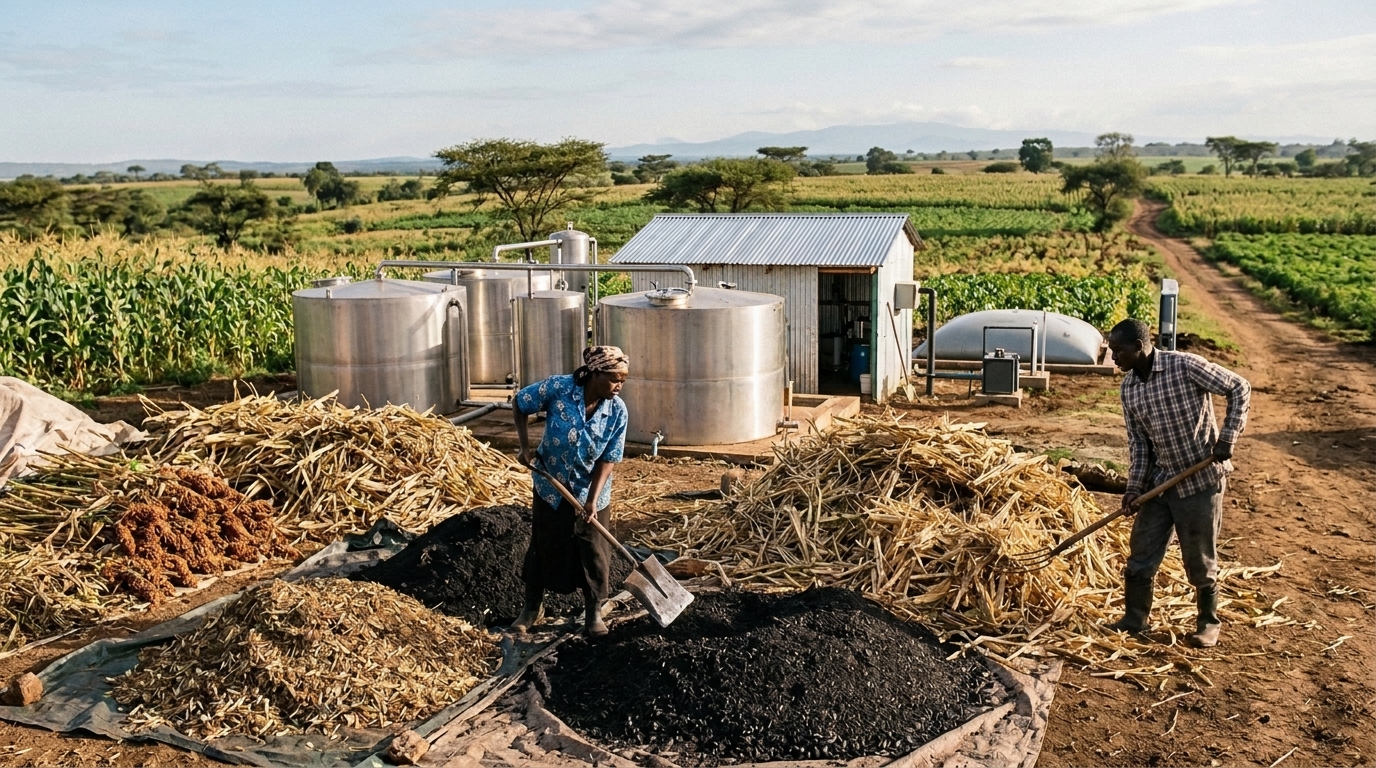
Anaerobic digestion constitutes the most practically viable near-term bioconversion pathway for wet agro-industrial residues, operating through a four-stage microbial cascade comprising hydrolysis, acidogenesis, acetogenesis, and methanogenesis. Operational stability requires meticulous control over temperature, organic loading rates, and carbon-to-nitrogen ratios to prevent volatile fatty acid accumulation or ammonia toxicity from arresting methanogenic archaea. Frontier bioprocess strategies now deploy enriched microbial consortia that more than double biogas volumes from complex substrates, alongside conductive magnetic nanoparticles that foster direct interspecies electron transfer within anaerobic biofilms. In Morocco, operational digesters at wastewater treatment plants run by the National Office of Electricity and Drinking Water, together with the Médiouna landfill gas capture facility near Casablanca, generate approximately 21.6 million cubic meters of biogas annually. Beyond raw biogas, anaerobic digestion yields nutrient-dense digestate that acts as a potent organic biofertilizer, reducing reliance on expensive synthetic inputs and enhancing soil organic carbon in arid zones. This dual capacity is extraordinarily synergistic with Morocco’s dominant phosphate industry, demonstrating how closed-loop nutrient recovery can fortify sustainable regional agronomy.
Microbial electrolysis cells utilize exoelectrogenic microbial biofilms on anodes to oxidize organic waste substrates, requiring only a small external applied voltage between 0.2 and 0.8 volts to drive clean hydrogen evolution at the cathode. In experimental configurations treating pre-fermented food wastes, hydrogen yields reach 1.029 liters per gram of chemical oxygen demand, representing a 39.1 percent increase over untreated feedstocks, while dark fermentation coupled with electrolysis achieves production rates of 3.2 liters of hydrogen per liter per day. In Morocco, the minimal voltage threshold required for microbial electrolysis cell systems creates an exceptional synergy with the nation’s burgeoning, low-cost solar photovoltaic electricity generation. Simultaneously, microbial fuel cells convert the chemical energy of dissolved organics directly into electrical current via extracellular microbial electron transport. These bioelectrochemical units offer dual utility for decentralized agricultural outposts, concurrently purifying toxic agro-industrial residues like olive mill effluents while generating local power, although scaling them from bench prototypes to industrial installations requires further reductions in expensive electrode architectures.
A holistic appraisal of biomass systems necessitates rigorous life cycle assessment and techno-economic modeling to quantify net greenhouse gas displacements and energy returns. Regional life cycle evaluations demonstrate that circular biorefineries can achieve carbon-negative balances; for instance, coupling lignocellulosic ethanol refining with edible fungal cultivation has been shown to reduce life cycle emissions by 148.68 percent relative to standalone fuel production, yielding a net-negative global warming potential. Southern Morocco exemplifies how localized feedstock mapping uncovers overlooked regional bioeconomies. Investigations conducted by the African Sustainable Agriculture Research Institute at Mohammed VI Polytechnic University in Laâyoune quantified the anaerobic digestion potential of camel, bovine, caprine, and ovine manure across Guelmim-Oued Noun, Laâyoune-Sakia El Hamra, and Dakhla-Oued Ed-Dahab. These three southern administrative zones generate an aggregate manure volume exceeding 580,000 tonnes annually, containing a theoretical methane potential of 44.9 million cubic meters of biomethane per year. This biomethane equivalent could yield 155 gigawatt-hours of electrical energy alongside 64,400 tonnes of stabilized compost per year, providing vital organic soil conditioning for fragile arid rangelands while valorizing pastoral livestock economies.
Translating these documented biomass opportunities into durable infrastructure across Africa demands systemic regulatory modernization, cooperative clustering, and dedicated fiscal instruments. Approximately 40 percent of domestic biogas digesters constructed across the continent have historically fallen into disuse due to inadequate technical maintenance networks, unskilled labor pools, and absent supply chains. In Morocco, despite the 2021 National Biomass Energy Strategy targeting 28 terawatt-hours of biomass-generated electricity by 2050, deployment is severely constrained by the absence of dedicated feed-in tariffs or guaranteed grid-injection tariffs for biomethane. Small-scale agricultural mills, typical of the fragmented olive processing sector, cannot individually finance modern anaerobic digesters. Establishing cooperative aggregation hubs, wherein decentralized operators pool seasonal wastes for centralized bioconversion, offers a proven Mediterranean model. By legally reclassifying agro-industrial effluents from hazardous liabilities into valorizable energy assets, instituting supportive feed-in tariffs, and conducting granular spatial feedstock inventories, African nations can replace fragmented pilot projects with robust circular bioeconomies, permanently anchoring national energy sovereignty in sustainable bioconversion.
Subject of Research: Sustainable biomass bioconversion technologies and circular bioeconomy strategies across Africa
Article Title: Biomass to bioenergy transition through sustainable bioconversion and circular bioeconomy strategies
Article References: Niya, B., Mahmud, A., Ou-douaou, A., Boutafda, A., Benhida, R., & Danouche, M. (2026). Biomass to bioenergy transition through sustainable bioconversion and circular bioeconomy strategies. Bioresources and Bioprocessing, 13(1), Article 162. https://doi.org/10.1186/s40643-026-01141-1
Image Credits: AI Generated
DOI: 10.1186/s40643-026-01141-1
Keywords: bioenergy, biomass conversion, circular bioeconomy, anaerobic digestion, biofuels, Africa energy transition, Morocco renewable energy, biotechnology, Biomass, transition, sustainable, bioconversion
News Source: Gregory Coleman. (November 5, 2026). Unlocking Africa’s Vast Biomass Potential Through Advanced Bioconversion and Circular Bioeconomies. Scienmag.