Recombinant adeno-associated viral vectors, the delivery vehicles behind several approved gene therapies, are routinely captured from cell culture harvests using affinity chromatography. Because upstream titers are often low, manufacturers frequently need long loading phases that can stretch beyond multiple hours, yet the consequences of such extended capsid-ligand contact have remained largely uncharacterized. A new study from researchers at Roche Diagnostics GmbH in Penzberg and the Karlsruhe Institute of Technology, published in Frontiers in Bioengineering and Biotechnology, now provides an extensive dataset showing that long binding times on affinity resins trigger serotype-specific yield losses, shift capsid protein composition and substantially improve impurity clearance, all without damaging the packaged transgene.
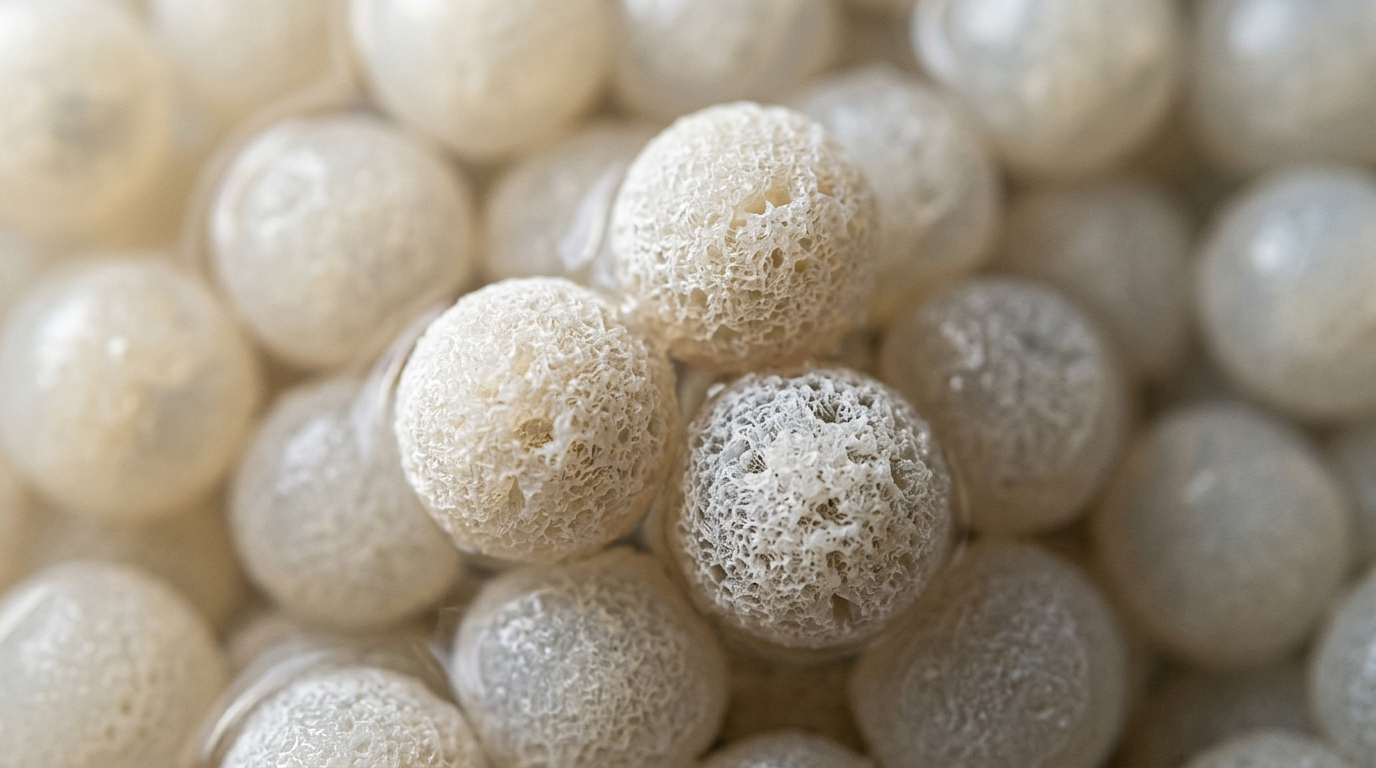
The team, led by Lukas Bongers and Andres D. Martinez, examined three constructs: a recombinant AAV2 variant, wild-type AAV8 and wild-type AAV9, each carrying an identical 4.7 kilobase transgene encoding the fluorescent reporter mGreenLantern. Vector stocks were produced in-house through a standardized 500-liter triple-transfection process in HEK293 cells and concentrated 15-fold by tangential flow filtration, reaching titers around 10^13 capsids per milliliter with full-to-total ratios between 18 and 25 percent. The researchers tested three affinity ligands, all based on camelid-derived single-domain VHH fragments: POROS CaptureSelect AAVX, POROS CaptureSelect AAV9 and Capto AVB. These ligands target highly conserved regions around the five-fold pore of the icosahedral capsid and require acidic pH for elution.
Because the study needed consistent binding durations for every capsid, the primary design used a simulated loading approach. Concentrated material was rapidly bound to the resin, then washed with equilibration buffer for up to 24 hours at either room temperature or 10 degrees Celsius, using a constant residence time of two minutes and a load density of 7 x 10^13 capsids per milliliter of resin, well below the maximum dynamic binding capacity of any resin tested. To validate this design, the researchers ran a direct comparison for AAV8 in which unconcentrated harvest material was loaded continuously over 24 hours. They also held material on the bench for 24 hours before purification to separate ligand-binding stress from load instability; all serotypes remained stable in the loading buffer except for an AAV8 deamidation change that occurred on the bench as well and was therefore not attributed to the resin.
The most consequential finding concerned yield. On CaptureSelect AAVX resin, extended washing of eight hours or longer reduced elution yields in a serotype-dependent manner. AAV9 capsid yield fell from 9.89 x 10^12 to 7.08 x 10^12 capsids per milliliter, a 28 percent loss, while rAAV2 dropped from 7.59 x 10^12 to 4.96 x 10^12 capsids per milliliter, a 35 percent loss. Viral genome yields fell further, to 53 percent for AAV9 and 66 percent for rAAV2, with no additional significant decline beyond eight hours. AAV8 yield, by contrast, remained constant at roughly 7.60 x 10^12 capsids per milliliter regardless of wash duration. Capsids missing from the elution pool were not found in the flow-through; they stayed on the column until cleaning-in-place, and those lost during extended holds had eluted during the wash and could rebind when reloaded onto the same resin, pointing to dissociation rather than irreversible degradation.
Temperature proved decisive for one serotype-ligand pair. A 24-hour equilibration-buffer wash at 10 degrees Celsius caused a 95 percent viral genome yield reduction for AAV9, down to 6.6 x 10^10 viral genomes per milliliter, while leaving rAAV2 and AAV8 unaffected. The loss preferentially removed full capsids, dropping the full-to-total ratio in the elution pool to below 2 percent from an initial 21.9 percent. The authors hypothesize that the mechanism involves variable region II on the exposed DE loop, which the AAVX ligand contacts, and suggest that cooling alters its conformational flexibility and destabilizes binding, though they note that directly validating a localized structural rearrangement was beyond the scope of the work and that hydrogendeuterium exchange mass spectrometry could test the idea in the future.
Extended hold times also reshaped capsid composition. Across all three serotypes, the relative abundance of VP3, the most abundant and structurally conserved of the three capsid proteins, increased in the elution pool. AAV9 showed the largest enrichment, approximately 1.9 percent above control after 24 hours at 10 degrees Celsius, while rAAV2 gained up to 1.5 percent after eight hours at room temperature with no further increase. AAV8 showed no significant VP3 change at room temperature and only a 0.9 percent increase after 24 hours at 10 degrees. A multivariate correlation analysis across the pooled datasets found a significant negative relationship between relative VP3 content and both capsid yield (r = -0.79) and viral genome yield (r = -0.69), indicating that the capsids washing off over time were selectively enriched in VP1 and VP2, the isoforms whose unstructured N-terminal extensions sit inside the capsid interior.
Alongside these yield costs came a clear process benefit: cleaner product. Host-cell protein clearance improved across all serotypes with longer washing. Log removal factors rose from 3.34 to 4.71 for AAV8, from 3.34 to 4.87 for rAAV2 and from 2.77 to 4.91 for AAV9, with AAV9 and rAAV2 levels falling below the assay limit of quantification at the first eight-hour timepoint. No temperature-dependent differences in host-cell protein clearance appeared for any serotype. Non-encapsulated host-cell DNA clearance was more serotype-specific: AAV8 concentrations dropped below 20 nanograms per milliliter across all timeframes and temperatures, AAV9 improved significantly after 16 and 24 hours at room temperature, and rAAV2 fell to roughly 30 nanograms per milliliter at room temperature, though a 10-degree wash was less effective for both AAV9 and rAAV2.
Quantitative proteomics on AAV9 eluates sharpened the picture. In the control, the most abundant co-eluting host-cell proteins were a DNA-binding protein and heat shock 70 kDa protein 1A, present at 24.1 and 22.0 nanograms per 10^12 viral genomes. After a 24-hour wash these fell to 1.1 and 3.6 nanograms per 10^12 viral genomes, reduction factors of 35.8 and 10.2. The largest relative clearance went to chromobox protein homolog 1, reduced 275-fold. Histones H2A and H2B, chaperones, metabolic enzymes and structural proteins all showed substantial reductions, and the total concentration of the ten most abundant impurities fell from 67.6 to 6.7 nanograms per 10^12 viral genomes. Overall, the proteome consistently detected after 24 hours was reduced roughly tenfold compared with the control, confirming that DNA-interacting proteins known to hitchhike on AAV capsids during affinity capture are cleared dramatically during several-hour binding times.
Functionally, the news was reassuring. Transgene integrity was confirmed by capillary electrophoresis and next-generation sequencing, with no damage identified within the scope of those methods, and deamidation at residues N57 and N94 remained constant across conditions except for the bench-related AAV8 change. Transduction efficiency in a cell-based potency assay stayed stable for rAAV2 and AAV8 regardless of binding time or temperature. AAV9 showed a progressive, statistically significant but likely biologically meaningless 1.3-fold potency increase at room temperature, but a large drop to 0.28 relative potency after 24 hours at 10 degrees, which the authors attribute to the near-total loss of full capsids in that eluate. Ligand choice mattered: for the same 24-hour hold, the serotype-specific ligand CaptureSelect AAV9 kept AAV9 yield at 67 percent versus 47 percent on AAVX, and Capto AVB kept rAAV2 yield at 65 percent versus 35 percent on AAVX, while matching impurity clearance and maintaining potency.
The study closes with a practical demonstration. When unconcentrated AAV8 harvest was loaded continuously over 24 hours, mimicking a real manufacturing scenario, viral genome yield reached 87 percent, substantially above both the control at 56 percent and the 24-hour wash at 54 percent, while transduction efficiency remained constant and impurity clearance stayed high, with host-cell protein falling below 100 nanograms per milliliter. The authors conclude that strategic ligand selection is essential to preserve yield during long hold times, that extended binding systematically polishes the capsid population toward a VP3-dominant, lower-aggregation profile while stripping DNA-associated impurities, and that continuous direct loading can be a favorable mode of operation, though it must be evaluated for each specific serotype-ligand combination before adoption in manufacturing.
Subject of Research: Effects of long capsid-ligand contact times during affinity chromatography on recombinant AAV vector quality attributes
Article Title: Assessing AAV stability on affinity resins and the effects of long contact times through extensive washing
Article References: Bongers, L., Clemenz, L., Martinez, J. N., Weber, M., Hubbuch, J., Falkenstein, R., & Martinez, A. D. (2026). Assessing AAV stability on affinity resins and the effects of long contact times through extensive washing. Frontiers in Bioengineering and Biotechnology, 14, Article 1954356. https://doi.org/10.3389/fbioe.2026.1954356
Image Credits: AI Generated
DOI: 10.3389/fbioe.2026.1954356
Keywords: adeno-associated viral vectors, affinity chromatography, gene therapy, downstream processing, host-cell protein clearance, viral protein stoichiometry, capsid stability, elution yield, direct loading, bioprocess engineering, impurity removal, transduction efficiency
News Source: Gregory Coleman. (November 5, 2026). Long Contact Times on AAV Affinity Resins Reshape Yield and Purity. Scienmag.