A previously unknown species of groundwater amphipod has been formally described from a single karst mountain ridge in Central Switzerland, and nowhere else in the country despite years of dense, nationwide sampling. The crustacean, named Niphargus entlebuchensis, was discovered through a citizen science programme in which drinking water providers filtered animals out of spring catchment boxes, and it was later traced to a cave on the same ridge. Molecular and morphological analyses both support its status as a distinct species, according to the study published in the journal Subterranean Biology.
The new species belongs to Niphargus, a species-rich genus of blind, eyeless amphipods that dominates groundwater habitats across the Western Palaearctic. In Switzerland, groundwater amphipods are the most commonly encountered stygobites, the specialized animals that complete their entire lives in subterranean waters. The country’s groundwater holds a volume comparable to all of its lakes combined and supplies 80 percent of its drinking water, yet its biodiversity remains understudied and is largely absent from national monitoring programmes and biodiversity reports.
The first specimens of N. entlebuchensis surfaced in samples collected as part of a large citizen science study across Switzerland. They were found in two spring catchment boxes at the bottom of the western flank of the Schrattenfluh, a karstic mountain ridge roughly six kilometres long that spans elevations between 1,200 and 2,100 metres and lies within the UNESCO Biosphere Reserve Entlebuch. In such boxes, groundwater is passively sourced through a horizontal drainage pipe and used for drinking water supply; the animals were captured with a filter net of 0.8 millimetre mesh attached to the pipe inlet over several days. Speleologists later collected additional specimens in a cave in the eastern part of the ridge, bringing the total to 18 individuals preserved in 80 percent molecular-grade ethanol.
The holotype, an 18.5-millimetre-long male, came from the Silwängenhöhle cave at 1,567 metres above sea level, roughly 100 to 150 metres inside the cave and about 25 metres below the entrance, in small and permanently flowing seepage water. Paratypes were collected from drinking water wells at the Imbrig Quellen, operated by a local water cooperative. In total, the researchers examined two males and eight females in detail, dissecting them in glycerol and mounting appendages on slides for study under a microscope and stereomicroscope.
Molecular work reinforced the morphological case. All 18 specimens were sequenced for the mitochondrial cytochrome oxidase I gene and shared a single haplotype, while three specimens were additionally sequenced for three nuclear markers and showed no intraspecific variability. In species delimitation analyses based on COI, all ten best-scoring ASAP partitions recognized the animals as a distinct species, and the MolD analysis identified two diagnostic nucleotide positions in the COI alignment, at positions 456 and 586, with 100 percent support. The lowest interspecific genetic distance observed was 10.9 percent, between the new species and Niphargus arolaensis.
Phylogenetic analyses based on a 1,653-base-pair concatenated matrix of COI, 28S rRNA and H3 sequences from 145 niphargid taxa placed the new species within a clade that also includes other Swiss species such as N. luchoffmanni, N. muotae and N. arolaensis. However, the exact position of the new species within that clade is ambiguous, and both the maximum likelihood and Bayesian analyses returned weak support values for the clade, so its precise phylogenetic placement cannot yet be resolved with certainty. The authors note that such ambiguity is not uncommon for species in this part of the Niphargus phylogeny.
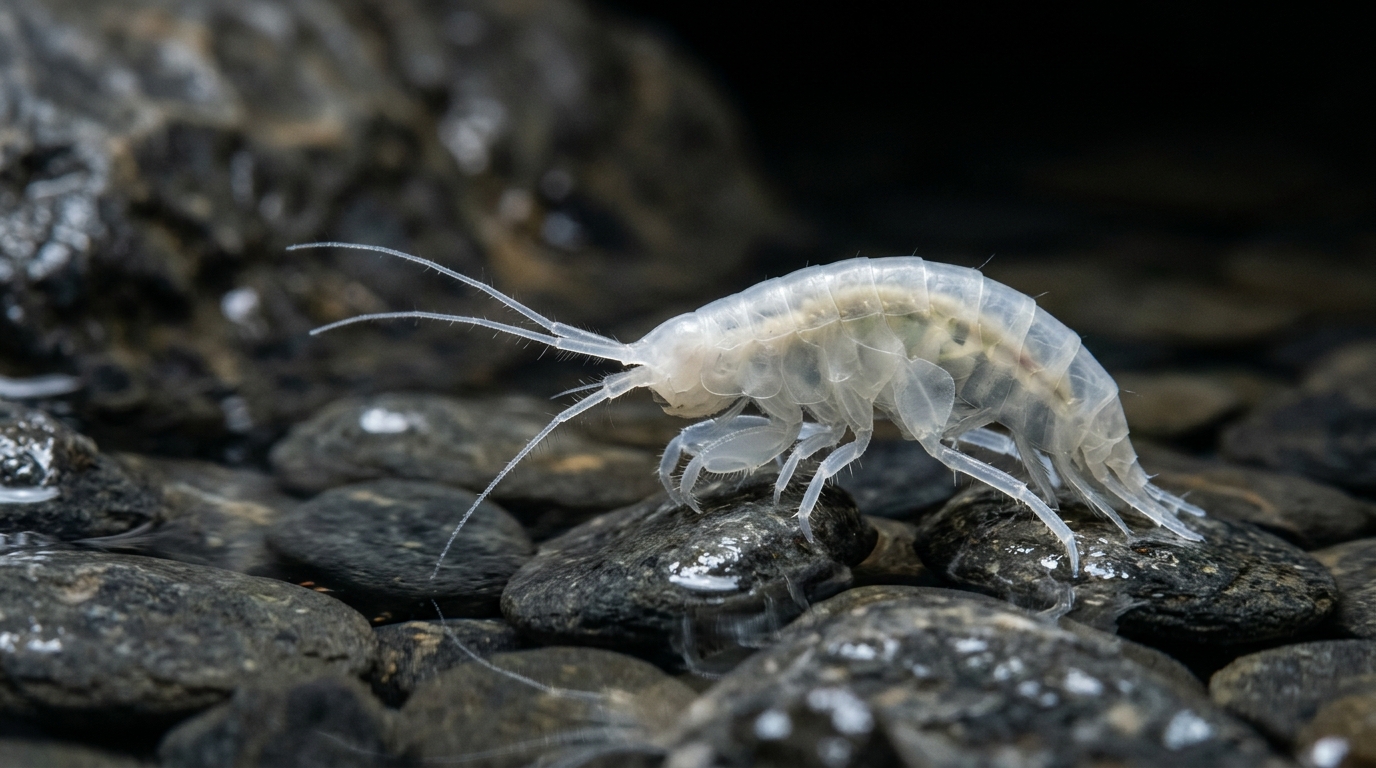
Morphologically, the species is a slender, mid-to-large Niphargus reaching up to 18.5 millimetres, comparatively large among Swiss representatives of the genus. Its most decisive diagnostic feature lies in the mouthparts: the outer lobe of maxilla I carries nine to eleven bifurcate spines, whereas a large majority of Niphargus species have only seven. Among the few species with more, some have multidenticulate spines or pectinate pereopods or sexually non-dimorphic uropods, and the authors report that the combination of more than seven spines with simple denticulation, simple dactyli and a sexually dimorphic uropod III appears to be unique to the new species. Other traits include propodi of the gnathopods that are mid-to-large with an oblique palm, a single spine with a tiny seta at the base of the nail on pereopod dactyli III to VII, and uropod III that is sexually dimorphic and elongated in males.
Not every proposed diagnostic character proved stable. A pair of spines growing from the same point at the base of uropod I, present in most observed individuals, was absent in some and showed left-right asymmetry in others, though this trait is generally rare in the genus. The species otherwise shows typical subterranean amphipod architecture: antennae reaching about half the body length, a deeply cleft telson with three to four apical spines per lobe, and epimeral plates with pointed postero-ventral corners. Larger individuals carry more spines and setae, and the uropods show moderate sexual dimorphism.
The restricted distribution is the most striking aspect of the discovery. Despite relatively dense sampling of Niphargus across Switzerland, the species was absent from every other sampling site, indicating a high level of endemism comparable to species reported from the Hölloch cave system. The authors suggest that the species’ comparatively large body size is likely associated with its occurrence in the karstic aquifer, and that an intermediate length of appendages may indicate that it lives in running water rather than entering the system of crevices. Intriguingly, Pierre Strinati, who extensively documented Swiss cave fauna in the 1960s, visited a large cave in the same area but reported no Niphargus specimens, underscoring how much of this fauna has remained hidden until systematic sampling began.
The finding illustrates how collaboration with cavers and drinking water providers has transformed knowledge of Swiss stygofauna in recent years, producing data with very high spatial resolution across previously undersampled regions. That approach enabled researchers to document Niphargus diversity and distribution at a national scale and to detect narrowly distributed species such as this one. With multiple new groundwater amphipod species now described from the country, Swiss subterranean species richness appears to have been long underestimated, and isolated karst systems are emerging as strongholds of endemic subterranean biodiversity. For N. entlebuchensis, the entire known world remains one six-kilometre ridge in the Entlebuch, a reminder of how much diversity can persist, undetected, beneath ordinary landscapes.
Subject of Research: Description of a new subterranean amphipod species restricted to a karst area in Central Switzerland
Article Title: Niphargus entlebuchensis sp. nov., a new subterranean amphipod species ( Crustacea , Amphipoda , Niphargidae ) restricted to a karst area in Central Switzerland
Article References: Knüsel, M., Alther, R., Zakšek, V., Fišer, C., & Altermatt, F. (2026). Niphargus entlebuchensis sp. nov., a new subterranean amphipod species (Crustacea, Amphipoda, Niphargidae) restricted to a karst area in Central Switzerland. Subterranean Biology, 58, 115-136. https://doi.org/10.3897/subtbiol.58.209466
Image Credits: AI Generated
DOI: 10.3897/subtbiol.58.209466
Keywords: Niphargus entlebuchensis, groundwater amphipod, stygofauna, karst, Switzerland, species delimitation, COI barcoding, phylogenetics, endemism, citizen science, Subterranean Biology, Entlebuch
News Source: Drew Townsend. (November 6, 2026). New blind amphipod species found only in one Swiss karst ridge. Scienmag.