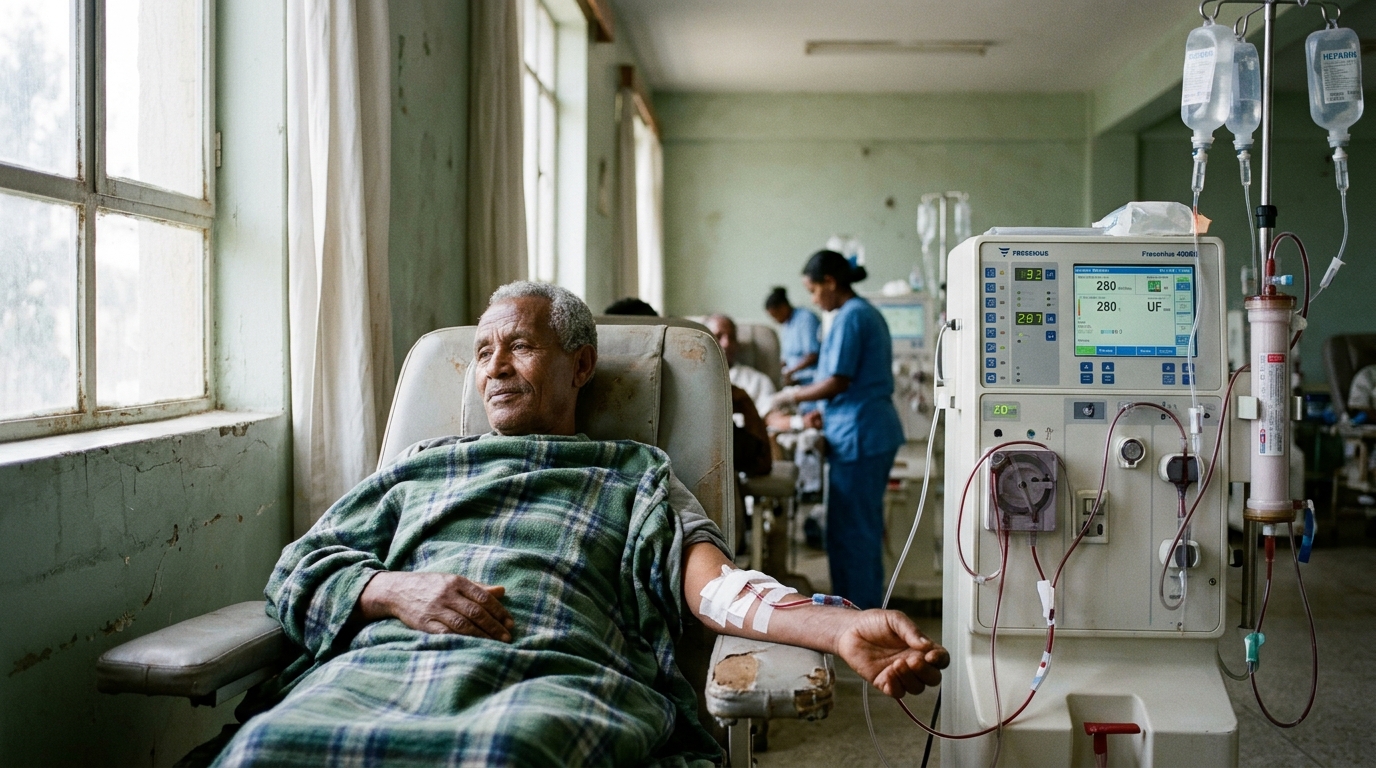
Patients with end-stage kidney disease who depend on life-sustaining hemodialysis in Tigray, northern Ethiopia, face a tangle of physical pain, financial ruin, disrupted care and emotional distress, according to a qualitative study published in BMC Nephrology. The research, conducted at Ayder Comprehensive Specialized Hospital in Mekelle, explored the lived experiences of adults on maintenance hemodialysis in a healthcare system weakened by the combined aftermath of the COVID-19 pandemic and war in the region. The findings offer a rare, first-person account of what it means to survive on dialysis when the infrastructure around that survival is itself struggling to function.
The study used a hermeneutic phenomenological design, a qualitative approach that seeks to understand human experiences through the detailed interpretation of participants’ own stories. Between February 14 and March 15, 2026, the researchers purposively selected twenty-one adult patients receiving long-term hemodialysis, using a maximum variation sampling technique to capture a breadth of perspectives. Interviews were conducted in Tigrigna with a semi-structured guide and analyzed with Atlas.ti version 25, with themes and subthemes identified through repetitive coding and interpretation of the participants’ narratives.
Four key themes and eight sub-themes emerged from the analysis. The first, living with the burden of hemodialysis, described ongoing physical pain and exhaustion, dependency on others, reduced productivity, and persistent uncertainty about survival and the possibility of ever receiving a kidney transplant. For patients whose treatment is not a cure but a continuous lifeline, the researchers found, the therapy itself imposes a daily weight that reshapes work, family roles and expectations about the future.
The second theme, hemodialysis within a fragile health system, documented the structural obstacles surrounding treatment. Participants reported limited access to hemodialysis services, shortages of medicines and supplies, difficulty arranging transportation to the hospital, and heavy financial costs. These pressures pushed families into selling possessions and adopting other coping mechanisms to keep treatment going. In a region where healthcare services were greatly disrupted by war and the pandemic, the study notes, access to life-sustaining dialysis became not only a medical matter but an economic and logistical one.
Against this backdrop of scarcity, the third theme, humanized care and provider support, stood out. Patients described supportive relationships with healthcare professionals, trust, respectful communication and emotional support, even as resources ran thin. The finding suggests that the quality of interpersonal care remained a meaningful part of the dialysis experience in Tigray, independent of the material conditions in which that care was delivered.
The fourth theme, emotional distress and psychosocial resilience, captured the psychological dimension of long-term dialysis in an unstable setting. Participants reported hopelessness, anxiety, social isolation and fear of death. Yet the same accounts revealed resilience built through faith, family support and hope for transplantation. The researchers present these as two sides of one experience: profound psychological strain coexisting with active coping strategies sustained by relationships and belief.
The study’s authors conclude that patients with end-stage kidney disease receiving hemodialysis in the post-conflict setting of the Tigray region face multifaceted challenges that are exacerbated by weakened healthcare systems, financial hardship and disruptions in essential services. They argue that addressing these challenges requires strengthening the hemodialysis infrastructure, providing comprehensive psychosocial support, and establishing financial protection mechanisms. Such interventions, they write, are crucial for improving survival outcomes and enhancing the quality of life of ESKD patients living in conflict-affected settings.
As a hermeneutic phenomenological study of twenty-one patients at a single hospital, the research does not measure the prevalence of these experiences across the region, nor does it test the effectiveness of any intervention. Its contribution lies in the depth and specificity of the accounts: a documented picture of how physical burden, system fragility, provider relationships and psychosocial resilience interweave for dialysis patients in one of the world’s most strained healthcare environments. The authors note that there has been limited understanding of the lived experiences of patients undergoing hemodialysis in unstable environments, a gap this study begins to fill from the perspectives of the patients themselves.
Subject of Research: Lived experiences of hemodialysis patients in a conflict-affected health system in Tigray, Ethiopia
Article Title: Silent struggles: exploring the lived experiences of patients undergoing hemodialysis in a fragile health system following the COVID-19 pandemic and war in tigray: a hermeneutic phenomenological qualitative study
Article References: Weldebrhan, D., Weldebrhan, T., & Berhe, E. (2026). Silent struggles: exploring the lived experiences of patients undergoing hemodialysis in a fragile health system following the COVID-19 pandemic and war in tigray: a hermeneutic phenomenological qualitative study. BMC Nephrology. https://doi.org/10.1186/s12882-026-05493-w
Image Credits: AI Generated
DOI: 10.1186/s12882-026-05493-w
Keywords: hemodialysis, end-stage kidney disease, Tigray, Ethiopia, qualitative research, phenomenology, fragile health systems, COVID-19, conflict, psychosocial resilience, healthcare access, Ayder Comprehensive Specialized Hospital
News Source: Ophelia Keating. (November 6, 2026). Hemodialysis Patients in Postwar Tigray Describe Silent Struggles in Qualitative Study. Scienmag.