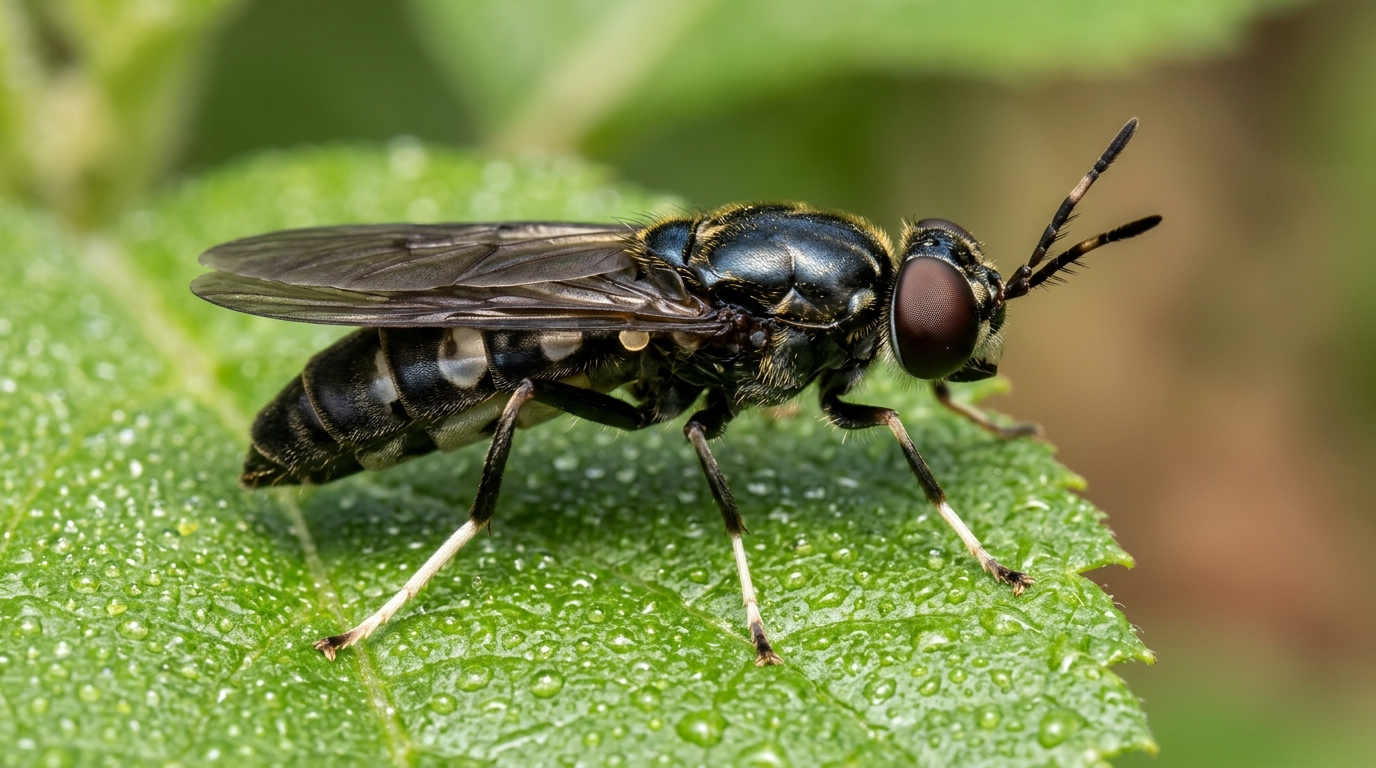
The black soldier fly is key to the circular bioeconomy. Yet intensive mass-rearing risks genetic drift and inbreeding depression. A new study published in BMC Ecology and Evolution has now tested how a long-domesticated strain of Hermetia illucens copes with an acute burst of inbreeding, and the results reveal a striking split between resilience and vulnerability within the same insect population.
Researchers led by Patrick Klüber and Rocio Rodriguez-Servin worked with a laboratory strain that had already been colonized for more than 64 generations, a lineage far beyond the early domestication phase in which genetic erosion typically strikes hardest. Earlier work on this species has shown that newly established colonies lose genetic diversity rapidly, yet long-term colonies often persist without collapsing, a pattern that has been attributed to the purging of deleterious alleles. The open question was whether such highly domesticated strains still carry residual susceptibility to inbreeding depression when relatives are forced to mate. To find out, the team created full-sib matings and measured how acute inbreeding affected life-history, physiological and reproductive traits across the entire insect life cycle.
The headline outcome is reassuring for industry: full-sib mating triggered no severe phenotypic declines and did not compromise the growth curves of the colony. Developmental durations did differ significantly across most ontogenetic stages, but the absolute variations were marginal, remaining within 1.2 days. This phenotypic resilience, the authors conclude, is highly valuable for managing sudden population bottlenecks.
Beneath that stable surface, however, the study uncovered measurable costs. Inbred larvae exhibited higher substrate reduction and lower feed conversion efficiency, known as ECI, indicating elevated metabolic costs. Final larval weights and adult weights were also reduced in the inbred group, although the analysis showed that natural sexual dimorphism remained the primary driver of body weight variance, meaning the sex difference between males and females outweighed the inbreeding effect itself.
The reproductive side of the life cycle proved remarkably resistant. Reproductive parameters and fecundity did not differ significantly between inbred and outbred groups, and clutch sizes and oviposition patterns differed only descriptively rather than statistically.
Adult survival told a very different story. Inbred flies showed reduced lifespans and an earlier median lethal time, the LT50, in females.
The study’s conclusions draw a careful line between two messages. Acute inbreeding does not cause an immediate production collapse in long-term domesticated strains, which is the finding with the most direct relevance to genetic management. At the same time, the metabolic inefficiencies in larvae and the reduced adult longevity show that inbreeding depression has not been fully purged; it can compromise survival and resource utilization even when the most visible production traits appear unaffected. The authors frame these results as a foundational population biology perspective for optimizing the genetic management and long-term stabilization of industrial insect rearing systems.
Subject of Research: Effects of acute full-sib inbreeding on life-history, physiological and reproductive traits in a long-domesticated black soldier fly laboratory strain.
Article Title: Inbreeding without consequences? Limited effects of inbreeding on life-history and performance traits in Hermetia illucens
Article References: Klüber, P., & Rodriguez-Servin, R. (2026). Inbreeding without consequences? Limited effects of inbreeding on life-history and performance traits in Hermetia illucens. BMC Ecology and Evolution, 26(1), Article 99. https://doi.org/10.1186/s12862-026-02609-6
Image Credits: AI Generated
DOI: 10.1186/s12862-026-02609-6
Keywords: black soldier fly, Hermetia illucens, inbreeding depression, full-sib mating, life-history traits, feed conversion efficiency, adult longevity, fecundity, genetic management, insect rearing, circular bioeconomy, population bottlenecks
News Source: Beatrice Stafford. (November 6, 2026). Black Soldier Fly Strains Shrug Off Inbreeding, but Longevity Pays the Price. Scienmag.