Every one of 6,648 carbon atoms in a twisted bilayer graphene sample has now been pinned down in three dimensions with a precision of 0.12 ångströms, according to a study published in Nature Nanotechnology. The achievement, made by a research team using a technique called ptychographic atomic electron tomography, or pAET, delivers the most complete three-dimensional picture yet of individual light atoms in a material and opens a route to connecting atomic-scale structure with the properties of technologically important light-element materials.
The method builds on ptychography, a computational microscopy approach that unifies crystallography and microscopy by combining coherent diffraction patterns with iterative phase retrieval. Multislice electron ptychography is already renowned for achieving deep-sub-ångström lateral resolution in two dimensions, but its depth resolution has typically remained at the nanometre scale, far too coarse to track the vertical positions of single atoms. Ptychographic atomic electron tomography had previously enabled three-dimensional atomic structure determination in nanomaterials, yet reliably resolving individual light atoms such as carbon, which scatter electrons weakly compared with heavier elements, remained a formidable challenge.
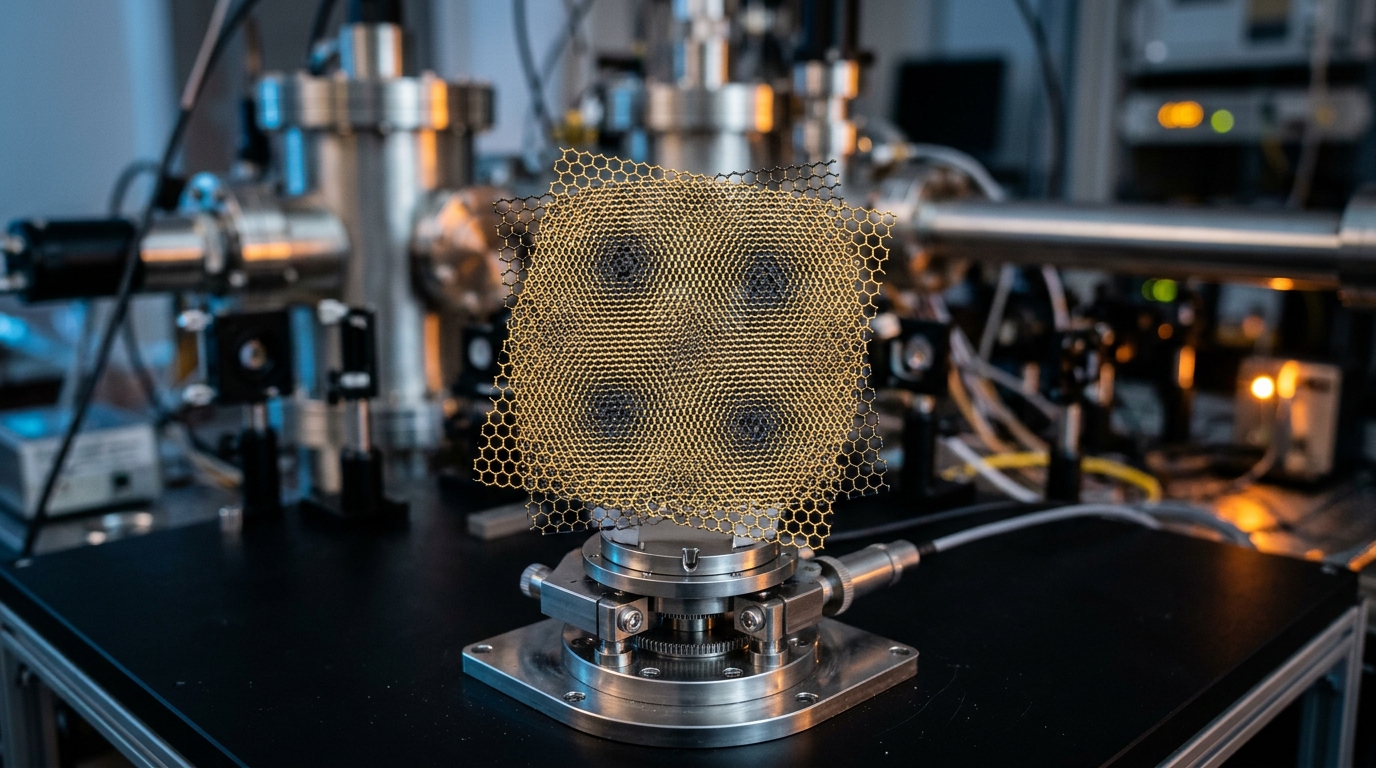
To overcome this, the team turned to twisted bilayer graphene as a model moiré system. Twisted bilayer graphene consists of two atomically thin sheets of carbon stacked with a slight rotational twist, producing a moiré supercell, a large interference pattern that periodically modulates the local atomic environment. By acquiring diffraction data across the sample and reconstructing the three-dimensional atomic structure, the researchers localized all 6,648 carbon atoms with 0.12 ångström precision, a level of accuracy fine enough to resolve subtle vertical displacements of atoms that are themselves only about 1.4 ångströms apart in the graphene lattice.
The resulting 3D atomic structure revealed that the spacing between the two graphene layers is not uniform. Instead, the interlayer spacing and the corrugation, the gentle undulation of the sheets out of plane, vary systematically across the moiré supercell depending on the local stacking arrangement of the atoms. Where the carbon atoms of the two layers sit in particular registered alignments, the layers pull closer together or bow apart, producing a landscape of atomic-scale hills and valleys dictated by stacking-dependent interlayer interactions. This direct visualization confirms, atom by atom, how the geometry of twisted van der Waals materials is sculpted by the interplay between twist angle and stacking order.
Beyond the corrugations, the measured atomic coordinates exposed chiral lattice distortions with distinctive topological character. The researchers identified displacement textures resembling merons, anti-merons and anti-skyrmions, spin-like patterns familiar from magnetism that here appear in the structural distortions of the carbon lattice itself. These chiral textures, quantified through three-dimensional displacement vectors of the individual atoms, demonstrate that the lattice of twisted bilayer graphene winds in handed, vortex-like patterns at the nanometre scale, a structural phenomenon that had been predicted theoretically but is now directly imaged experimentally.
The study also resolved local defects within the moiré material. The three-dimensional atomic positions allowed the team to characterize three silicon dopant atoms and one carbon vacancy embedded in the graphene lattice, showing that even isolated impurities and missing atoms can be located and their local environments determined in three dimensions. Because dopants and vacancies strongly influence the electronic behaviour of graphene-based devices, the ability to image them atom by atom in 3D provides a powerful tool for understanding and ultimately engineering defect-related properties.
To explore the consequences of the experimentally derived structure, the researchers performed density functional theory calculations based on the measured atomic coordinates. These calculations predict electronic band narrowing and the opening of a gap at the K point of the electronic band structure relative to a relaxed theoretical model of the material. In other words, the subtle structural distortions captured by the imaging, the corrugations and chiral displacements, are expected to leave measurable fingerprints in the electronic properties, underscoring the importance of using experimentally determined atomic structures rather than idealized relaxed models when predicting the behaviour of moiré materials.
Multislice pAET simulations further suggest that the method can be extended beyond graphene. The calculations support applying the technique to diamond containing a nitrogen–vacancy centre, a defect of intense interest for quantum sensing and quantum information technologies, and to amorphous carbon, where the disordered arrangement of atoms has long resisted precise three-dimensional characterization. Extending pAET to such systems would bring the same atom-by-atom 3D precision to materials central to quantum technologies and to the study of disordered light-element networks.
The work establishes ptychographic atomic electron tomography as a practical tool for three-dimensional imaging of individual carbon atoms and demonstrates, in a single model system, how stacking-dependent corrugations, chiral lattice distortions, dopants and vacancies shape the atomic landscape of a moiré material. By linking the experimentally determined 3D atomic structure to predicted electronic behaviour, the study marks a step toward a long-sought goal in materials science: understanding how the precise positions of individual light atoms give rise to the macroscopic properties of materials.
Subject of Research: Three-dimensional atomic imaging of individual carbon atoms in twisted bilayer graphene using ptychographic atomic electron tomography
Article Title: Three-dimensional imaging of individual carbon atoms
Article References: Kim, N. Y., Zhong, H., Zhang, J., O’Leary, C. M., Liao, Y., Zou, J., Sha, H., Pham, M., Li, W., Yuan, Y., Park, J.-H., Kim, D. S., Jiang, H., Kong, J., Chi, M., & Miao, J. (2026). Three-dimensional imaging of individual carbon atoms. Nature Nanotechnology. https://doi.org/10.1038/s41565-026-02316-9
Image Credits: AI Generated
DOI: 10.1038/s41565-026-02316-9
Keywords: ptychography, electron tomography, twisted bilayer graphene, carbon atoms, moiré supercell, lattice distortions, skyrmions, density functional theory, nitrogen-vacancy centre, light-element materials, atomic resolution, graphene defects
News Source: Neil Sanderson. (November 6, 2026). Carbon atoms mapped in 3D with record precision in twisted bilayer graphene. Scienmag.