Researchers investigating sustainable industrial wastewater remediation have demonstrated that unmodified chitosan hydrogel beads achieve a Congo red dye removal efficiency of 96.99 ± 0.6 percent at an initial concentration of 80 milligrams per liter in batch experiments, outperforming modified composites without requiring costly additive processing. The experimental investigation, conducted by Palak Saket, Gunjan Nagpure, Kiran Bala, and Abhijeet Joshi and published in Biotechnology for Sustainable Materials, systematically evaluated calcium alginate and chitosan hydrogels alongside formulations modified with activated charcoal powder and immobilized microalgal cells across batch and continuous column systems. While biopolymer remediation literature frequently prioritizes complex chemical modifications, the experimental data revealed that unmodified chitosan beads provided superior elimination of the recalcitrant anionic diazo dye under environmentally benign conditions of room temperature and neutral pH.
The study addressed severe ecological hazards associated with industrial effluents, particularly from textile manufacturing facilities that discharge recalcitrant synthetic dyestuffs into aquatic ecosystems. Commercial textile wastewater typically contains dye concentrations ranging between 10 and 50 milligrams per liter, with an estimated 2 to 50 percent of total dyestuffs released during commercial dyeing processes. Congo red is an anionic diazo dye containing aromatic rings and an azo linkage within its chemical structure, making it highly robust, naturally immune to degradation, and carcinogenic and mutagenic to human health. While traditional and modern remediation technologies—such as coagulation, flocculation, membrane filtration, ozonation, ion exchange, ultrasound irradiation, photocatalytic degradation, and electrochemical methods—have been developed, they face common limitations including toxic sludge generation, high operational expenses, and technical inefficiencies. Adsorption was examined as an efficient alternative because adsorbents can be recovered and reused while preventing toxic by-product formation.
For experimental materials, the authors procured sodium alginate, chitosan, and calcium chloride alongside analytical-grade Congo red dye, sodium hydroxide, methanol, and commercial activated charcoal powder. For the biological component, pure cultures of the photosynthetic microalga Scenedesmus species were isolated from the nearby region of Indore, India, and cultivated under controlled conditions in BG11 nutrient media within 250-milliliter Erlenmeyer flasks. The culture chamber was maintained at 27 ± 3 degrees Celsius under continuous light illumination of 3000 to 3500 lux. Microalgal cells intended for immobilization were harvested during their exponential growth phase, washed three times with distilled water, and adjusted to an optical density of two units to ensure consistent cellular concentration across tested matrices.
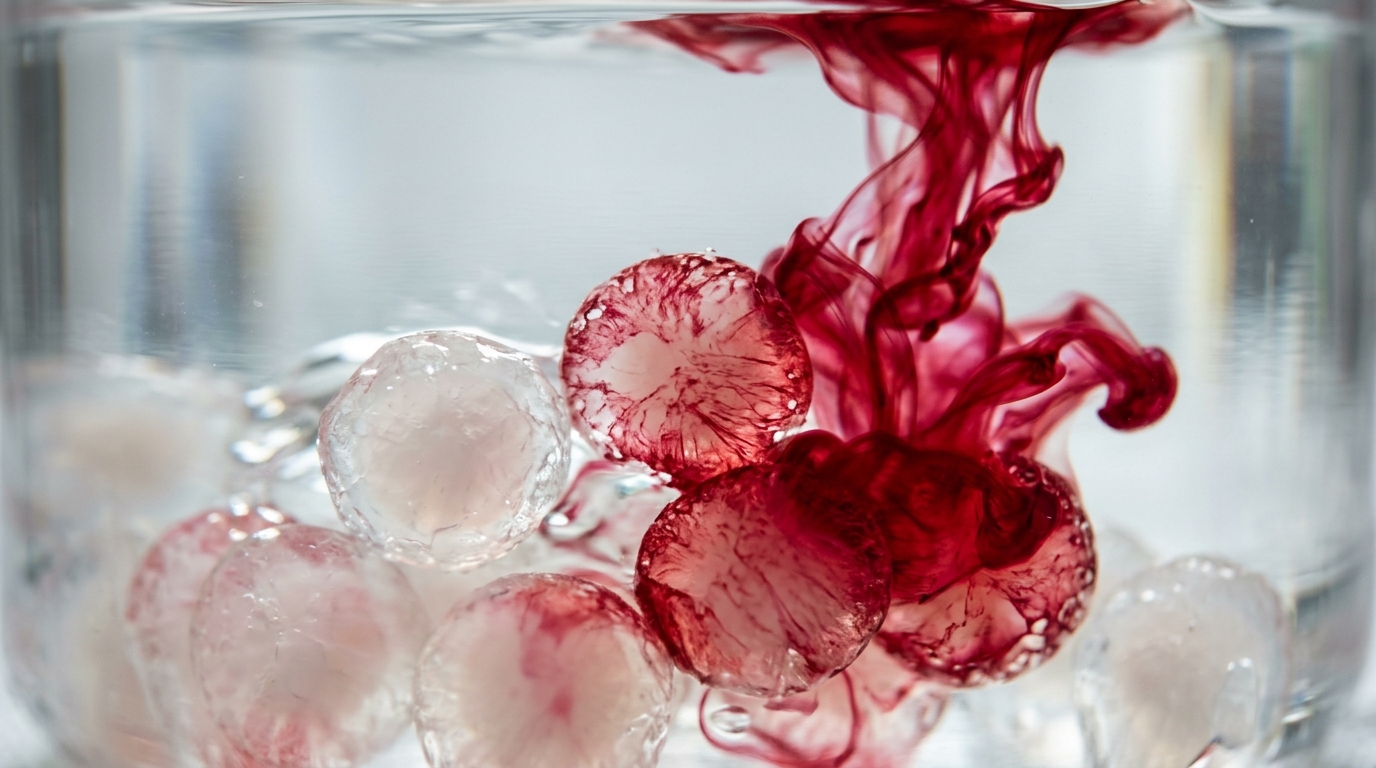
Bead synthesis utilized an adapted dropping methodology to fabricate uniform hydrogel carriers under mild chemical conditions. Unmodified alginate beads were synthesized by dissolving 2 percent weight per volume sodium alginate in distilled water and introducing 10 milliliters dropwise into a 1 percent calcium chloride cross-linking bath, producing 60 to 80 spherical beads. Unmodified chitosan beads were produced from 2 percent chitosan dissolved in 1 percent acetic acid, dropped into a precipitating bath of water, methanol, and 0.1 normal sodium hydroxide in a 4:5:1 weight ratio. Composite matrices were formulated by adding 4 grams per liter of activated charcoal to alginate and chitosan solutions before dropping. Similarly, washed microalgal cells were blended into the polymer solutions to produce algae-immobilized beads, yielding eight comparative experimental groups including bare charcoal powder and free algal cells.
Batch removal experiments evaluated the adsorbents across initial Congo red dye concentrations of 5, 10, 20, 40, and 80 milligrams per liter, measuring residual concentrations spectrophotometrically at 498 nanometers. All chitosan-based hydrogels exhibited exceptional removal efficiency at higher loadings, achieving approximately 96.9 ± 0.6 percent dye elimination at 80 milligrams per liter. Furthermore, maximum removals at 40 and 20 milligrams per liter were achieved by unmodified chitosan at 94.08 ± 2.8 percent and chitosan-algae at 87.1 ± 0.8 percent, respectively. Conversely, alginate-based formulations favored lower concentrations, with alginate-algae removing 99.8 ± 0.1 percent at 5 milligrams per liter and 90.8 ± 3.02 percent at 10 milligrams per liter. Saturation for alginate hydrogels occurred at 10 milligrams per liter, beyond which removal efficiencies declined to 74.5 ± 3.7 percent for alginate-algae and 67.5 ± 0.6 percent for unmodified alginate at 80 milligrams per liter. Free algae and bare charcoal achieved lower removal ranges between 40 and 70 percent.
Adsorption capacity scaled directly with initial dye concentration across all adsorbents, driven by increased mass transport forces from the aqueous phase to active sorbent sites. In batch trials at 80 milligrams per liter, unentrapped charcoal displayed the highest adsorption capacity at 9.8 milligrams per gram, followed by 6.6, 2.5, 1.4, and 0.7 milligrams per gram at 40, 20, 10, and 5 milligrams per liter, respectively, enabled by its high internal microporosity and hydrophobic surface area. At 80 milligrams per liter, hydrogel adsorption capacities decreased in the order of unmodified chitosan at 0.13 milligrams per gram, chitosan-algae at 0.12 milligrams per gram, chitosan-charcoal at 0.11 milligrams per gram, alginate-algae at 0.08 milligrams per gram, alginate-charcoal at 0.074 milligrams per gram, and unmodified alginate at 0.072 milligrams per gram. The authors highlighted that while charcoal achieved greater unit capacity, its fine powder form presents severe separation difficulties, whereas hydrogel beads are readily harvested.
Contact time assessments demonstrated distinct kinetic behaviors between the biopolymer systems over 6 hours of testing for hydrogels and charcoal, compared to 120 hours for free microalgae. Chitosan-based hydrogels exhibited rapid uptake, with unmodified chitosan registering a sharp removal jump to 90 ± 1.2 percent within the first hour at 80 milligrams per liter before plateauing. In contrast, alginate hydrogels reached equilibrium at 2 hours, whereas alginate-charcoal and alginate-algae achieved maximum initial uptake at 1 hour followed by slower increases up to 6 hours. Free microalgal cells exhibited dye removal over 120 hours governed primarily by biological degradation rather than adsorption. Kinetic modeling revealed that dye uptake on all hydrogels and charcoal followed the pseudo-second-order model with determination coefficients ranging from 0.945 to 0.999, confirming chemisorption. Intraparticle diffusion plots displayed multilinearity, indicating that surface mass transfer was followed by intraparticle diffusion into hydrogel cavities.
Fourier-transform infrared spectroscopy characterized the hydrogels across the mid-infrared range of 4000 to 400 reciprocal centimeters to verify functional group participation during adsorption. Pristine Congo red showed characteristic peaks at 3448 reciprocal centimeters for amine stretching, 1604 and 1582 reciprocal centimeters for azo bond stretching, and 1500 to 1180 reciprocal centimeters for aromatic rings. Unadsorbed chitosan beads displayed major peaks at 3362 reciprocal centimeters for bonded amine and hydroxyl groups, 2854 reciprocal centimeters for carbon-hydrogen stretching, 1571 reciprocal centimeters for amine bending, 1424 reciprocal centimeters for alkane bending, and 1020 reciprocal centimeters for carbon-oxygen stretching. Following dye uptake, chitosan spectra exhibited peak broadening and shifting at 3314 and 1568 reciprocal centimeters, confirming the involvement of amine and hydroxyl groups in hydrogen bonding and electrostatic interactions. For alginate, peak shifts at 1620 and 1423 reciprocal centimeters and the disappearance of the 3201 reciprocal centimeters hydroxyl peak confirmed carboxylate and hydrogen-bonding involvement in dye binding.
Adsorption isotherm modeling provided critical insights into adsorbent surface properties and interaction mechanisms. Experimental data for chitosan, chitosan-charcoal, and chitosan-algae correlated most strongly with the Langmuir isotherm model, signifying homogeneous monolayer adsorption across active binding sites. This homogeneous binding was mediated by strong electrostatic attraction between the cationic amine groups of chitosan and the anionic sulfonate groups of Congo red dye. In contrast, unmodified alginate, alginate-charcoal, alginate-algae, and bare charcoal conformed more closely to the Freundlich isotherm model, indicating heterogeneous surface energy and multilayer adsorption. Because the negative surface charge of alginate electrostatically repelled the anionic dye, adsorption on alginate matrices depended upon dye diffusion into internal cavities through hydrogen bonding and van der Waals interactions, allowing embedded microalgae and charcoal to contribute active sites at lower dye concentrations.
To assess operational practicality in continuous wastewater treatment, a continuous-flow fixed-bed column was constructed from two connected 5-milliliter syringes packed with unmodified chitosan beads. The column received upward-flowing Congo red solutions driven by a peristaltic pump at a volumetric flow rate of 0.033 milliliters per minute, establishing a hydraulic retention time of 60 minutes at 28 degrees Celsius. In the first cycle, the column achieved dye removal efficiencies of 81.9 ± 0.07 percent at 40 milligrams per liter and 74.4 ± 0.03 percent at 80 milligrams per liter. For initial concentrations of 5, 10, and 20 milligrams per liter, maximum removals of 89.8 ± 0.04 percent, 84.1 ± 0.33 percent, and 90.3 ± 0.04 percent were attained during the second operational cycle. Throughout continuous operation, chitosan beads maintained over 75 percent removal across all initial concentrations, exhibiting higher adsorption capacities ranging from 0.032 to 0.4 milligrams per gram compared to batch trials due to enhanced dynamic contact conditions.
Adsorbent regeneration was tested using 70 percent volume per volume ethanol across three cycles to evaluate dye recovery and matrix reusability after saturation at 80 milligrams per liter. Desorption in batch mode recovered 52.21 milligrams per liter of Congo red dye from chitosan beads, whereas continuous column elution yielded 33.13 milligrams per liter. The researchers attributed higher batch recovery to extended solvent contact time, vigorous mixing, and reduced mass transfer resistance. Although column recovery decreased across successive cycles and hydrogel capacities were modest compared to bare charcoal, the overall findings establish that unmodified chitosan hydrogels serve as highly effective, low-cost, and regenerable adsorbents for treating high-molecular-weight diazo dyes without necessitating complex modifications.
Subject of Research: Adsorption of Congo red dye using chitosan and alginate hydrogels
Article Title: Unlocking the potential of chitosan and alginate for Congo red dye removal by economical modifications in batch and column study
Article References: Saket, P., Nagpure, G., Bala, K., & Joshi, A. (2025). Unlocking the potential of chitosan and alginate for Congo red dye removal by economical modifications in batch and column study. Biotechnology for Sustainable Materials, 2(1), Article 23. https://doi.org/10.1186/s44316-025-00043-0
Image Credits: AI Generated
DOI: 10.1186/s44316-025-00043-0
Keywords: chitosan hydrogel, alginate beads, Congo red dye, dye adsorption, wastewater remediation, continuous flow column, adsorption kinetics, textile effluent, Unlocking, potential, chitosan, alginate
News Source: Gregory Coleman. (November 6, 2026). Unmodified Chitosan Hydrogels Efficiently Capture Toxic Congo Red Dye from Wastewater. Scienmag.