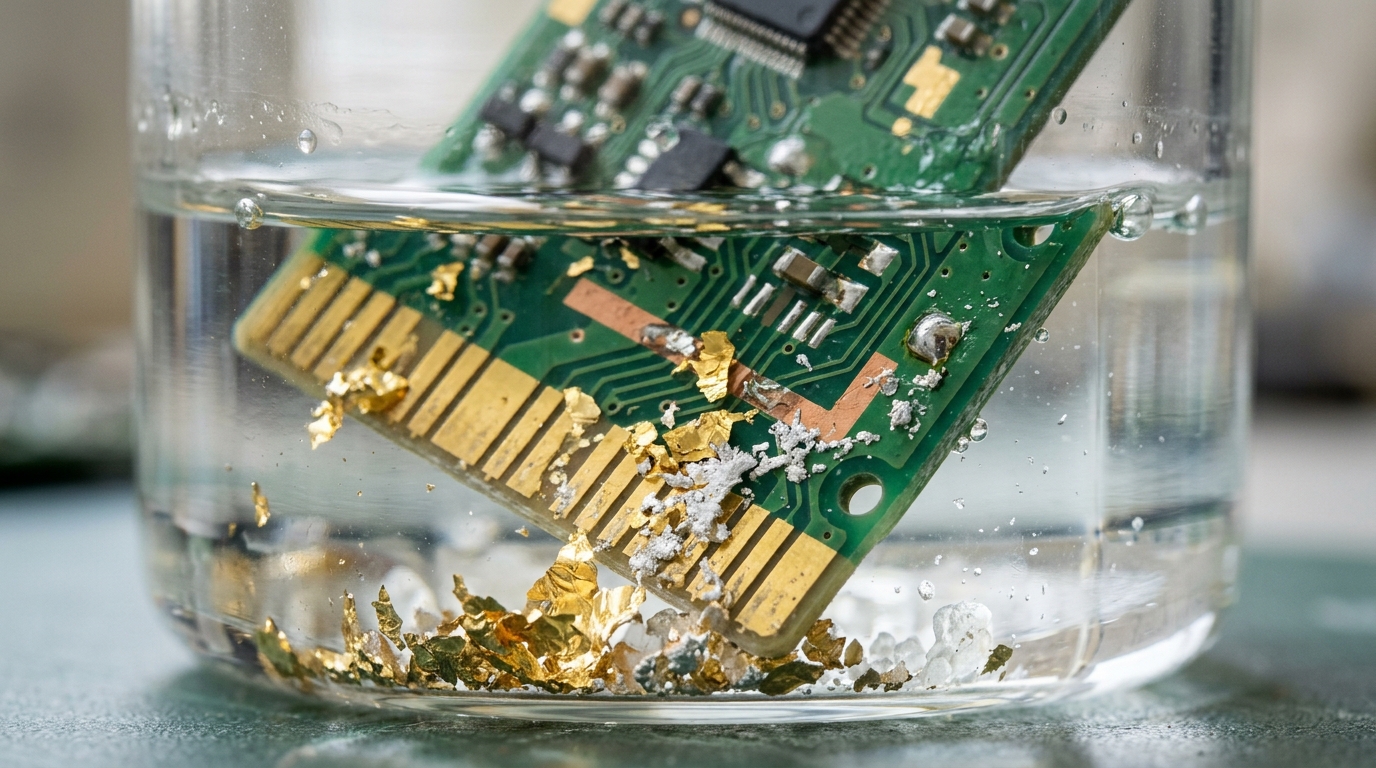
Chemists have demonstrated a two-step, room-temperature process that strips nearly all of the gold and palladium out of the acidic etching solutions left over from dissolving printed circuit boards, yielding powders of both metals with purity above 99.9 percent. The method, described in Gold Bulletin, replaces the toxic reducing agent hydrazine used in earlier schemes with ordinary ascorbic acid, better known as vitamin C, and then plucks palladium from the leftover liquid using sodium iodide, a simple iodide salt.
The work targets a growing waste problem. Printed circuit boards are found in most electronic devices and contain valuable metals including gold, silver, copper and palladium alongside base metals such as aluminum, iron, nickel and zinc. Gold and palladium are in high demand for industrial uses, especially in electronics and jewelry, so recovering them from discarded boards is considered essential both economically and environmentally. Before recycling, boards undergo pretreatment: disassembly to remove hazardous components, shredding or crushing to liberate embedded metals from resin, fiberglass and plastics, and magnetic separation to strip out iron and other ferromagnetic particles. Research cited by the authors indicates that grinding boards below 6 millimeters frees the ferromagnetic materials and copper almost completely. The pretreated material is then dissolved in aqua regia, the harsh acid mixture, to bring the precious metals into solution.
In the study, waste printed circuit boards together with other gold-bearing wastes were dissolved in aqua regia at 80 degrees Celsius at a pulp density of 250 grams per liter. The resulting etching solution contained gold as Au(III), palladium as Pd(II), and a cocktail of base metals: aluminum, copper, iron, nickel, tin and zinc, all quantified by inductively coupled plasma optical emission spectrometry. The central challenge was selectivity. Any recovery chemistry must pull out the two precious metals without dragging the cheaper ones along.
The researchers, Thi Nhan Hau Nguyen and Man Seung Lee, exploited a large gap in electrochemistry. Standard reduction potentials show that Au(III) is far easier to reduce than the other ions in solution. Because gold and palladium form strong chloride complexes in aqua regia, existing as AuCl4− and PdCl42−, the team calculated the potentials of those complexes directly. The difference between AuCl4− and PdCl42− at 25 degrees Celsius comes to 0.80 volts, larger than the 0.55-volt gap between the bare ions, meaning selective reduction of gold over palladium should actually be easier in chloride solution. Ascorbic acid, with a reduction potential of 0.40 volts, sits comfortably below gold but only 0.1 volts above the palladium complex, and the strong acidity of the etching solution hinders reduction of PdCl42− further.
Experiments confirmed the prediction. When the molar ratio of ascorbic acid to Au(III) was raised from 1.5 to 3, the reduction percentage of gold climbed from 96.9 to 99.9 percent and then plateaued all the way to a ratio of 15. Stoichiometry demands 1.5 moles of ascorbic acid per mole of Au(III), and the team settled on that minimum ratio for subsequent runs. Selectivity held remarkably well: at a ratio of 15, only 9.6 percent of Pd(II), 7.8 percent of Cu(II) and 4.3 percent of Fe(III) were reduced, while aluminum, tin, zinc and nickel were essentially untouched. Gold recovered at an ascorbic acid ratio of 3 was redissolved in aqua regia and analyzed; only Au(III) and a trace of Pd(II) appeared, with gold at 7.51 grams per liter and palladium at just 3.6 milligrams per liter, confirming metal purity above 99.9 percent.
Timing and temperature mattered. After 30 minutes at room temperature, Au(III) was completely reduced, and longer reaction times up to 90 minutes changed nothing. At that 30-minute mark only 3 percent of Pd(II) had been reduced and the other ions none at all. Heating, by contrast, hurt: raising the temperature from 20 to 80 degrees Celsius collapsed the gold reduction percentage from 99.9 to 40 percent, which the authors attribute to thermal degradation of ascorbic acid. X-ray diffraction of the powder obtained under the optimum conditions, a 1.5 ascorbic acid to Au(III) ratio at 20 degrees Celsius for 30 minutes, showed only the peaks of gold metal, corroborating the purity measurement.
With the gold removed, the filtrate still held the palladium, and the team first tried to reduce it directly. Sodium borohydride performed far better than ascorbic acid, which managed only 17 percent Pd(II) reduction even at a 25-fold molar excess; borohydride reached 91 percent at its highest ratio. But the selectivity failed. Copper co-reduction climbed to 45 percent under the same conditions, and analysis of the dissolved residues showed the recovered palladium metal was contaminated, with 831.8 milligrams per liter of Pd(II) accompanied by 32.8 milligrams per liter of Cu(II) in the aqua regia test solution. The authors note that hydrogen gas generated by borohydride hydrolysis can act as a secondary reducing agent for copper, explaining the contamination. Chemical reduction was therefore judged ineffective for separating palladium from the filtrate.
Precipitation proved the answer. Guided by the hard-soft acid-base principle, in which Pd(II) is a soft acid and iodide the softest of the halide bases, the researchers added sodium iodide to the filtrate. Palladium iodide is extraordinarily insoluble, with a solubility product of 2.5 × 10⁻²³ at 25 degrees Celsius, while copper, iron, nickel, tin, aluminum and zinc do not form insoluble iodide precipitates. As the NaI to Pd(II) molar ratio rose from 1 to 7, palladium precipitation jumped from 26 to 99.9 percent and stayed flat up to a ratio of 10, with the other metals remaining near zero throughout. Residues collected at a ratio of 5 and redissolved in aqua regia contained only Pd(II), at 681.95 milligrams per liter, with no other metal ions detected. Reaction time followed the same pattern: precipitation rose from 24 to 99.8 percent as time extended to 60 minutes and then held steady to 90 minutes. The optimal conditions were fixed at a NaI/Pd(II) ratio of 7, 20 degrees Celsius, 500 rpm stirring and 60 minutes, and the PdI2 precipitate tested above 99.9 percent pure.
The proposed flowsheet is deliberately simple: reduce gold with ascorbic acid, then precipitate palladium as PdI2 with sodium iodide, both at ambient temperature and without adjusting the acidity of either solution. The authors highlight the room-temperature operation as an advantage that reduces energy consumption compared with processes requiring hot stages. They also contrast the approach with earlier schemes. One prior route cemented gold and palladium with copper powder, then redissolved the cement and separated the metals through solvent extraction and oxidative precipitation, a multi-step sequence. A second, simpler route used hydrazine to reduce the gold, but hydrazine brings toxicity, explosive potential and carcinogenic properties, and it still required oxidizing agents to convert Pd(II) to Pd(IV) for recovery as ammonium hexachloropalladate. The ascorbic acid route sidesteps both problems: the reductant is harmless and affordable, and palladium is recovered without ever changing its oxidation state.
Limitations remain. The purity assays relied on dissolving the recovered powders in aqua regia and measuring the dissolved ions by ICP-OES, so the 99.9 percent figures reflect the composition of those test solutions at the stated pulp densities. The reduction and precipitation percentages were calculated from metal masses in solution before and after each step, and the work was performed on a specific etching solution whose composition the authors note can fluctuate between batches of boards, a variability they acknowledge as a constraint on any separation process applied to such feeds. Sodium borohydride, despite its stronger hydride chemistry, was ruled out for the palladium step because of copper co-reduction. Even so, the demonstration that vitamin C can selectively drop gold out of a multi-metal acid leachate in half an hour on a laboratory bench, and that a cheap iodide salt can then catch the palladium, offers recyclers a notably gentler recipe for turning electronic scrap back into precious metal.
Subject of Research: Recovery of gold and palladium from printed circuit board etching solutions by chemical reduction and precipitation
Article Title: Simple process for the recovery of gold metals and palladium(II) compound from aqua regia etching solutions of printed circuit boards by chemical reduction and precipitation
Article References: Nguyen, T. N. H., & Lee, M. S. (2025). Simple process for the recovery of gold metals and palladium(II) compound from aqua regia etching solutions of printed circuit boards by chemical reduction and precipitation. Gold Bulletin, 58(1), Article 1. https://doi.org/10.1007/s13404-024-00354-6
Image Credits: AI Generated
DOI: 10.1007/s13404-024-00354-6
Keywords: gold recovery, palladium recovery, printed circuit boards, aqua regia, ascorbic acid, sodium iodide, chemical reduction, precipitation, electronic waste recycling, hydrometallurgy, PdI2, metal purity
News Source: Denise Maddox. (November 6, 2026). Vitamin C and salt pull pure gold and palladium from circuit board waste at room temperature. Scienmag.