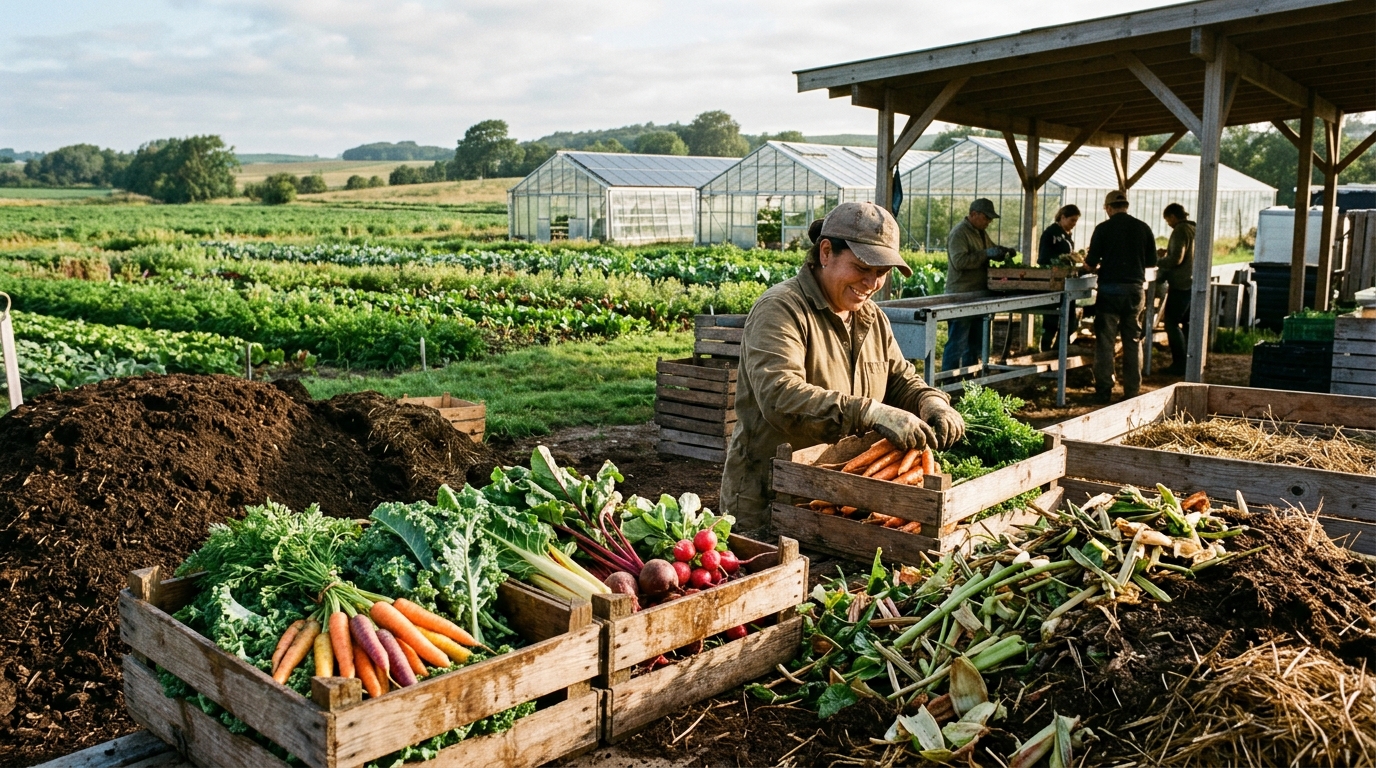
Agri-food supply chains operate under an intense dual burden across modern economies, underpinning global food security, rural livelihoods, and economic stability while simultaneously straining freshwater reserves, arable soil, energy infrastructures, and sensitive ecological balances. In response to mounting greenhouse gas emissions, extensive resource degradation, and severe post-harvest food losses, global policymakers and industry leaders have increasingly moved away from conventional linear take-make-dispose industrial paradigms toward regenerative bio-circular-green frameworks that treat agricultural networks as interconnected biological and operational systems. Implementing such multi-faceted operational transformations across fragmented agri-food channels remains extraordinarily difficult, particularly because traditional enterprise strategies frequently tackle green, circular, and bio-based practices in isolated silos rather than through synchronized, end-to-end supply chain capabilities. To overcome these deep-seated systemic fragmentation barriers, industrial engineering researchers Detcharat Sumrit and Pantita Moolma have developed an advanced decision-support architecture published in Cleaner Engineering and Technology that leverages circular intuitionistic fuzzy mathematics alongside multi-criteria decision-making algorithms to systematically identify, evaluate, and sequence sustainable supply chain capability enablers within complex agri-food ecosystems.
The conceptual foundation of this newly formulated modeling framework synthesizes the resource-based view and dynamic capabilities view of organizational management, mapping their core tenets directly onto the five foundational processes of the Supply Chain Operations Reference model: planning, sourcing, making, delivering, and returning. Within this operational matrix, sustainable supply chain capabilities cannot merely be regarded as static collections of isolated internal machinery or localized eco-friendly techniques, but must function as dynamic, cross-organizational capability bundles that allow diverse commercial actors to sense emerging climate vulnerabilities, seize collaborative market opportunities, and continuously reconfigure complex supply flows. The empirical viability of the proposed methodology was rigorously tested through an in-depth case study analyzing an end-to-end rice supply chain participating in a Royal Patronage pilot initiative embedded within Thailand’s national Bio-Circular-Green economy strategy. This intricate agricultural network encompasses agricultural producers, farming cooperatives, local paddy collectors, industrial rice mills, bulk storage silos, multimodal logistics providers, wholesale brokers, packaging facilities, retail distribution channels, and export authorities, illustrating the immense operational complexity and multi-tier stakeholder interdependencies inherent to national-scale staple food distribution.
To capture and model the diverse, frequently ambiguous judgments of experienced industry practitioners, the research team assembled a specialized expert panel comprising agricultural producers, agri-food processors, logistics managers, policy directors, and downstream retail leaders, all possessing extensive professional track records in Thai sustainable supply chain initiatives. Human decision-makers evaluating multi-tier sustainability criteria naturally experience epistemic uncertainty, hesitation, and incomplete knowledge when assessing technical interrelationships across disparate economic sectors. To rigorously address these subjective evaluation hurdles without losing critical nuance, the researchers formulated their decision algorithms within a circular intuitionistic fuzzy environment, which extends conventional intuitionistic fuzzy sets by enclosing evaluations within circular geometrical regions defined by membership degrees, non-membership degrees, and an explicit uncertainty radius in membership-nonmembership space. Expert contributions were systematically aggregated through circular intuitionistic fuzzy weighted averaging operators, where individual expert weights were objectively determined based on verified field experience and calibrated hesitation values to ensure balanced, mathematically robust consensus across the entire analytical pipeline.
The first core computational phase of the integrated hybrid architecture employed the Full Consistency Method under circular intuitionistic fuzzy conditions to prioritize twelve fundamental multi-stakeholder requirements across bio, circular, and green dimensions. Compared to traditional analytical hierarchy or best-worst comparison models that impose massive cognitive burdens through extensive pairwise matrix evaluations, the Full Consistency Method derives stable criteria weights with minimal pairwise comparisons and built-in consistency constraints. Expert linguistic assessments were converted into crisp scoring functions and optimized using nonlinear mathematical programming solvers, achieving a consistency deviation virtually equal to zero. The resulting weight distributions established bio-quality, food safety, and compliance as the supreme stakeholder priority with a normalized weight of 0.098, closely trailed by end-to-end product traceability at 0.095, waste reduction and by-product utilization at 0.085, environmentally responsible operations at 0.085, and emissions measurement and reduction at 0.085. These quantitative findings demonstrate that baseline operational compliance, strict food safety protocols, and rigorous tracking infrastructure serve as non-negotiable foundational prerequisites before supply chain networks can successfully absorb more advanced circular interventions.
Having established the primary stakeholder requirements, the researchers organized fifteen sustainable supply chain capability enablers across the standard planning, sourcing, manufacturing, distribution, and reverse-flow supply chain dimensions, subsequently deploying the circular intuitionistic fuzzy Weighted Influence Non-linear Gauge System to expose hidden causal interdependencies and feedback mechanisms. By processing direct and indirect network influences within an aggregated total-influence matrix, the algorithm computed systemic prominence and causal orientation metrics for every candidate capability. This structural analysis revealed that sustainable supplier development and auditing, alongside resource-efficient, low-impact production processes, exert the most potent causal driving forces across the entire system, functioning as pivotal strategic leverage points. Sourcing governance, green logistics operations, and reverse logistics systems likewise emerged within the causal group, whereas high-level supply chain planning, performance monitoring, climate-resilient risk forecasting, circular input collaboration, and digital traceability systems were categorized as effect-oriented capabilities, demonstrating that their operational effectiveness fundamentally hinges upon the maturity of upstream operational and relational control routines.
The structural outputs from the causal influence network were subsequently coupled with the prioritized stakeholder criteria within a circular intuitionistic fuzzy Quality Function Deployment framework, formally embedding the analytical network results directly into the roof matrix of a comprehensive House of Quality. In this integrated phase, weighted WHAT-HOW relationships between stakeholder demands and operational capabilities were combined with the normalized interdependency effects to compute initial and final absolute importance indices for each enabler. Before accounting for network interdependencies, closed-loop coordination, circular reuse and recycling systems, and reverse logistics management recorded the highest initial importance scores, ranging from 8.145 to 8.282, while supplier development and auditing registered a significantly lower initial score of 4.446. However, when the Weighted Influence Non-linear Gauge System roof interactions were fully integrated, the total systemic impact of these network interactions surfaced, producing final adjusted importance scores spanning from 4.760 to 8.594, while preserving closed-loop coordination and stakeholder engagement, circular reuse and recycling, and reverse logistics management as the undisputed top three capability priorities across the entire enterprise framework.
The final unified ranking derived from the House of Quality analysis settled into a precise hierarchical sequence: closed-loop coordination and stakeholder engagement claimed first place, followed sequentially by circular reuse and recycling, reverse logistics management, integrated green planning, digital traceability, climate-resilient planning, green logistics, supplier collaboration, waste valorization, sustainability performance monitoring, resource-efficient production, food safety integration, cold-chain integrity, traceable sourcing, and sustainable supplier auditing. This distribution demonstrates an essential dynamic sequencing mechanism governing sustainable supply chain maturity. Although foundational governance capabilities such as supplier auditing, quality assurance, and traceability might appear to receive lower final deployment weights, their high causal driving power indicates they construct the indispensable operational runway that allows higher-order circular capabilities to function effectively.
To guarantee the statistical validity, stability, and broad algorithmic reliability of their findings, Sumrit and Moolma executed an extensive four-part sensitivity analysis that tested the mathematical model against severe parameter variations and methodological alterations. Systematically varying the score-function radius adjustment coefficient across twenty-one scenarios demonstrated that the complete enabler ranking remained perfectly identical to the baseline across 85.71% of iterations, while the top three leading enablers preserved their exact positions across every tested value. Furthermore, a comprehensive perturbation analysis altering individual criteria weights within a broad range of minus thirty percent to plus thirty percent generated eighty-four distinct scenarios, confirming that the prioritization hierarchy remained exceptionally stable despite substantial shifts in policy preferences. Comparative benchmarking against circular intuitionistic fuzzy DEMATEL algorithms yielded a robust Spearman rank correlation of 0.732, while comparisons against alternative fuzzy WINGS models exhibited strong positive rank correlations up to 0.868, confirming the superior discriminative capability and structural consistency of the proposed hybrid formulation under severe judgment hesitation.
The resulting insights provide actionable operational and strategic blueprints for commercial managers, technology providers, and agricultural policymakers seeking to realize systemic circular transitions. Rather than dispersing limited capital investments across disconnected environmental projects or treating circularity as a purely technological challenge, enterprise leaders must pursue a structured, path-dependent capability maturation roadmap that first stabilizes supplier verification, baseline environmental controls, and transparent digital data linkages before allocating intensive resources toward multi-tier closed-loop return systems and material recycling ventures. By bridging the conceptual divide between theoretical dynamic capabilities and quantitative engineering prioritization under uncertainty, this circular fuzzy decision framework provides a replicable, mathematically sound methodology capable of transforming ambitious bio-circular-green development goals into coordinated, resilient, and enduring realities across global agri-food supply networks.
Subject of Research: Decision-support framework for prioritizing sustainable supply chain capabilities in bio-circular-green agri-food systems
Article Title: Prioritizing sustainable supply chain capability for bio-circular-green economy implementation in agri-food supply chains: A circular intuitionistic fuzzy approach
Article References: Sumrit, D., & Moolma, P. (2026). Prioritizing sustainable supply chain capability for bio-circular-green economy implementation in agri-food supply chains: A circular intuitionistic fuzzy approach. Cleaner Engineering and Technology, 35, Article 101341. https://doi.org/10.1016/j.clet.2026.101341
Image Credits: AI Generated
DOI: 10.1016/j.clet.2026.101341
Keywords: agri-food supply chain, bio-circular-green economy, circular intuitionistic fuzzy sets, FUCOM, WINGS, Quality Function Deployment, sustainable supply chain, reverse logistics, rice supply chain, decision-support systems, Prioritizing, sustainable
News Source: Denise Maddox. (November 6, 2026). Research report: Prioritizing sustainable supply chain capability for bio-circular-green economy implementation in agri-food supply chains: A circular intuitionistic fuzzy approach. Scienmag.