A new study published in Applied Microbiology and Biotechnology reports that a two-stage vertical flow constructed wetland (VFCW) system, tested from pilot scale all the way to a working field installation, can handle this high-strength waste reliably and cheaply, provided the design is scaled up according to organic loading rate rather than volume alone.
At pilot scale, the researchers operated the system at flow rates of 4 to 6 litres per day. The best performance emerged at the lowest flow, 4 L per day, which corresponded to an organic loading rate (OLR) of 653.4 ± 43 g m⁻² day⁻¹. Under these conditions, the control wetland removed 88.95 ± 3.12% of chemical oxygen demand (COD), 86.32 ± 5.48% of total organic carbon (TOC), 87.71 ± 1.12% of phosphate, 73.37 ± 4.95% of total ammoniacal nitrogen (TAN) and 51.25 ± 3.46% of total nitrogen (TN).
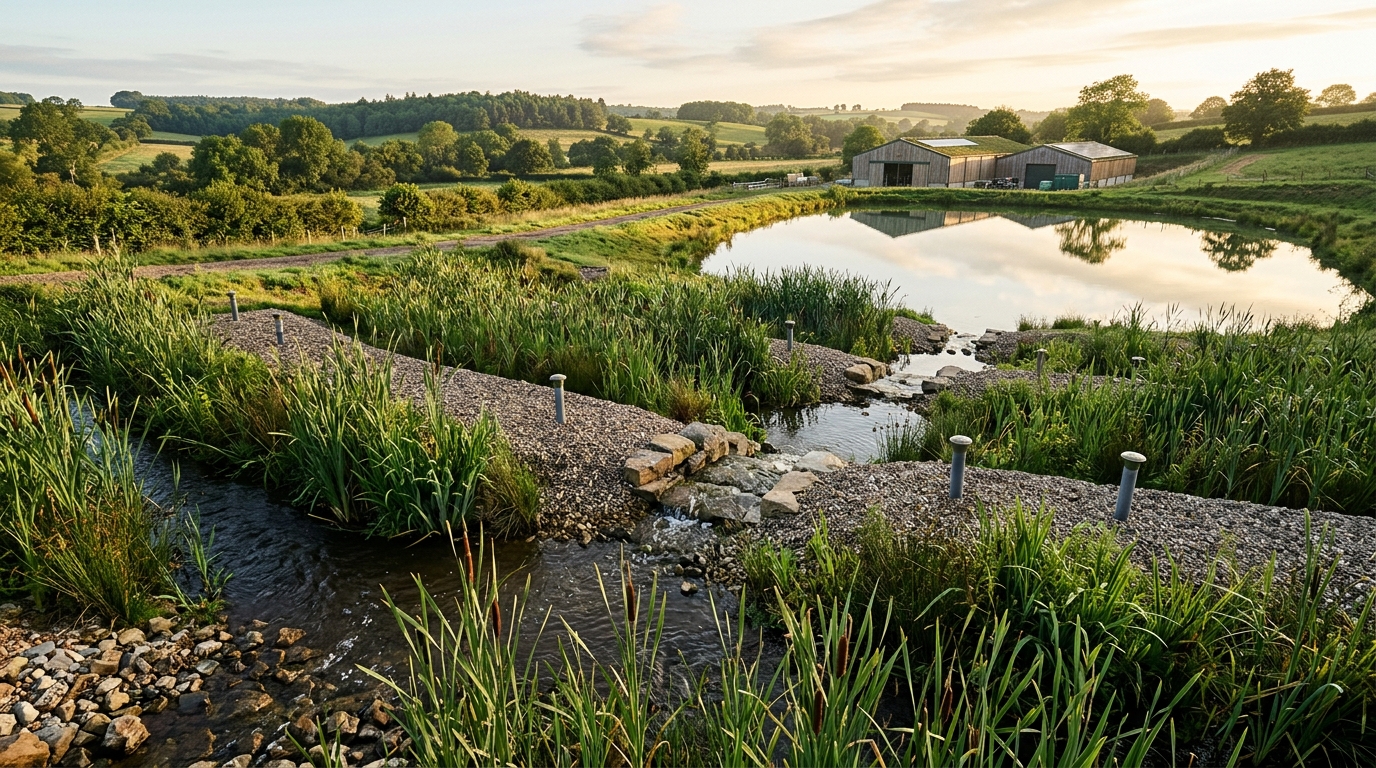
The decisive improvement came from a simple engineering modification: perforated pipes inserted within the wetland medium to allow passive aeration. This aerated variant, designated CW-A, lifted removal efficiencies to 90.36 ± 2.98% for COD, 89.68 ± 3.87% for TOC, 90.23 ± 0.98% for phosphate, 87.23 ± 4.23% for TAN and 67.12 ± 4.23% for TN. The gains were not uniform across all pollutants. Passive aeration had only marginal effects on organic matter and phosphate removal, but significantly enhanced nitrogen removal, particularly through improved ammonium oxidation and overall nitrogen transformation.
Crucially, the aeration was achieved without blowers, compressors or any powered equipment.
Scale-up was the second challenge the study addressed. The researchers avoided this trap by maintaining a comparable organic loading rate during scale-up rather than simply multiplying dimensions. The resulting field-scale system treated 7200 litres per day at an OLR of 604.3 ± 90.6 g m⁻² day⁻¹, close to the pilot optimum. The field system achieved overall removals of 87.85 ± 12.47% for COD, 86.35 ± 12.08% for TOC, 91.08 ± 10.63% for phosphate, 81.02 ± 13.13% for TAN, 60.45 ± 12.74% for nitrate and 64.86 ± 13.62% for TN.
Performance was not instantaneous. The field system required a stabilisation period of four to five weeks before removal efficiencies settled, after which it remained stable and showed resilience to variability in influent composition. Once established, the wetland absorbed swings in pollutant load without collapse, a property that matters for piggery operations where waste strength fluctuates with herd management, cleaning cycles and feed changes.
The techno-economic analysis is perhaps the most consequential part of the work for real-world adoption. Treatment cost came to ₹45.5 per cubic metre, equivalent to approximately $0.48, with energy consumption of just 0.16 kWh per cubic metre.
The study’s central lesson is methodological as much as technical: OLR-based scale-up enabled successful translation from pilot to field performance.
Limitations remain. The reported removal efficiencies carry substantial standard deviations at field scale, reflecting real-world variability rather than controlled laboratory conditions. Nevertheless, the demonstrated combination of robust performance, passive operation and a treatment cost under half a US dollar per cubic metre positions two-stage VFCWs as a credible option for piggery wastewater management in settings where centralised treatment is unavailable or unaffordable.
Subject of Research: Pilot- to field-scale evaluation of a two-stage vertical flow constructed wetland system for treating piggery wastewater
Article Title: Pilot- to field-scale evaluation of a two-stage vertical flow constructed wetland system for piggery wastewater treatment
Article References: Murthy, K. N., & Mutnuri, S. (2026). Pilot- to field-scale evaluation of a two-stage vertical flow constructed wetland system for piggery wastewater treatment. Applied Microbiology and Biotechnology. https://doi.org/10.1007/s00253-026-14088-2
Image Credits: AI Generated
DOI: 10.1007/s00253-026-14088-2
Keywords: constructed wetland, piggery wastewater, passive aeration, nitrogen removal, organic loading rate, techno-economic analysis, vertical flow, wastewater treatment, decentralised treatment, scale-up, Pilot-, field-scale
News Source: Gregory Coleman. (November 6, 2026). Passively aerated constructed wetlands turn piggery wastewater into a low-cost success story. Scienmag.