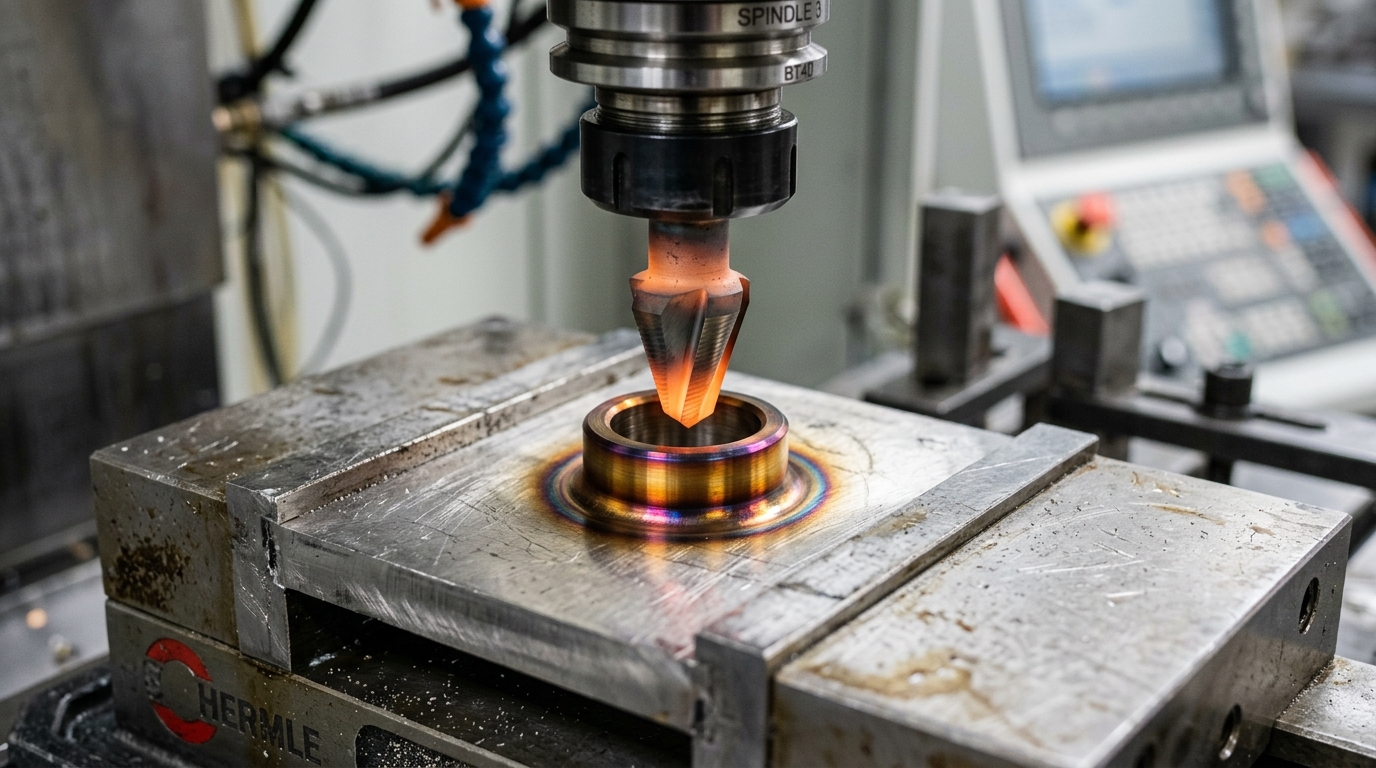
A comprehensive experimental investigation into friction drilling of Incoloy 800 has established quantitative relationships between processing parameters and hole characteristics, showing that rotational speed and multi-parameter interactions govern process performance. Conducted by researchers Vinayak W. Bembrekar and R. N. Yerrawar in Discover Mechanical Engineering, the study applied Taguchi optimization and analysis of variance to examine how spindle speed, feed rate, and sheet thickness influence thrust force, torque, temperature, bush length, cylindricity, and top diameter. Friction drilling uses friction-generated heat rather than cutting chips, creating an integral bushing for thread forming in lightweight structures. Spindle speed was the primary linear driver for thermal and thrust responses, where increasing speed from 2000 rpm to 5000 rpm reduced thrust force by nearly 22 percent from approximately 1500 N to 1170 N and lowered peak temperatures by about 15 percent. Higher feed rates of 65 mm/min increased drilling torque by nearly 18 percent compared to the lowest feed setting.
Friction drilling represents a non-conventional, chipless thermo-mechanical hole-making process that converts mechanical energy into controlled plastic flow rather than producing traditional machining chips. During operation, a rapidly rotating conical tool penetrates the workpiece under axial force, generating substantial frictional heat through continuous sliding contact at the tool-workpiece interface. This localized thermal energy elevates the temperature of the contact zone, inducing pronounced thermal softening that diminishes the flow resistance of the metal. As the tool advances, the softened material is displaced rather than sheared, extruding along the tool contour to form a clean circular hole lined with an integral tubular bushing. By transforming metal cutting into severe plastic extrusion, the technique eliminates chip waste, minimizes burrs, and removes the need for secondary deburring. The resulting extruded bushing effectively increases the local wall thickness by two to three times the initial sheet thickness, providing the necessary engagement depth required for high-strength mechanical joints in thin-walled sections across automotive, aerospace, appliance, and energy manufacturing.
The research focused specifically on Incoloy 800, a high-performance nickel-iron-chromium superalloy including specialized 800H and 800HT grades widely deployed in demanding thermal environments. The alloy is extensively utilized in petrochemical reformers, heat exchangers, steam generator tubing, and high-temperature nuclear facilities due to its creep strength, structural stability, and resistance to oxidation and carburization. However, the metallurgical characteristics that deliver superior in-service performance create severe obstacles during conventional machining. Incoloy 800 exhibits high mechanical strength at elevated temperatures, exceptional work-hardening tendencies during deformation, and relatively low thermal conductivity and diffusivity. In traditional drilling and milling operations, the inability of the alloy to dissipate heat rapidly concentrates thermal loads at the cutting zone, triggering intense mechanical stresses, rapid tool wear, and compromised surface integrity. The thermo-mechanical dynamics of friction drilling offer an attractive pathway to generate holes and bushings without chip formation, provided process parameters are carefully balanced to avoid excessive thermal degradation and geometrical inaccuracy.
To systematically assess process mechanics, experiments were conducted on a Vertical Machining Centre, model VMC PVM 40, featuring a spindle speed range from 60 to 6000 rpm. Incoloy 800 plates measuring 40 mm by 250 mm across thicknesses of 2, 3, and 4 mm were rigidly clamped to the table to eliminate vibration during penetration. Hole-making operations utilized a solid tungsten carbide friction drilling tool selected for wear resistance under intense thermal contact. The tool featured a conical tip with a 36-degree cone angle, an 8.3 mm diameter cylindrical body, a 13 mm shoulder, and a 9.8 mm shank, with a nominal diameter of 10 mm matching M10 by 1.5 thread specifications. A Kistler dynamometer logged dynamic thrust force and torque during engagement. Drilling temperatures were measured using an infrared pyrometer, while bushing length, cylindricity, and top diameter were evaluated using a Coordinate Measuring Machine and Vernier calipers. Optical microscopy examined bushing morphology, and a Vickers hardness tester evaluated hardness variations across the processed zone.
The experimental campaign was structured using the Taguchi parameter design methodology, selecting an L27 orthogonal array to evaluate three process parameters across three predetermined factor levels. Spindle speed was evaluated at 2000, 3500, and 5000 rpm; feed rate was tested at 35, 50, and 65 mm/min; and workpiece thickness was examined at 2, 3, and 4 mm. The parameter intervals were established through preliminary trial experiments to identify operational windows ensuring stable tool penetration, sufficient frictional heating, and uniform bushing extrusion without causing tool breakage or excessive thermal damage. Because three parameters at three levels yield 27 distinct combinations, the L27 array systematically represented every permutation in a balanced experimental framework. To account for experimental uncertainty and verify repeatability, every trial was executed twice under identical conditions, with average response values and standard deviations incorporated into the analytical evaluation. Data were analyzed using Taguchi signal-to-noise ratios and analysis of variance to establish statistical significance and model multi-response performance criteria.
Experimental observations across the 27 Taguchi trials revealed substantial variations in mechanical loading, thermal generation, and hole geometry. Recorded thrust force spanned from a minimum of 466.6 N during Run 19 to a peak of 1972 N in Run 8. Measured torque ranged from a low of 5.31 N·m in Run 1 to a maximum of 22.62 N·m in Runs 13 and 22. Formed bush length demonstrated high consistency across trials, remaining between 10 mm and 10.27 mm, while peak temperatures reached 848 °C during Runs 23 and 27. Cylindricity deviation varied between 0.1002 mm in Run 17 and 0.2408 mm in Run 23, and top diameter deviation ranged from 0.0148 mm in Run 4 to 0.1175 mm in Run 13. Among all trials, Run 19 was identified as the optimal condition, yielding the lowest thrust force of 466.6 N and lowest temperature of 450 °C alongside moderate torque of 10.59 N·m, low cylindricity deviation of 0.1028 mm, and top diameter deviation of 0.016 mm.
Analysis of variance confirmed that the regression models possessed high statistical reliability, with determination coefficients exceeding 98 percent and error terms below 2 percent across investigated responses. For thrust force, plate thickness was the dominant linear contributor at 32.24 percent, while spindle speed contributed 11.02 percent and feed rate contributed 3.20 percent. However, two-way interaction effects proved far more decisive than single parameters, with the speed-thickness interaction contributing 27.77 percent and the speed-feed interaction contributing 24.60 percent, collectively accounting for over 52 percent of total thrust variance. For torque, the model explained 99.57 percent of observed variation, with two-way interactions generating 55.83 percent of the variance. Spindle speed contributed 15.36 percent and feed rate contributed 15.26 percent as individual terms, while plate thickness provided 13.12 percent. The speed-thickness interaction was the largest single contributor to torque at 23.73 percent, confirming that torque is governed by the dynamic balance between rotational softening and mechanical resistance.
The ANOVA results for interface temperature demonstrated a distinct physical mechanism compared to force and torque dynamics, with the regression model explaining 99.36 percent of total thermal variation. Spindle speed overwhelmingly commanded the thermal environment, independently accounting for 88.79 percent of the total variance in recorded drilling temperature. This dominance confirms that heat generation in Incoloy 800 is governed almost entirely by rotational velocity, where faster tool rotation escalates frictional energy dissipation and plastic strain rates at the contact interface. Tool feed rate contributed 5.91 percent to temperature variation, where increased feed slightly reduced localized heat accumulation by shortening contact duration, while workpiece thickness exhibited a minor 2.35 percent effect, showing that thermal generation is driven by interfacial friction rather than bulk material volume. Two-way parameter interactions played a minimal role in thermal response, accounting for just 2.32 percent of variance, with the speed-feed interaction contributing 1.75 percent and speed-thickness showing no statistical significance.
In contrast to temperature behavior, the geometric quality of drilled holes and extruded bushings was overwhelmingly dictated by two-way parameter interactions rather than isolated variables. For top bush length, the ANOVA model explained 99.56 percent of total variation, with interaction terms contributing 61.80 percent. The speed-feed interaction was the most influential factor at 45.93 percent, followed by linear spindle speed at 31.06 percent, speed-thickness at 8.27 percent, feed rate at 5.34 percent, and thickness at 1.36 percent. For hole cylindricity, the model accounted for 99.67 percent of variation, with interaction effects contributing 71.80 percent, led by speed-thickness at 37.39 percent and speed-feed at 34.40 percent, compared to linear contributions of 17.61 percent for speed and 7.85 percent for thickness. Top diameter variations were similarly dominated by interactions, accounting for 75.98 percent of variance, led by speed-thickness at 30.17 percent and speed-feed at 27.19 percent, while spindle speed alone contributed 18.32 percent.
To resolve competing demands across mechanical forces, thermal loading, and dimensional accuracy, researchers utilized Grey Relational Grade analysis to integrate individual mathematical response models into a unified multi-objective optimization criterion. Because friction drilling is a strongly coupled thermo-mechanical process, optimal performance cannot be achieved through isolated parameter adjustments. Residual analysis and re-evaluated model-adequacy indicators, including adjusted R-squared, predicted R-squared, and prediction error metrics, confirmed the robustness of the regression models with determination coefficients ranging between 91.8 percent and 96.2 percent. Physical interpretations of experimental trends emphasized that rotational speed governs heat input and thermal softening, while feed rate and plate thickness dictate deformation resistance and plastic flow. Confirmation experiments conducted at predicted optimum settings closely matched model predictions, validating the multi-response methodology for practical deployment. The resulting quantitative framework provides practical guidelines for hole generation in Incoloy 800 components within aerospace and automotive manufacturing, while establishing a foundation for future investigations into tool wear progression and microstructural evolution.
Subject of Research: Friction drilling optimization of Incoloy 800 superalloy
Article Title: Multi-objective evaluation of friction drilling characteristics using Taguchi design and ANOVA
Article References: Bembrekar, V. W., & Yerrawar, R. N. (2026). Multi-objective evaluation of friction drilling characteristics using Taguchi design and ANOVA. Discover Mechanical Engineering, 5(1), Article 214. https://doi.org/10.1007/s44245-026-00405-6
Image Credits: AI Generated
DOI: 10.1007/s44245-026-00405-6
Keywords: friction drilling, Incoloy 800, Taguchi design, ANOVA, thrust force, torque, bush length, cylindricity, Multi-objective, evaluation, friction, drilling
News Source: Denise Maddox. (November 6, 2026). Study Optimizes Friction Drilling Dynamics and Bushing Formation in Incoloy 800. Scienmag.