A newly published engineering study introduces IoT ArtNet, an intelligent multimodal framework that couples Internet of Things sensing with deep learning to drive adaptive digital media creation. Developed by researcher Yuan Zhu and published in Discover Internet of Things, the system unifies three distinct computational tasks into a coordinated pipeline: categorizing artistic visual movements, predicting aesthetic quality scores, and recognizing real-time hand gestures captured through near-infrared sensors. In prototype benchmark evaluations, the integrated architecture achieved a 93.2 percent style classification accuracy on the WikiArt dataset, an aesthetic prediction mean absolute error of 0.29 on the Aesthetic Visual Analysis benchmark, and a 96.1 percent gesture command recognition accuracy on the LeapGestRecog dataset. By deploying a dedicated Adaptive Media Fusion Module that integrates visual embeddings and gesture control tokens via attention-weighted mechanisms, the architecture provides an automated decision workflow capable of dynamically adjusting visual styles, color palettes, and compositional structures across smart exhibition environments and creative digital media systems.
The integration of modern Internet of Things infrastructures with artificial intelligence has increasingly shifted computational media from static, rule-based software automation toward context-aware, responsive digital environments. Prior research in AI-driven art creation has extensively investigated generative adversarial networks, convolutional neural networks, and neural style transfer techniques to optimize visual rendering efficiency, synthesize complex imagery, and narrow semantic gaps. However, earlier media systems have remained largely confined to evaluating static imagery or generating content offline without direct interactive input. Conventional digital media generation workflows have historically depended on manual artistic adjustments or rigid parameter scripts that fail to dynamically incorporate real-time physical environmental cues or immediate human control signals. Although edge computing and sensor networks have shown promise in immersive media applications, existing computational art frameworks have lacked a comprehensive architecture that seamlessly fuses deep visual intelligence with real-time human-machine interaction, leaving a noticeable operational gap between sensory environment detection and generative aesthetic refinement.
To overcome these historical limitations, the investigation was organized around three core research questions: how artistic movements, aesthetic evaluation, and gesture-driven interaction could be jointly modeled within a single adaptive media pipeline; how completely independent benchmark datasets could be synthesized without assuming natural sample-level pairing; and how significantly each independent computational module contributed to overall media adaptation decisions. Existing multimodal frameworks could not be deployed directly because user interaction in an interactive creative setting represents an operational command signal rather than a merely descriptive sample feature. Within the proposed framework, hand movements operate as direct control vectors that simultaneously govern style shifts, palette modifications, and spatial composition levels. Rather than treating creative output as a unilateral automated broadcast, the experimental design structures the entire generative process as an interactive dialogue between an ambient IoT sensor array, deep representation models, and direct physical user movements.
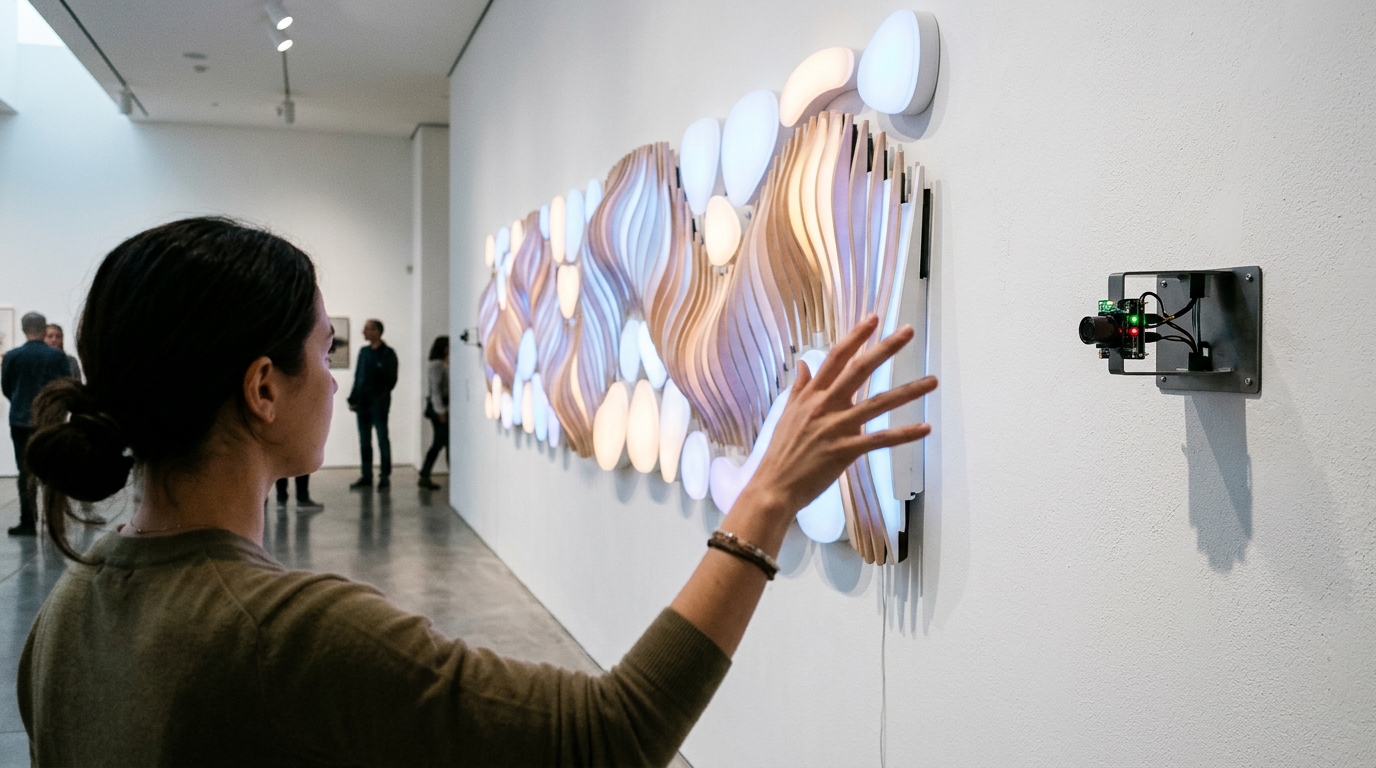
Architecturally, IoT ArtNet is structured across nine functional layers designed to balance data acquisition, feature extraction, cross-modal integration, and physical output delivery. The pipeline begins at the IoT Input Layer, which collects environmental context, ambient lighting conditions, and raw interaction signals from deployed devices. Directly connected to this, the Gesture Acquisition Layer interfaces with Leap Motion sensors or depth cameras to capture hand-gesture image streams in the near-infrared spectrum at thirty frames per second. These raw image frames undergo immediate preprocessing, including background subtraction and dimensional normalization, before being dispatched to the dedicated gesture classification sub-network. At the core of the visual pipeline operate two specialized modules: the Art Style Representation Module and the Aesthetic Intelligence Module. Working alongside the central Adaptive Media Fusion Module, an Edge-Cloud Inference Layer, an Adaptive Digital Media Output Layer, and an online Human Feedback Loop, the framework establishes a continuous closed-loop workflow that systematically adjusts media rendering based on observed user reactions and explicit gesture commands.
The Art Style Representation Module is responsible for extracting rich visual features from source artwork and learned style references. It utilizes an EfficientNet-B3 backbone pretrained on ImageNet and fine-tuned on the WikiArt Art Movements and Styles dataset, which comprises twenty-seven distinct historical art movements including Impressionism, Realism, Romanticism, Expressionism, Cubism, and Abstract Art. By applying global average pooling at the penultimate layer of the fine-tuned network, the system generates a 1536-dimensional style embedding vector that characterizes movement-specific brushstroke patterns, textural arrangements, color distributions, and visual structures. A fully connected classification head transforms this dense embedding vector through a softmax function to generate class probability distributions across the twenty-seven recognized historical movements. Unlike classical neural style transfer methods that rely exclusively on iterative style-content loss optimization, the EfficientNet-B3 backbone provides rapid, single-pass feature extraction that maintains high representational fidelity while significantly reducing computational overhead during media adaptation cycles.
Working in parallel with the style extraction pipeline, the Aesthetic Intelligence Module evaluates the perceptual quality of candidate digital visuals. Also built upon an EfficientNet-B3 backbone, this module is fine-tuned on the large-scale Aesthetic Visual Analysis benchmark, which compiles extensive photographic imagery evaluated by human community ratings on a continuous numerical scale ranging from one to ten. Extracting a separate 1536-dimensional aesthetic feature representation from its penultimate layer, the network passes this vector into a linear regression head with learned weights and biases to output a continuous numerical aesthetic prediction score. This regression score serves as an automated quality-guidance metric within the larger system, preventing the generation pipeline from converging toward visually incoherent, cluttered, or unbalanced compositional states. By continuously evaluating aesthetic suitability, the module allows the system to balance user-directed stylistic transformations with objective visual harmony.
Direct human interaction is captured and interpreted by the Gesture-Based Human-Machine Interaction Module, which translates physical hand movements into high-level media editing commands. To satisfy low-latency execution requirements on resource-constrained hardware, this module employs a lightweight convolutional neural network composed of three sequential convolutional blocks, each integrating a convolutional layer, batch normalization, a rectified linear unit, and a max-pooling operation. These feature-extraction stages are followed by global average pooling and two fully connected dense layers, generating a compact 256-dimensional gesture feature embedding. Trained on the LeapGestRecog benchmark across ten distinct hand gesture classes, the lightweight classifier maps detected gestures to discrete operational instructions, such as triggering style transitions, adjusting palette saturation, altering spatial layout arrangements, and varying visual abstraction levels. In execution profiles on an NVIDIA Jetson Xavier NX edge hardware platform, the gesture module recorded an estimated latency of twelve milliseconds, facilitating rapid interaction response.
The core computational integration occurs within the Adaptive Media Fusion Module, which synthesizes the heterogeneous embeddings into a unified cross-modal representation. Because the WikiArt, Aesthetic Visual Analysis, and LeapGestRecog benchmarks constitute independent datasets without natural multimodal pairing, the training protocol implemented modular pretraining followed by scenario-level fusion. The 1536-dimensional style vector, 1536-dimensional aesthetic vector, and 256-dimensional gesture embedding are projected into a shared 512-dimensional latent space using three learned linear projection matrices. These projected tokens are concatenated and processed through a multi-head dot-product attention block, dynamically weighting feature interactions before feeding into the adaptive decision head. The entire framework is optimized using a joint multi-task loss function balancing cross-entropy style loss, cross-entropy gesture loss, and mean squared error aesthetic loss with weighting coefficients set to 1.0, 1.0, and 0.5, ensuring stable convergence across disparate training objectives.
Comprehensive performance evaluations demonstrated that the proposed architecture consistently surpassed standard baseline models across individual tasks and system-level operations. On the WikiArt evaluation split, the style module achieved a 93.2 percent classification accuracy, outperforming comparative baselines including VGG-16 at 85.4 percent, ResNet-50 at 89.1 percent, standalone EfficientNet-B3 at 91.0 percent, and Vision Transformer ViT-B/16 at 90.3 percent. On the aesthetic benchmark, the regression head yielded a mean absolute error of 0.29 and a root mean squared error of 0.38, achieving a 17.1 percent error reduction relative to the baseline while demonstrating a Spearman rank correlation coefficient of 0.726. Across the complete adaptive pipeline, IoT ArtNet demonstrated an overall decision accuracy of 93.2 percent and an F1-score of 0.92 with an estimated end-to-end inference latency of 45 milliseconds. Systematic ablation experiments revealed that substituting the attention-based fusion block with simple feature concatenation caused a 5.8 percentage point drop in decision accuracy, while removing the gesture module decreased adaptive accuracy by 4.9 percentage points, highlighting the necessity of attention weighting.
Despite these favorable benchmark findings, the study highlights important engineering limitations that contextualize the system’s operational readiness. Error analysis revealed persistent misclassifications between visually similar art movements, particularly between Impressionism and Post-Impressionism or Realism and Naturalism, as well as gesture recognition errors induced by hand occlusions and simulated low-light noise. Furthermore, the experimental results remain grounded in offline benchmark simulations using public datasets rather than end-to-end physical hardware testing with active human participants. The current system is also restricted to static hand gesture recognition rather than continuous kinetic tracking, which may constrain smooth interaction in dynamic settings. Future research directions outlined by the author emphasize deploying the framework on physical edge-cloud hardware, incorporating continuous hand tracking, integrating supplementary Internet of Things sensing modalities such as voice, eye-tracking, and physiological biosensors, and exploring federated learning strategies to ensure privacy-preserving personalization across distributed interactive environments.
Subject of Research: Multimodal deep learning and Internet of Things framework for adaptive digital media creation
Article Title: IoT-enabled intelligent art design framework for adaptive digital media creation using deep learning and human machine interaction
Article References: Zhu, Y. (2026). IoT-enabled intelligent art design framework for adaptive digital media creation using deep learning and human machine interaction. Discover Internet of Things, 6(1), Article 257. https://doi.org/10.1007/s43926-026-00549-7
Image Credits: AI Generated
DOI: 10.1007/s43926-026-00549-7
Keywords: Internet of Things, Adaptive Digital Media, Deep Learning, Human-Machine Interaction, Art Style Classification, Computational Aesthetics, Gesture Recognition, Multimodal Fusion, IoT-enabled, intelligent, design, framework
News Source: Blake Davidson. (November 6, 2026). Multimodal IoT Framework Blends Gesture Control and Deep Learning for Adaptive Art. Scienmag.