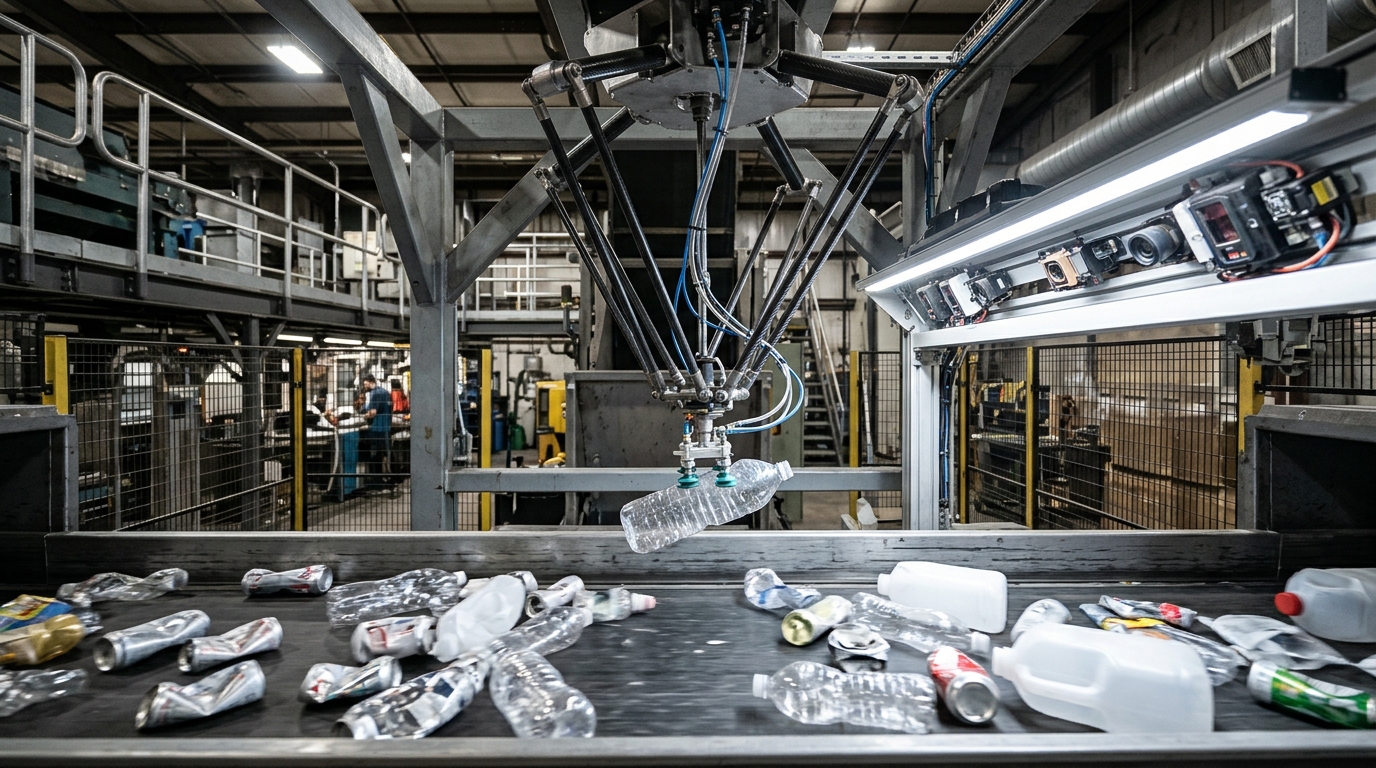
A transition toward a circular economy requires the high-quality recovery of materials from increasingly complex and heterogeneous waste streams, yet conventional automated sorting systems often struggle to deliver the differentiation needed for high-grade remanufacturing. In a research study published in the journal Autonomous Robots, investigators Konstantinos Kokkalis, Maria Koskinopoulou, Fotios K. Konstantinidis, Angelos Amditis, and Panayiotis Frangos introduce a real-time decision-making architecture termed value-aware robotic sorting, or VARS. Modern recycling facilities are heavily tasked with isolating pure material fractions from stochastic conveyor flows, where standard bulk separation methods relying on physical traits like shape, particle density, or magnetism fail to achieve clean separations. High-speed industrial robots equipped with advanced vision algorithms have emerged as a promising solution to this challenge, but existing task planning mechanisms routinely prioritize raw operational throughput over the actual economic or environmental worth of the targeted objects. By reframing the sorting challenge from a basic pick-and-place frequency optimization into an expected utility maximization problem, the newly developed framework demonstrates how robotic manipulators can selectively bypass low-value or ambiguous items to preserve output stream purity and elevate overall revenue.
Standard planning algorithms governing contemporary robotic sorters have long adhered to a throughput-first paradigm that treats every detectable object on a moving conveyor belt as an equally valuable target. In fast-paced industrial recycling, however, waste streams exhibit massive variance in commercial value, unit mass, and perceptual classification confidence. Under typical heavy loading regimes, far more items enter the operational workspace than a mechanical manipulator can physically intercept and sort. When a robotic planning system focuses strictly on maximizing pick-and-place counts per unit of time, it frequently expends critical cycle time pursuing low-impact or ambiguously identified objects while allowing high-value, easily recoverable materials to slip past downstream boundaries. This operational misallocation leads directly to downcycling, a condition where recovered batches contain excessive cross-contamination and fail to meet the demanding technical standards required for circular manufacturing applications.
To overcome the fundamental inefficiencies of throughput-driven sorting, the researchers formulated high-speed robotic picking as an Orienteering Problem with Time Windows, an established combinatorial optimization model historically classified as NP-hard. In classical orienteering, an agent must collect the highest possible score by visiting a chosen subset of destination nodes while adhering to a strict travel budget. The authors adapted this formulation to dynamic conveyor environments by integrating time-dependent execution windows and an uncertainty-aware economic utility model directly into the real-time robotic control loop. Because the conveyor moves continuously, every detected waste item remains reachable only during a strictly bounded temporal interval defined between its arrival across the upstream workspace border and its exit across the downstream limit. Unlike classical static orienteering where a traveling agent can wait outside a station until an arrival window opens, continuous conveyor sorting links object reachability directly to belt displacement, making waiting periods physically meaningless and establishing temporal feasibility as the primary operational constraint.
The mathematical formalization of the VARS architecture accounts for hardware actuation dynamics and sequence-dependent travel durations between successive sorting tasks. In the experimental system, a full pick-and-place cycle consists of an initial pickup phase composed of four dedicated kinematic motions followed by a fifth motion dedicated to placing the object into a designated destination bin. The pickup phase explicitly integrates hardware actuation latencies, including a constant tracking window during which the mechanical gripper actuates to capture the moving target. Once an object is grasped, the subsequent placement phase is free from conveyor-induced temporal deadlines because the object is already secured, though its duration varies based on the relative spatial location of the target bin. The sequence-dependent processing time between consecutively picked objects captures the necessary movement from the previous bin drop-off pose to the next intercept pose, enabling sequential scheduling that reflects actual physical constraints while safely treating transit times as time-invariant due to manipulator speeds operating roughly an order of magnitude faster than the conveyor.
A central feature of the framework is its explicit handling of classification uncertainty and asymmetric contamination penalties through a comprehensive expected utility formulation. For every incoming item, an integrated sensing system generates a posterior probability distribution across potential material classes. The sorting cell maps these classes to physical destination bins through a structured utility matrix whose diagonal entries quantify positive economic returns for correct sorting, while off-diagonal entries impose asymmetric penalties for misplacement. These mathematical penalties directly reflect industrial realities where certain material contaminants, such as non-target polymers entering a high-purity recycling batch, inflict substantially greater operational and economic damage than others. By multiplying the class posterior probabilities against the utility matrix, the system calculates a scalar expected utility for each candidate object, allowing the planner to systematically weigh immediate sorting gains against the prospective downstream costs of misclassification.
To execute real-time decision-making across varied computational budgets, the research team developed and evaluated both greedy dispatching rules and sequence-level combinatorial planning algorithms. Traditional throughput-oriented dispatching baselines—such as First-In First-Out, Shortest Processing Time, and Shortest Distance—were evaluated alongside novel value-aware dispatching rules. The Maximum Value heuristic greedily selects the item offering the highest anticipated utility, whereas the Value-to-Time Ratio rule prioritizes targets that maximize expected utility divided by cycle duration. To achieve optimal sequence-level coordination, the framework incorporates an exact Mixed-Integer Programming Scheduling solver alongside an adapted Iterated Local Search metaheuristic. The Iterated Local Search metaheuristic alternates between constructive greedy insertion steps that respect time-window limits and shake-step perturbations designed to escape local optima, propagating allowable slack delays along planned paths to deliver near-optimal multi-object sequences within sub-second execution budgets.
Validation of the decision-making framework was conducted through a two-stage methodology combining an extensive discrete-event simulation digital twin with physical testing on an industrial Delta robot. The digital twin, implemented via the Salabim discrete-event simulation library, modeled stochastic waste streams using exponential interarrival distributions across thousands of Monte Carlo runs to benchmark algorithmic behavior under controlled, repeatable conditions. The physical sorting cell integrated a high-speed Delta manipulator operating over a conveyor running at zero point five meters per second, equipped with dual-modality sensing that coupled an RGB-D camera with a hyperspectral sensor. The RGB-D camera performed object detection, spatial segmentation, and three-dimensional pose estimation, while the hyperspectral sensor analyzed identified regions of interest to determine material class posteriors. Because the camera field of view did not overlap with the manipulator workspace, an indirect hand-eye calibration procedure tracking conveyor encoder counts was implemented using the Kabsch algorithm to establish rigid spatial transformations between coordinate frames.
The benchmark use case evaluated sorting a five-class polymer stream composed of thirty percent polypropylene, twenty percent polystyrene, twenty-five percent polyethylene terephthalate, fifteen percent high-density polyethylene, and ten percent non-target residual materials into four dedicated collection bins. Simulation trials examined four distinct object arrival rates ranging from an underloaded state of zero point five items per second up to heavily overloaded conditions of four items per second. In the underloaded regime where the robot could reach nearly all incoming items, performance differences across algorithms remained minor. However, as arrival rates increased and the sorting cell entered an overloaded state where items were routinely missed, the value-aware algorithms maintained significantly higher normalized recovered utility and output stream purity than throughput-oriented baselines. Furthermore, the sub-optimality gap between the approximate Iterated Local Search sequences and the exact mathematical programming solutions remained consistently below one percent across all arrival rates, demonstrating the computational tractability of the metaheuristic approach.
To evaluate system resilience against perception degradation, the investigators introduced synthetic confusion matrices that reduced classification confidence, specifically perturbing polyethylene terephthalate identification by introducing substantial ambiguity with less valuable polystyrene. Under baseline perception with high classification confidence, all algorithms achieved clean separations, but when presented with ambiguous class distributions, value-aware planners demonstrated marked superiority in preserving output stream purity. By factoring asymmetric contamination costs into target selection, the value-aware planner intentionally declined to grasp ambiguous items that presented an unacceptable risk of cross-contaminating sorted bins. Additionally, in the most severe overloading scenario with an arrival rate of four items per second, the Iterated Local Search metaheuristic actually outperformed the exact integer programming solver; the exact solver required strict horizon truncation to avoid exponential runtime delays, whereas the metaheuristic effectively optimized over a broader operational window within equivalent latency constraints.
Physical trials conducted on the industrial Delta robotic cell verified the transferability of simulation trends to real hardware without significant performance degradation. Operating with sixty municipal waste samples of clean, unoccluded plastic items distributed across the four target polymer types, the system was tested under arrival rates of one and two items per second. Across comparative trials, the difference in normalized recovered utility between simulated digital twin sequences and physical robot execution remained below one percent in nearly every evaluated setting. Qualitative grasping assessments illustrated a pronounced contrast in operational behavior: while standard Shortest Processing Time dispatching blindly captured low-yield polystyrene items to maintain rapid picking tempos, the value-aware Iterated Local Search algorithm deliberately bypassed lower-value items to conserve cycle time for high-value targets appearing downstream. The authors noted that while intentionally letting items pass unpicked decreases total handled mass, this controlled trade-off is critical in oversubscribed industrial environments to satisfy strict commercial purity standards and prevent downcycling.
The investigators also identified several operational boundaries and outlined essential avenues for subsequent engineering developments. The current formulation assumes relatively unclustered material streams where three-dimensional localization can accurately target upper objects during mild planar overlaps, but it does not account for heavily entangled, dense waste piles where extracting an item alters the poses of underlying materials. Adapting the control architecture to cluttered three-dimensional environments will necessitate continuous object tracking and the integration of dynamic grasp-success probabilities into the objective function. Furthermore, the physical validation examined clean, single-material plastics, leaving composite or stained materials as an open perception-layer challenge. Future iterations of the framework are slated to incorporate inferred volume and mass directly into dynamic utility calculations alongside periodic market pricing updates, while expanding the underlying optimization model to accommodate cooperative multi-robot sorting teams.
Subject of Research: Value-aware robotic waste sorting via combinatorial optimization and orienteering with time windows
Article Title: VARS: value-aware robotic sorting of waste streams via orienteering with time windows
Article References: Kokkalis, K., Koskinopoulou, M., Konstantinidis, F. K., Amditis, A., & Frangos, P. (2026). VARS: value-aware robotic sorting of waste streams via orienteering with time windows. Autonomous Robots, 50(4), Article 47. https://doi.org/10.1007/s10514-026-10272-5
Image Credits: AI Generated
DOI: 10.1007/s10514-026-10272-5
Keywords: Robotic Sorting, Waste Management, Orienteering Problem, Combinatorial Optimization, Recycling Technology, Industrial Robotics, Computer Vision, Hyperspectral Imaging, VARS, value-aware, robotic, sorting
News Source: Denise Maddox. (November 6, 2026). Robotic Waste Sorting Framework Maximizes Economic Value and Recycled Material Purity. Scienmag.