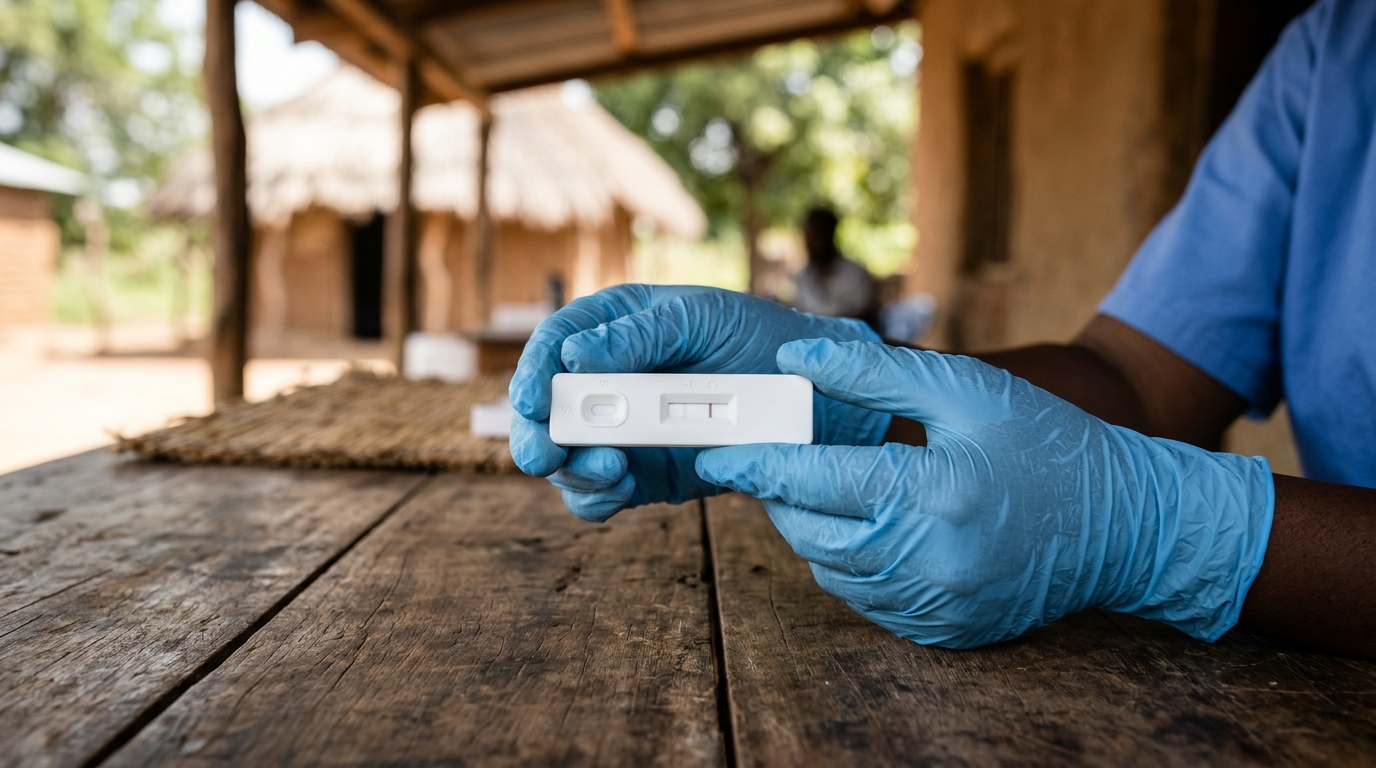
Human African trypanosomiasis, better known as sleeping sickness, has retreated dramatically over the past two decades thanks to sustained vector control, active case detection and improved treatments. Ten countries, including Benin, Chad, Côte d’Ivoire, Equatorial Guinea, Ghana, Guinea, Togo and Uganda for the gambiense form, and Kenya and Rwanda for the rhodesiense form, have already achieved elimination of the disease as a public health problem. Yet a new review published in Frontiers in Parasitology argues that the endgame is precisely where diagnosis becomes hardest, and that a wave of CRISPR-based tools may finally close the gap between screening and treatment in the world’s most remote endemic areas.
The review, written by researchers at the Institut Pasteur in Paris and the Institut Pasteur of Guinea, summarizes the main diagnostic approaches currently used to detect African trypanosomes in both humans and animals. The parasites concerned, Trypanosoma brucei gambiense and Trypanosoma brucei rhodesiense, are transmitted by tsetse flies and cause a life-threatening vector-borne disease. Gambiense human African trypanosomiasis, which accounts for more than 94 percent of reported cases, is a chronic infection marked by low parasitaemia, while the rhodesiense form is usually acute, associated with higher parasite loads and a predominantly zoonotic transmission cycle. The Democratic Republic of the Congo carries the highest disease burden.
As reported cases decline, the review notes, infections increasingly present with such low parasite levels that conventional tools struggle to detect them. The authors also flag a growing concern for elimination programmes: the potential role of asymptomatic infection in sustaining transmission. Trypanosoma brucei gambiense has been detected in the extravascular dermis of seropositive people whose infections were never confirmed by standard parasitological tests, raising the possibility that the skin acts as a reservoir that could hamper transmission control. The contribution of domestic and wild animals to gambiense epidemiology remains unclear, though some evidence suggests their potential involvement in parasite cycles, which supports a One Health approach to surveillance.
Current diagnostic strategies rest on three pillars: serology, parasitology and molecular testing, and each has well-documented weaknesses. Serological tests cannot reliably distinguish old infections from active ones. Conventional parasitological methods, which require direct observation of living parasites in blood or other fluids, lack sensitivity when parasitaemia is low or fluctuating, with a detection limit around 10,000 parasites per millilitre. Molecular techniques such as PCR offer superior sensitivity and species discrimination but demand laboratory infrastructure that is difficult to maintain in resource-limited settings. Confirmatory diagnosis still largely depends on specialized reference laboratories rather than point-of-care testing, creating logistical barriers to timely case confirmation.
Serology remains the entry point for most screening. The card agglutination test for trypanosomiasis, or CATT, is the gold standard for initial gambiense diagnosis, combining high sensitivity of roughly 87 to 98 percent with excellent specificity of about 98 percent and low cost, making it effective for mass screening. However, it requires a cold chain, an agitator and a power supply, and its multi-dose packaging suits central facilities better than peripheral health centres where patient numbers are low. Rapid diagnostic tests have pushed screening into communities, needing only finger-prick blood and no equipment, but their specificity remains suboptimal compared with CATT, risking false positives in low-prevalence settings. Enzyme-linked immunosorbent assays and the immune trypanolysis test, which is highly specific but requires fresh rodent serum, remain laboratory-bound.
Parasitological confirmation is still compulsory after a positive serological test because it provides direct evidence of active infection. Concentration techniques improve detection: the micro-haematocrit centrifugation technique, buffy coat examination and the mini anion-exchange centrifugation technique can all concentrate parasites from blood. The mini anion-exchange method is the most sensitive for gambiense infection, with a detection limit of 10 to 30 trypanosomes per millilitre and up to 96 percent sensitivity in its buffy coat version. But these methods need centrifuges, electricity and trained personnel, which limits their use precisely where the disease persists.
Molecular diagnostics have transformed detection and characterization of infections by targeting parasite nucleic acids. PCR-based techniques targeting multicopy markers such as TBR satellite DNA, 18S rRNA or spliced leader RNA provide group-level detection, while single-copy genes such as SRA and TgsGP distinguish the rhodesiense and gambiense subspecies, though their low copy number reduces analytical sensitivity. In cattle, species-specific 7SL sRNA reverse-transcription quantitative PCR assays showed high accuracy for detecting active Trypanosoma brucei, T. congolense and T. vivax infections, with sensitivities of 93 to 100 percent and specificities of 82 to 100 percent. Isothermal amplification methods such as loop-mediated isothermal amplification, or LAMP, achieve performance comparable to PCR without a thermocycler, and recombinase polymerase amplification has been adapted for Trypanosoma evansi detection with results within 15 minutes.
The review’s most forward-looking section concerns CRISPR-derived diagnostics, particularly the SHERLOCK platform, which stands for Specific High-Sensitivity Enzymatic Reporter UnLOCKing. SHERLOCK combines isothermal amplification with CRISPR-mediated target recognition to reach attomolar analytical sensitivity and single-nucleotide specificity. Applied to sleeping sickness through the SHERLOCK4HAT platform, assays targeting the SRA gene of T. b. rhodesiense and the TgsGP gene of T. b. gambiense both showed 100 percent analytical specificity and a 10- to 100-fold improvement in analytical sensitivity compared with species-specific PCR and qPCR assays. The tests work on whole blood, buffy coat and dried blood spots, and are compatible with lateral-flow readout, opening the door to point-of-care use.
Real-world testing has revealed important caveats. When evaluated on archived buffy-coat samples stored for prolonged periods without preservative buffer, clinical sensitivity dropped: the TgsGP assay fell to 26.5 percent, likely because RNA degraded disproportionately in single-copy targets, and a parallel qPCR analysis found 53 percent of confirmed gambiense samples negative. A pan-Trypanozoon SHERLOCK assay targeting the multicopy 18S ribosomal RNA gene improved analytical sensitivity tenfold, detecting parasitaemia below 10 parasites per millilitre, and can identify both human-infective species with the same approach. For animal African trypanosomiasis, the SHERLOCK4AAT toolbox adds species-specific assays for T. congolense, T. vivax, T. theileri, T. simiae and T. suis with 100 percent analytical specificity and 98 to 100 percent analytical sensitivity, and identified mixed Trypanozoon and T. congolense infections in pigs from Côte d’Ivoire and Guinea. Estimated cost is approximately 2.50 euros per test, excluding sample preparation.
The authors argue that SHERLOCK could become pivotal as treatment simplifies. With single-dose oral acoziborole anticipated, a rapid, highly sensitive molecular confirmatory test at the point of care would enable streamlined test-and-treat pathways in peripheral health facilities, reducing referrals to specialized laboratories. The platform’s single-nucleotide discrimination also allows detection of resistance-conferring mutations, including the AQP2/3(814) chimera linked to melarsoprol and pentamidine resistance and a CPSF3 variant conferring acoziborole resistance in vitro. Before large-scale deployment, however, field-compatible nucleic acid extraction, lyophilized reagents, optimized one-pot reactions and demonstrated reagent stability without a cold chain are still needed. The review concludes that sustainable control will depend not only on more sensitive tools but on their effective integration into health systems, with future efforts focused on validating approaches across sample types and field settings while meeting REASSURED criteria for point-of-care implementation.
Subject of Research: Diagnostic approaches for human and animal African trypanosomiases
Article Title: Advances and challenges in the diagnosis of human and animal african trypanosomiases
Article References: Pérez-Antón, E., Camara, A., Rotureau, B., & Glover, L. (2026). Advances and challenges in the diagnosis of human and animal african trypanosomiases. Frontiers in Parasitology, 5, Article 1993796. https://doi.org/10.3389/fpara.2026.1993796
Image Credits: AI Generated
DOI: 10.3389/fpara.2026.1993796
Keywords: sleeping sickness, African trypanosomiasis, SHERLOCK, CRISPR diagnostics, point-of-care testing, Trypanosoma brucei, serology, molecular diagnostics, animal African trypanosomiasis, disease elimination, Advances, challenges
News Source: Juliet Wilcox. (November 6, 2026). CRISPR Test Promises Point-of-Care Diagnosis for Sleeping Sickness. Scienmag.