• HOME
  • NEWS
  • EXPLORE
    • CAREER
      • Companies
      • Jobs
    • EVENTS
    • iGEM
      • News
      • Team
    • PHOTOS
    • VIDEO
    • WIKI
  • BLOG
  • COMMUNITY
    • FACEBOOK
    • INSTAGRAM
    • TWITTER
Friday, November 6, 2026
BIOENGINEER.ORG
No Result
View All Result
  • Login
  • HOME
  • NEWS
  • EXPLORE
    • CAREER
      • Companies
      • Jobs
        • Lecturer
        • PhD Studentship
        • Postdoc
        • Research Assistant
    • EVENTS
    • iGEM
      • News
      • Team
    • PHOTOS
    • VIDEO
    • WIKI
  • BLOG
  • COMMUNITY
    • FACEBOOK
    • INSTAGRAM
    • TWITTER
No Result
View All Result
Bioengineer.org
No Result
View All Result
Home NEWS Science News Technology

Atmospheric Gravity Waves Triggered by Wind Turbines Alter Flows and Power

by
November 6, 2026
in Technology
Reading Time: 2 mins read
0
Atmospheric Gravity Waves Triggered by Wind Turbines Alter Flows and Power

Atmospheric Gravity Waves Triggered by Wind Turbines Alter Flows and Power

Share on FacebookShare on TwitterShare on LinkedinShare on RedditShare on Telegram

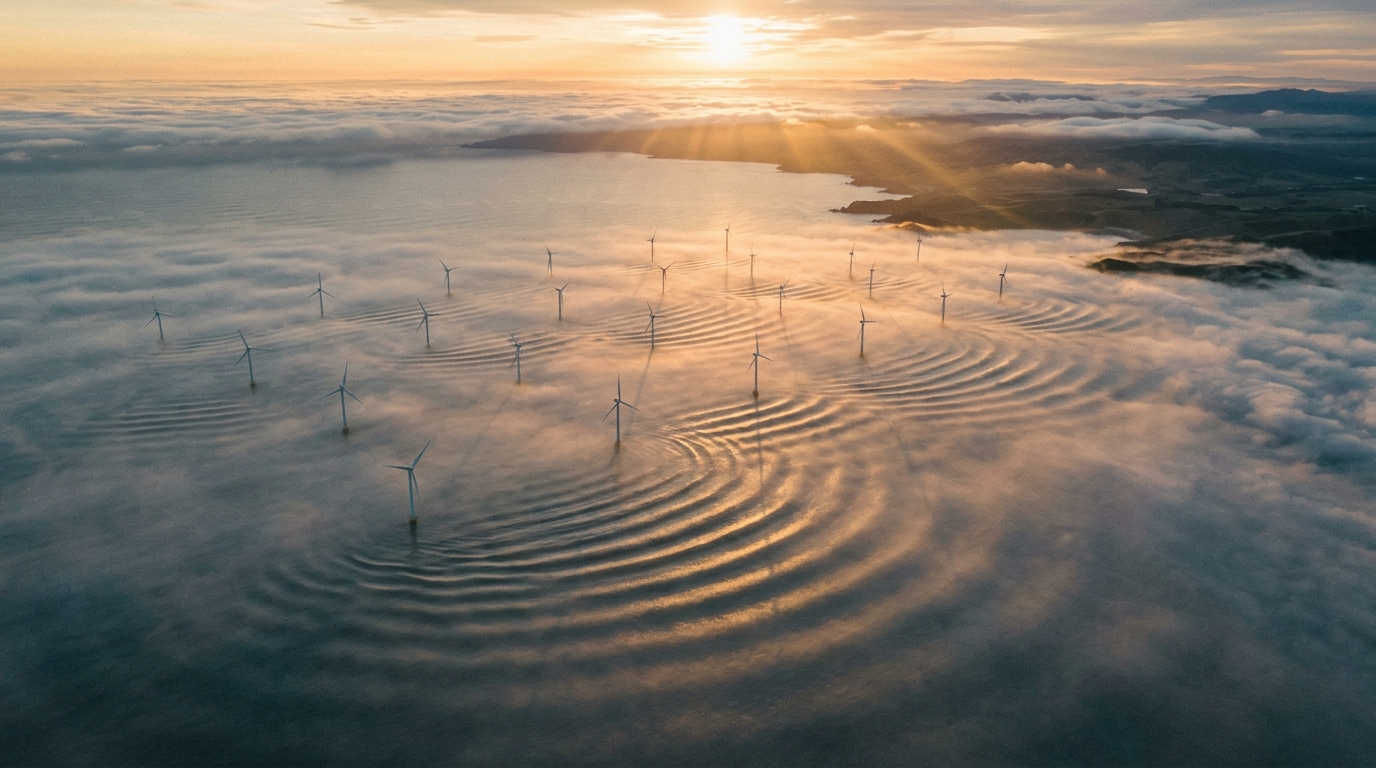
Atmospheric gravity waves induced by modern wind turbines can alter local flow fields, inducing an upstream flow deceleration that reduces power generation alongside distinct sinusoidal variations in turbine wakes. In a preprint submitted to the journal Wind Energy Science, researchers Timothy Rafferty and Christopher Vogel from the Department of Engineering Science at the University of Oxford investigated these turbine-scale interactions through computational fluid dynamics simulations, demonstrating that gravity wave effects can be effectively captured using single-turbine models.

As modern commercial wind turbines reach greater heights, their operation increasingly interacts with geostrophic layers of the atmosphere, triggering atmospheric gravity waves. Despite these interactions, scientific understanding regarding how such waves influence flows at the turbine scale has remained limited. To evaluate this behavior, the authors conducted Large Eddy Simulations incorporating an actuator line model to represent the wind turbine, tracking how turbine-generated gravity waves alter wake dynamics, structural blade loading, and overall power production.

The computational simulations demonstrated that gravity waves create an atypical flow field behind the turbine, characterized by sinusoidal variations in wake width in both horizontal and vertical directions. The wake recovery was observed to be non-monotonic, exhibiting an inverse relationship between peaks and troughs in velocity deficit and the atmospheric waves aloft. An evaluation of both turbulent and mean energy budget terms within the turbine wake indicated that the gravity waves had relatively little impact on the instantaneous flow field.

The researchers also investigated the role of turbine lateral spacing by adjusting the computational domain width. The strength of the triggered waves and the resulting wake variations were found to be negatively correlated with lateral spacing. Furthermore, a wave-induced upstream deceleration occurred in all evaluated cases, with the magnitude of this deceleration decreasing alongside wave strength as both parameters asymptotically approached non-zero values with increased lateral spacing.

By establishing that gravity waves can be initiated in a model representing only a single turbine, the study outlines a lower-cost computational methodology for future investigations. The findings also suggest that relatively small clusters of turbines may trigger atmospheric gravity waves, contrasting with earlier research that focused primarily on large wind farms containing 100 or more turbines. Additionally, simulations comparing turbulent and uniform inflows showed consistent agreement, confirming that the gravity waves and their broader flow effects remain relatively independent of instantaneous variations at the turbine scale.

Subject of Research: Atmospheric gravity wave impacts on wind turbine flows

Article Title: The Impact of Atmospheric Gravity Waves on Turbine Scale Flows

Article References: Rafferty, T., & Vogel, C. (2026). The Impact of Atmospheric Gravity Waves on Turbine Scale Flows. https://doi.org/10.5194/wes-2026-208

Image Credits: AI Generated

DOI: 10.5194/wes-2026-208

Keywords: atmospheric gravity waves, wind turbines, large eddy simulations, wake dynamics, wind energy, actuator line model, fluid dynamics, power production, Impact, Atmospheric, Gravity, Waves

News Source: Russell Cooper. (November 6, 2026). Atmospheric Gravity Waves Triggered by Wind Turbines Alter Flows and Power. Scienmag.


Tags: actuator line modelAtmosphericatmospheric gravity wavesfluid dynamicsgravityimpactlarge eddy simulationspower productionwake dynamicswaveswind energywind turbines
Share12Tweet7Share2ShareShareShare1

Related Posts

Deep learning network strips JPEG artifacts from ovarian ultrasound images

Deep learning network strips JPEG artifacts from ovarian ultrasound images

November 6, 2026
New Method Turns High-Variability Data Into Parameter Distributions Without Inverting Models

New Method Turns High-Variability Data Into Parameter Distributions Without Inverting Models

November 6, 2026

Robots Reading Feelings: Review Reveals Lab Gains Fade Fast in Real-World Emotion Recognition

November 6, 2026

StatMatch: Statistical Matching Challenges SMOTE for Imbalanced Data

November 6, 2026

POPULAR NEWS

  • Engineered Interfaces and Module Design Drive Advanced Mixed-Matrix Hydrogen Separation

    Engineered Interfaces and Module Design Drive Advanced Mixed-Matrix Hydrogen Separation

    29 shares
    Share 12 Tweet 7
  • Trust, relationships and funding gaps shape mental health implementation across England

    29 shares
    Share 12 Tweet 7
  • Honey Bee Colonies Are Superorganisms, and Their Microbiota Depends on How You Sequence It

    29 shares
    Share 12 Tweet 7
  • Umbrella Review Finds Digital Health Effective but Not Superior to Standard Therapies

    29 shares
    Share 12 Tweet 7

About

We bring you the latest biotechnology news from best research centers and universities around the world. Check our website.

Follow us

Recent News

Deep learning network strips JPEG artifacts from ovarian ultrasound images

How HPV rewires sugar chemistry in cervical cancer cells

Rare Lacrimal Gland Solitary Fibrous Tumour Features Floret-Type Giant Cells

Subscribe to Blog via Email

Enter your email address to subscribe to this blog and receive notifications of new posts by email.

Join 86 other subscribers
  • Contact Us

Bioengineer.org © Copyright 2023 All Rights Reserved.

Welcome Back!

Login to your account below

Forgotten Password?

Retrieve your password

Please enter your username or email address to reset your password.

Log In
No Result
View All Result
  • Homepages
    • Home Page 1
    • Home Page 2
  • News
  • National
  • Business
  • Health
  • Lifestyle
  • Science

Bioengineer.org © Copyright 2023 All Rights Reserved.