• HOME
  • NEWS
  • EXPLORE
    • CAREER
      • Companies
      • Jobs
    • EVENTS
    • iGEM
      • News
      • Team
    • PHOTOS
    • VIDEO
    • WIKI
  • BLOG
  • COMMUNITY
    • FACEBOOK
    • INSTAGRAM
    • TWITTER
Friday, November 6, 2026
BIOENGINEER.ORG
No Result
View All Result
  • Login
  • HOME
  • NEWS
  • EXPLORE
    • CAREER
      • Companies
      • Jobs
        • Lecturer
        • PhD Studentship
        • Postdoc
        • Research Assistant
    • EVENTS
    • iGEM
      • News
      • Team
    • PHOTOS
    • VIDEO
    • WIKI
  • BLOG
  • COMMUNITY
    • FACEBOOK
    • INSTAGRAM
    • TWITTER
No Result
View All Result
Bioengineer.org
No Result
View All Result
Home NEWS Science News Health

Rare Lacrimal Gland Solitary Fibrous Tumour Features Floret-Type Giant Cells

by
November 6, 2026
in Health
Reading Time: 2 mins read
0
Rare Lacrimal Gland Solitary Fibrous Tumour Features Floret-Type Giant Cells

Rare Lacrimal Gland Solitary Fibrous Tumour Features Floret-Type Giant Cells

Share on FacebookShare on TwitterShare on LinkedinShare on RedditShare on Telegram

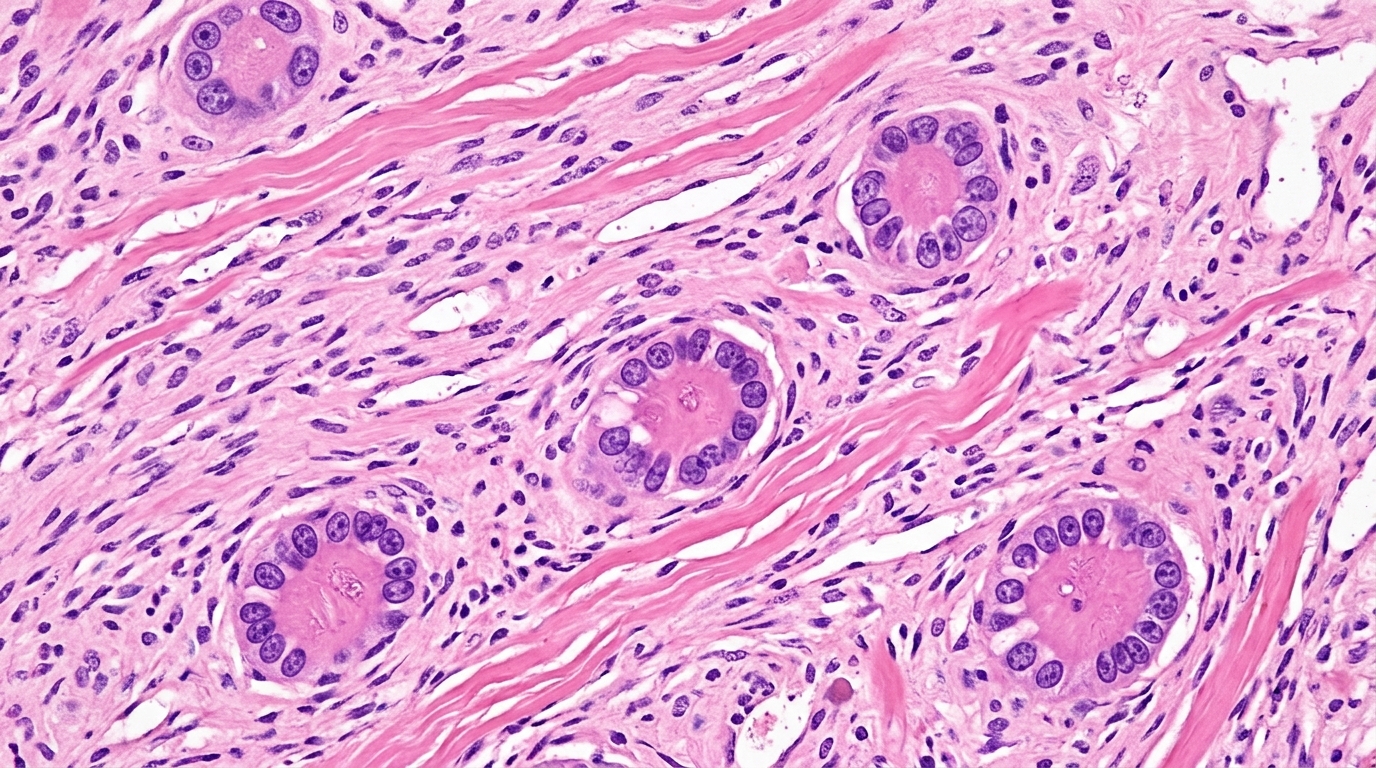
Physicians have reported a rare case of a solitary fibrous tumour arising in the lacrimal gland of a 52-year-old Egyptian man, marked by the presence of floret-type multinucleated giant cells and diffuse nuclear STAT6 expression. The patient, a non-smoker, presented with a five-month history of an enlarging left lacrimal swelling, accompanied by proptosis and mildly reduced visual acuity in the left eye measured at 6/9. Solitary fibrous tumours are rare fibroblastic neoplasms, and their involvement of the lacrimal gland represents an uncommon clinical occurrence.

Diagnostic evaluation using non-contrast orbital computed tomography revealed a well-defined lesion measuring 9 by 12 millimetres without evidence of bone erosion or local tissue invasion. Clinicians proceeded with complete surgical excision of the mass. Following the procedure, histopathological examination identified a patternless spindle-cell tumour exhibiting characteristic staghorn vasculature, low mitotic activity, and distinctive floret-type multinucleated giant cells, while showing no signs of necrosis, lymphovascular invasion, or perineural invasion.

Immunohistochemical analysis confirmed that the tumour cells expressed CD34, CD99, BCL2, and diffuse nuclear STAT6, supporting the formal diagnosis of a solitary fibrous tumour with negative surgical margins. At a three-month follow-up evaluation, the patient demonstrated full recovery of visual function with no reported diplopia. The report documents a small, completely excised, low-risk example of lacrimal gland solitary fibrous tumour, noting that recognizing this distinct floret-type morphology alongside STAT6 staining is essential because it can overlap with other giant-cell-rich spindle-cell lesions, with complete excision and risk-adapted surveillance remaining key management principles.

Subject of Research: Lacrimal gland solitary fibrous tumour with floret-type giant cells

Article Title: STAT6-positive solitary fibrous tumour of the lacrimal gland with floret-type giant cells: a rare case report

Article References: Sonbol, A., Tarek, R., Elzaafarany, M., Abdelaziz, R., Elbeah, Z., Khader, R., Bdair, M., Nazzal, L., & Elhakim, E. (2026). STAT6-positive solitary fibrous tumour of the lacrimal gland with floret-type giant cells: a rare case report. BMC Ophthalmology, 26(1), Article 731. https://doi.org/10.1186/s12886-026-05525-x

Image Credits: AI Generated

DOI: 10.1186/s12886-026-05525-x

Keywords: solitary fibrous tumour, lacrimal gland, STAT6, floret-type giant cells, orbital neoplasm, ophthalmic pathology, CD34, surgical excision, STAT6-positive, solitary, fibrous, tumour

News Source: Nathaniel Bowman. (November 6, 2026). Rare Lacrimal Gland Solitary Fibrous Tumour Features Floret-Type Giant Cells. Scienmag.

Tags: CD34fibrousfloret-type giant cellslacrimal glandophthalmic pathologyorbital neoplasmSolitarysolitary fibrous tumourSTAT6STAT6-positivesurgical excisiontumour
Share12Tweet7Share2ShareShareShare1

Related Posts

Thyme Extract Regulates Ovarian Gene Expression in Experimental Polycystic Ovary Syndrome

Thyme Extract Regulates Ovarian Gene Expression in Experimental Polycystic Ovary Syndrome

November 6, 2026
Invasive Pulmonary Aspergillosis Struck Nearly 12% of ICU Patients in the COVID-19 Era, Global Meta-Analysis Finds

Invasive Pulmonary Aspergillosis Struck Nearly 12% of ICU Patients in the COVID-19 Era, Global Meta-Analysis Finds

November 6, 2026

Severe Arterial Stenosis Increases Infarction Risk in Adult Moyamoya Revascularization

November 6, 2026

New mouse model of metastatic prostate cancer opens door to combination immunotherapy studies

November 6, 2026

POPULAR NEWS

  • Passively aerated constructed wetlands turn piggery wastewater into a low-cost success story

    Passively aerated constructed wetlands turn piggery wastewater into a low-cost success story

    29 shares
    Share 12 Tweet 7
  • Prior Head Injury Strongly Predicts New Mental Disorders After Mild Traumatic Brain Injury

    29 shares
    Share 12 Tweet 7
  • Polyaniline-Functionalized Magnetic Activated Carbon Efficiently Removes Methyl Orange From Water

    29 shares
    Share 12 Tweet 7
  • Plant Metabolite Brachycerine Shields Human Skin Samples From UV Damage

    29 shares
    Share 12 Tweet 7

About

We bring you the latest biotechnology news from best research centers and universities around the world. Check our website.

Follow us

Recent News

Thyme Extract Regulates Ovarian Gene Expression in Experimental Polycystic Ovary Syndrome

Invasive Pulmonary Aspergillosis Struck Nearly 12% of ICU Patients in the COVID-19 Era, Global Meta-Analysis Finds

Severe Arterial Stenosis Increases Infarction Risk in Adult Moyamoya Revascularization

Subscribe to Blog via Email

Enter your email address to subscribe to this blog and receive notifications of new posts by email.

Join 86 other subscribers
  • Contact Us

Bioengineer.org © Copyright 2023 All Rights Reserved.

Welcome Back!

Login to your account below

Forgotten Password?

Retrieve your password

Please enter your username or email address to reset your password.

Log In
No Result
View All Result
  • Homepages
    • Home Page 1
    • Home Page 2
  • News
  • National
  • Business
  • Health
  • Lifestyle
  • Science

Bioengineer.org © Copyright 2023 All Rights Reserved.