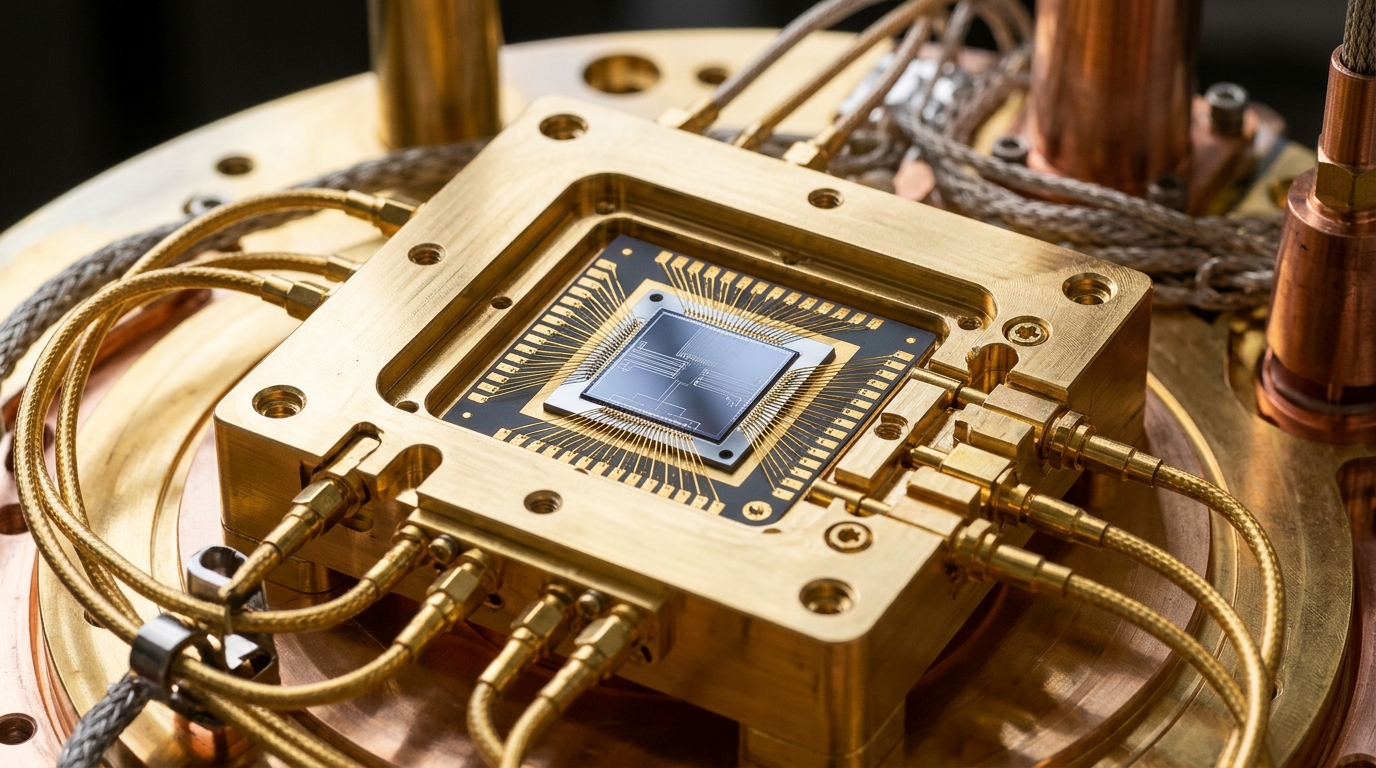
Employee attrition is one of the costliest operational risks a company faces, and it is notoriously hard to model: only about one worker in six leaves, so machine-learning systems that ignore that imbalance systematically miss the very people they are meant to flag. A new study in Quantum Machine Intelligence reports a careful test of whether a quantum-enhanced classifier can help, and its answer is deliberately measured. The researchers built a cost-sensitive, gate-based Quantum-enhanced Support Vector Machine, evaluated it by exact statevector simulation with a depolarizing sensitivity check, and framed the whole exercise as a feasibility indicator rather than a demonstration of quantum advantage.
The benchmark was the widely used IBM HR Analytics dataset of 1,470 employees, in which roughly 16 percent had left the company. Because false negatives and false positives carry very different business costs in attrition prediction, the team implemented class-dependent box constraints in the support vector machine, allowing the optimizer to penalize mistakes on the minority class of leavers more heavily. The quantum kernel itself was realized as a data re-uploading fidelity kernel, in which training data are encoded repeatedly into a small register of qubits and kernel values are read out from measurement fidelities. All metrics were computed from saved prediction vectors under repeated 5-times-3 nested stratified cross-validation, a design intended to keep hyperparameter tuning and performance estimation strictly separated.
On the fixed-kernel configuration that serves as the principal empirical model, the Q-SVM reached a minority-class recall of 0.571, which the authors describe as on a par with classical SVM kernels computed on the same features. Gradient-boosted trees led on threshold-free metrics such as ranking quality. In other words, the quantum kernel did not beat its classical rivals on this dataset, but it did not fall behind them either, an outcome the researchers treat as meaningful for a four-qubit simulated device running a genuinely quantum kernel construction.
One methodological finding from the comparison may prove more consequential than the quantum results themselves. Threshold metrics on imbalanced data, the authors show, are strongly sensitive to how the raw SVM margin is mapped onto a reported score. When two standard conventions were applied to identical fitted models, recall at a fixed cut differed by more than 0.5. That gap is large enough to overturn conclusions in any benchmark that reports a single convention, so the study reports every threshold metric under both conventions, a transparency practice the authors suggest should become standard in imbalanced-classification research.
A factorial ablation sharpened the attribution further. By crossing kernel type with cost weighting in a 2-by-2 design, the team localized the entire cost-sensitivity effect in the SVM decision layer rather than in the kernel: it is the class-dependent box constraints, not the quantum feature map, that drive the recall regime. This matters for anyone hoping that a quantum kernel will automatically rescue a skewed dataset; on this evidence, the leverage lies in the classical decision machinery wrapped around the kernel.
The study also identifies the encoding bandwidth as the dominant hyperparameter of the whole pipeline. When bandwidth was tuned inside the inner cross-validation loop, the Q-SVM’s AUC rose from 0.660 to 0.734 at four qubits, bringing it to statistical parity with a tuned classical radial basis function kernel at matched feature count. Yet a classical trigonometric map applied to the same encoding angles matched that performance in turn. The gain, the authors conclude, is attributable to the encoding rather than to the quantum feature space, a distinction that future benchmarking studies will need to respect if they are to claim quantum-specific benefits.
Alongside the empirical work, the paper states three assumption-bound theoretical results. The first is a convergence rate for cost-weighted kernel-target-alignment optimization under a weighted Polyak-Lojasiewicz condition. The second is a reproducing-kernel-Hilbert-space margin bound that holds only under an explicit disjoint-convex-hull separation hypothesis. The third is a high-probability Nyström error bound with a stratified minority-block scaling estimate in which all sampling factors are retained. Each result is stated with its conditions attached, and the authors are candid about how those conditions fare in practice.
The candor is warranted. A direct estimate of the RKHS convex-hull distance showed that the separation hypothesis required by the margin bound is not satisfied on this benchmark, so the theoretical guarantee does not apply to the data actually studied. The trainable kernel variant that the convergence theory describes was likewise evaluated separately from the fixed-kernel principal model, keeping the theory and the headline empirical result clearly distinguished. The paper adds calibration, decision-utility, and responsible-use analyses to round out the picture for practitioners weighing deployment.
What the study ultimately delivers is a template for honest quantum benchmarking on a real, imbalanced business problem: a cost-sensitive Q-SVM that matches classical kernels on minority-class recall, a demonstration that threshold conventions can swing reported recall by more than half a point, an ablation pinning cost sensitivity on the decision layer, and a bandwidth result crediting the encoding rather than the quantum feature space. The authors explicitly stop short of claiming quantum advantage. For now, the value lies in the methodology and the negative controls, which together show how quantum machine-learning claims should be tested before any of them is believed.
Subject of Research: Cost-sensitive quantum kernel methods for predicting employee attrition in imbalanced datasets
Article Title: Cost-sensitive quantum kernels for imbalanced attrition prediction
Article References: Sáez-Ortuño, L., Forgas-Coll, S., Huertas-García, R., & Ferrara, M. (2026). Cost-sensitive quantum kernels for imbalanced attrition prediction. Quantum Machine Intelligence, 8(2), Article 120. https://doi.org/10.1007/s42484-026-00464-8
Image Credits: AI Generated
DOI: 10.1007/s42484-026-00464-8
Keywords: quantum machine learning, quantum kernel, support vector machine, class imbalance, employee attrition, kernel-target alignment, encoding bandwidth, nested cross-validation, cost-sensitive learning, quantum advantage, benchmarking, HR analytics
News Source: Katie Riggs. (November 6, 2026). Quantum SVM matches classical kernels on imbalanced attrition data, study finds. Scienmag.