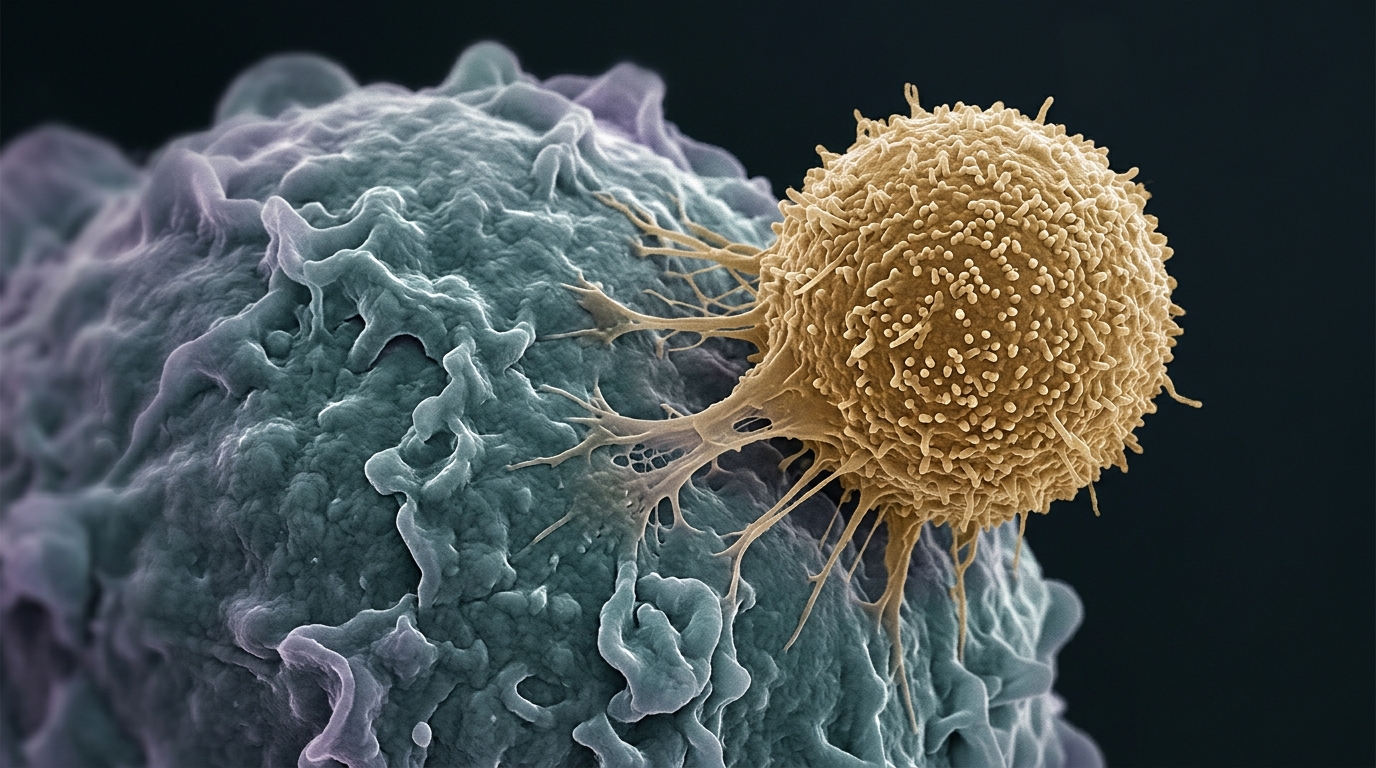
Leukemia, a blood cancer that begins in the bone marrow with the uncontrolled proliferation of immature white blood cells, remains a major global health concern. The work, published in the journal Discover Data, uses ordinary differential equations to capture the interplay between susceptible blood cells, infected cells, leukemic cells, immune cells, and cytokines, and evaluates the influence of CAR T-cell therapy and chemotherapy on leukemia progression.
The model divides the bloodstream into five compartments: susceptible blood cells replenished by sources such as the thymus, lymph nodes, and bone marrow; infected blood cells; leukemic or abnormal cells; immune cells such as white blood cells; and cytokine cells, with interleukin-6 production included as an additional factor to improve biological accuracy. Parameters describe natural death rates for each cell type, the rate at which cancer cells are eliminated through immune cell interactions, the decay of immune cells in the presence of leukemia, and the external infusion rate of T cells. Cancer cells are destroyed due to immune cell connections at a defined rate, and immune cells can proliferate naturally, especially during cancer recurrence. By setting the derivatives of all five compartments to zero, the researchers derived disease-free and endemic equilibrium points, the mathematical states that determine whether leukemia ultimately disappears or persists.
Stability analysis revealed a critical threshold governing treatment success. The model becomes stable when immune stimulation exceeds a certain level, and the endemic equilibrium point becomes locally asymptotically stable when the basic reproduction number is less than or equal to one, conditions under which it is also globally asymptotically stable. For the chemotherapy sub-model, which tracks effector cells, tumor cells, and drug concentration, the team identified conditions on the drug input rate under which specific equilibrium points are locally asymptotically stable. One equilibrium, in which both effector and tumor cell populations vanish while drug concentration settles at a fixed value, is stable when the drug input exceeds a threshold defined by the tumor growth rate, drug decay, and drug-induced tumor killing. A second equilibrium, with a residual tumor population, is stable under complementary conditions involving effector cell growth, natural decay, and tumor interaction rates.
Beyond stability, the researchers performed a bifurcation analysis using singularity theory to classify how the system’s steady states branch as parameters vary. They verified Sotomayor’s theorem, confirming that the model undergoes a transcritical bifurcation in which the cancer-free equilibrium and the cancer-endemic equilibrium intersect and exchange stability as the immune proliferation parameter passes through a critical value. The Jacobian matrix at the endemic equilibrium has a simple zero eigenvalue while all other eigenvalues are negative, creating a one-dimensional center manifold, and all required transversality and nondegeneracy conditions were satisfied. Further analysis confirmed that no Hopf bifurcation points exist in the chemotherapy model. Notably, bifurcation phenomena occur when the dimensionless drug intensity is below 4.31 times ten to the third, which the authors describe as consistent with clinical chemotherapy limits of up to 3500 milligrams per square meter per day.
Numerical simulations were run in Python using libraries such as SciPy, NumPy, and Matplotlib, with initial values of 149.079 susceptible blood cells, 1.082 infected cells, 1.597 leukemic cells, 252.26 immune cells, and 20 cytokine cells. The simulations spanned 350 days, roughly one year, and the team varied individual parameters to probe how the system responds. When the recruitment rate of cancer cells in the bloodstream grows, both infected and leukemic cell counts rise, indicating that cancer persists under those conditions. Changes in antigenicity or activation rates altered infected cell numbers over the 350-day period, while higher immune cell proliferation decreased cancer and infected cells but raised cytokine secretion, which the authors note may be harmful. Conversely, higher natural immune cell death allowed cancer to persist.
The chemotherapy simulations produced a nuanced picture.
The comparison with T-cell therapy was more decisive. Using conventional therapy parameters, the team found that external reinfusion of immune cells significantly reduces cancer and infected cell levels. T-cell infusion more effectively reduced tumor cells than chemotherapy alone, and the reduction was stronger and longer-lasting. Control strategies for self-protection and vaccination were designed to minimize infection while balancing treatment expenses, and numerical optimization computed co-state variables to minimize the Hamiltonian under the given constraints.
The study also acknowledges the clinical limitations of both approaches. CAR T-cell therapy, though highly specific, can cause severe side effects such as cytokine release syndrome and neurotoxicity, and its effectiveness is reduced when tumor cells change or lose the targeted antigen, leading to relapse. The therapy’s development follows five key steps: collecting T cells from the patient, genetically modifying them with chimeric antigen receptors to detect and attack tumor cells, expanding and stimulating them with cytokines outside the body, infusing the expanded cells back in a controlled dose, and carefully monitoring afterward to manage serious side effects. When CAR T-cell therapy is highly effective at destroying cancer cells, it can also cause severe and sometimes life-threatening complications. Chemotherapy, for its part, lacks selectivity, damaging healthy cells along with cancer cells, and its benefits decline over time due to drug resistance.
Despite major advances, obstacles such as adverse effects and limited efficacy in solid tumors persist, highlighting the value of mathematical modeling in optimizing treatment. The authors emphasize that their framework provides a strong theoretical basis for optimizing leukemia treatment through combined chemo-CAR T cell therapy, with future extensions planned for spatial effects, real-time calibration, and personalized applications.
For context, leukemia ranked as the fifth leading cause of cancer-related deaths among males and the sixth among females between 2009 and 2013. By 2016, nearly 2.3 million people worldwide were living with leukemia, accounting for roughly 353,500 deaths. In 2018, the United States was expected to record about 60,300 leukemia cases among approximately 1,695,850 total cancer cases, resulting in nearly 24,370 deaths.
Subject of Research: Mathematical modeling comparing the effectiveness of chemotherapy and CAR T-cell therapy for leukemia treatment
Article Title: Mathematical insights into the comparative effectiveness of chemotherapy and T-cell therapy of leukemia
Article References: Karim, R., Pk, M. A. B., & Dey, P. (2026). Mathematical insights into the comparative effectiveness of chemotherapy and T-cell therapy of leukemia. Discover Data, 4(1), Article 2. https://doi.org/10.1007/s44248-026-00102-5
Image Credits: AI Generated
DOI: 10.1007/s44248-026-00102-5
Keywords: leukemia, CAR T-cell therapy, chemotherapy, mathematical model, ordinary differential equations, stability analysis, bifurcation, optimal control, immune cells, cytokines, tumor dynamics, Discover Data
News Source: Nathaniel Bowman. (November 6, 2026). Math Model Shows CAR T-Cell Therapy Outperforms Chemotherapy Against Leukemia. Scienmag.