Every musical performance is, in one sense, unrepeatable. Even when a musician tunes an instrument carefully, controls string tension by regulating the air in a studio, and follows the written score exactly, the sounds that emerge never match the fundamental frequencies in hertz assigned to the notes on the page. A new study has now taken that familiar imperfection and subjected it to the tools of signal processing and network science, asking whether the resulting pattern of frequency fluctuations could serve as an acoustic fingerprint of a performer’s interpretive style. The answer, according to the researchers, is a cautious partial yes: the method works, but it cannot yet be tied conclusively to style.
The study, published in Frontiers in Signal Processing, was carried out by Igor Lugo of the Universidad Nacional Autónoma de México’s Regional Multidisciplinary Research Center, Martha G. Alatriste-Contreras of the university’s Faculty of Economics, and Rafael Sánchez-Guevara of its Faculty of Music. Their case study centered on fourteen audio recordings of compositions by three historical viola da gamba figures—Monsieur Demachy and Monsieur de Sainte-Colombe from the seventeenth century and Carl Friedrich Abel from the eighteenth—all performed by the same contemporary gambist. Holding both the performer and the instrument constant was a deliberate design choice, intended to strip away confounding variables and give the analysis its best chance of isolating anything resembling an interpretive signature.
The repertoire itself carries historical weight. Demachy and Sainte-Colombe lived in Paris during the second half of the seventeenth century and composed exclusively for the viola da gamba; Demachy published the first printed music for the instrument in France, while Sainte-Colombe’s legacy survives only in handwritten notebooks. Both were pioneers in adopting a seventh string on what had traditionally been a six-string instrument. Abel, considered the last prominent virtuoso of the viola da gamba, co-founded the Bach-Abel Concert Series in London with Johann Christian Bach. Seven of the pieces analyzed come from the Drexel Manuscript, an unpublished personal notebook of roughly twenty-five pieces for unaccompanied viola da gamba, several of which are unfinished or exceptionally brief and appear to have served as sketches or templates for improvisation.
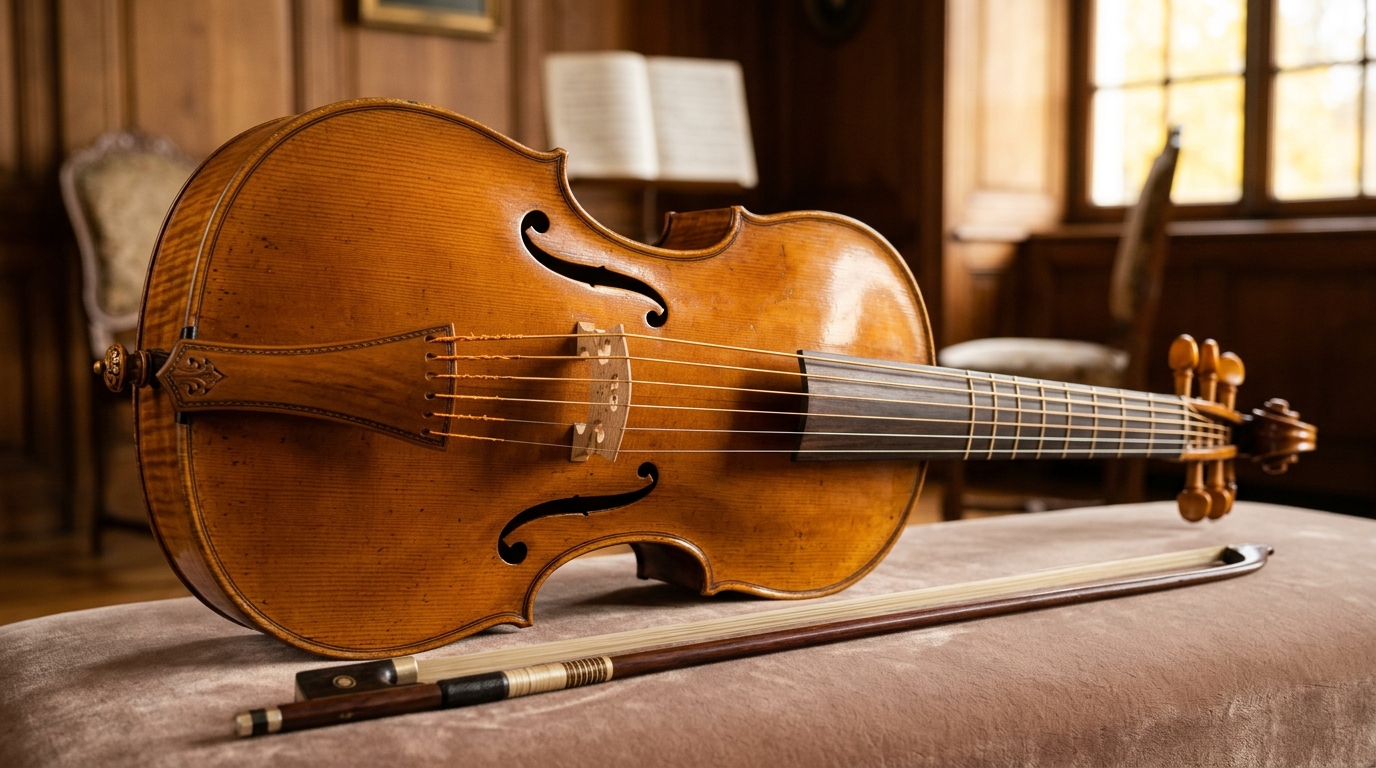
The instrument was also specified with care. For all recordings, the performer played a seven-string viola da gamba built by Francis Beaulieu in Montreal in 2012, a replica of an original 1683 instrument by Michel Colichon, who worked in Paris alongside Demachy and Sainte-Colombe. The original, now preserved in the Musée de la Musique in Paris, is the oldest surviving seven-string viola da gamba and has served as a model for numerous modern reproductions. The replica is strung with handmade gut strings—four plain gut strings for the upper register and three silver wire-wound strings for the lower register. The authors note, however, that recordings depend on many factors, including recording and postproduction techniques, equipment, editing, room acoustics, and performance expression, so an analysis of a recording cannot simply be equated with an analysis of a musical performance.
Methodologically, the pipeline began with spectral decomposition. The researchers computed the Fast Fourier Transform of each complete audio recording, using the real-valued variant designed for real data, to break each waveform into its constituent frequencies measured in hertz. They acknowledge that this step is parameter-sensitive: discretization choices and frequency binning can cause a loss of information, and the study did not resolve that question. From the resulting sequence of frequency components, they then ran a best-fit analysis using the Kolmogorov-Smirnov goodness-of-fit test, comparing the empirical data against eight theoretical distributions: normal, log-normal, exponential, Pareto, Gibrat, beta, power law, and exponentiated Weibull. Because audio signals transformed by the FFT often show skewed data and extreme outliers, a nonparametric framework was preferred for its resilience to such extremes.
The clearest finding of the study is statistical. In thirteen of the fourteen pieces—just over 92 percent of cases—the exponential distribution best described the behavior of the frequency components. The sole exception, a piece labeled 4Otra_cadencia, was best fit by a Gibrat distribution, which is itself a special case of the log-normal. The authors read this as evidence of a widespread statistical regularity: whatever else varies from piece to piece, the way frequencies fluctuate across these performances follows a predictable exponential pattern. Complementing the distribution analysis, the researchers translated each frequency sequence into a directed, unweighted network of sounds, where each node represents a unique sound defined by a specific frequency range, mapped to pitch pairs within the twelve-tone equal-tempered system, and directed edges connect sounds that occur consecutively in the audio timeline.
Network validation and structure followed. To confirm that these networks were not random artifacts, the team compared them against null models using the reciprocity measure—the proportion of edges that run in both directions. Against Erdős–Rényi random graphs, all fourteen cases showed statistically significant deviations from purely random topology. Against degree-preserving null models, however, four cases suggested their reciprocity was a byproduct of the node degree sequence rather than a meaningful underlying process. The networks themselves were dense: in the illustrative case of Demachy’s Suite Chaconne in G, reciprocity reached 0.9259, transitivity 0.8353, and the average clustering coefficient 0.8558, indicating tightly connected groups of sounds. In-degree and out-degree centrality measures identified the most influential and stable groups of sounds in each piece, while the largest cliques—subsets in which every node connects to every other—isolated functional groups of closely interacting sounds, numbering between 35 and 70 sounds per piece.
The two Arpeggiata recordings offered the study’s most revealing comparison. These are two different recordings of the same composition, captured across different time periods, performed by the same musician on the same instrument. Both showed in- and out-degree correlation values of 0.97 and similar numbers of largest cliques—56 and 57 respectively. Yet the number of sounds associated with those cliques varied significantly across certain frequency ranges. The authors attribute such small but significant variations to recording conditions, equipment technology, the musical venue, or the musician’s emotional state—precisely the kinds of confounds that make isolating an interpretive style so difficult.
That difficulty is the study’s central caveat. The researchers hypothesized that a performer may introduce distinctive frequency fluctuations into a given piece, with a predictable pattern of sounds coexisting alongside unpredictable variations. The data confirmed the presence of statistical regularities inherent to the frequency components and network properties, but the authors state plainly that they cannot conclusively determine the relationship between complex frequency fluctuations and interpretive style. With only one performer in the case study, the design cannot isolate performer-specific effects from the composition, the repertoire, the recording conditions, or other confounding factors. The centrality and clique measures, they found, were more useful for identifying similarities in pitch range, tonal structure, repertoire, and compositional characteristics than for detecting performer-specific behavior.
The authors frame the work as a first step rather than a conclusion. Because this methodology has not been applied in this way before, they urge that the results be interpreted with caution. Future work, they suggest, should study a sufficiently diverse set of musical pieces to test the method’s generalizability—including different performers playing the same composition and the same performer across multiple iterations of the same piece—alongside a full sensitivity analysis of the FFT parameters that shape the resulting networks. They also call for novel methods to identify a musician’s sound signature, understood as their individual and unique musical expression, derived directly from an audio signal. For now, the study demonstrates that musical audio signals can be effectively translated into frequency components and complex networks using signal processing, complex systems, and music theory—and that the search for what makes a performer’s sound uniquely their own remains an open question.
Subject of Research: Statistical and network analysis of frequency fluctuations in viola da gamba recordings to probe interpretive style
Article Title: Complexity of frequency fluctuations and the interpretive style in the case study of a set of musical pieces of bass viola da gamba
Article References: Lugo, I., Alatriste-Contreras, M. G., & Sánchez-Guevara, R. (2026). Complexity of frequency fluctuations and the interpretive style in the case study of a set of musical pieces of bass viola da gamba. Frontiers in Signal Processing, 6, Article 1939123. https://doi.org/10.3389/frsip.2026.1939123
Image Credits: AI Generated
DOI: 10.3389/frsip.2026.1939123
Keywords: viola da gamba, frequency fluctuations, spectral decomposition, complex networks, interpretive style, computational musicology, Fast Fourier Transform, Kolmogorov-Smirnov test, exponential distribution, reciprocity, centrality, early music
News Source: Denise Maddox. (November 6, 2026). Viola da Gamba Recordings Reveal Exponential Sound Patterns, but Not a Performer’s Signature. Scienmag.