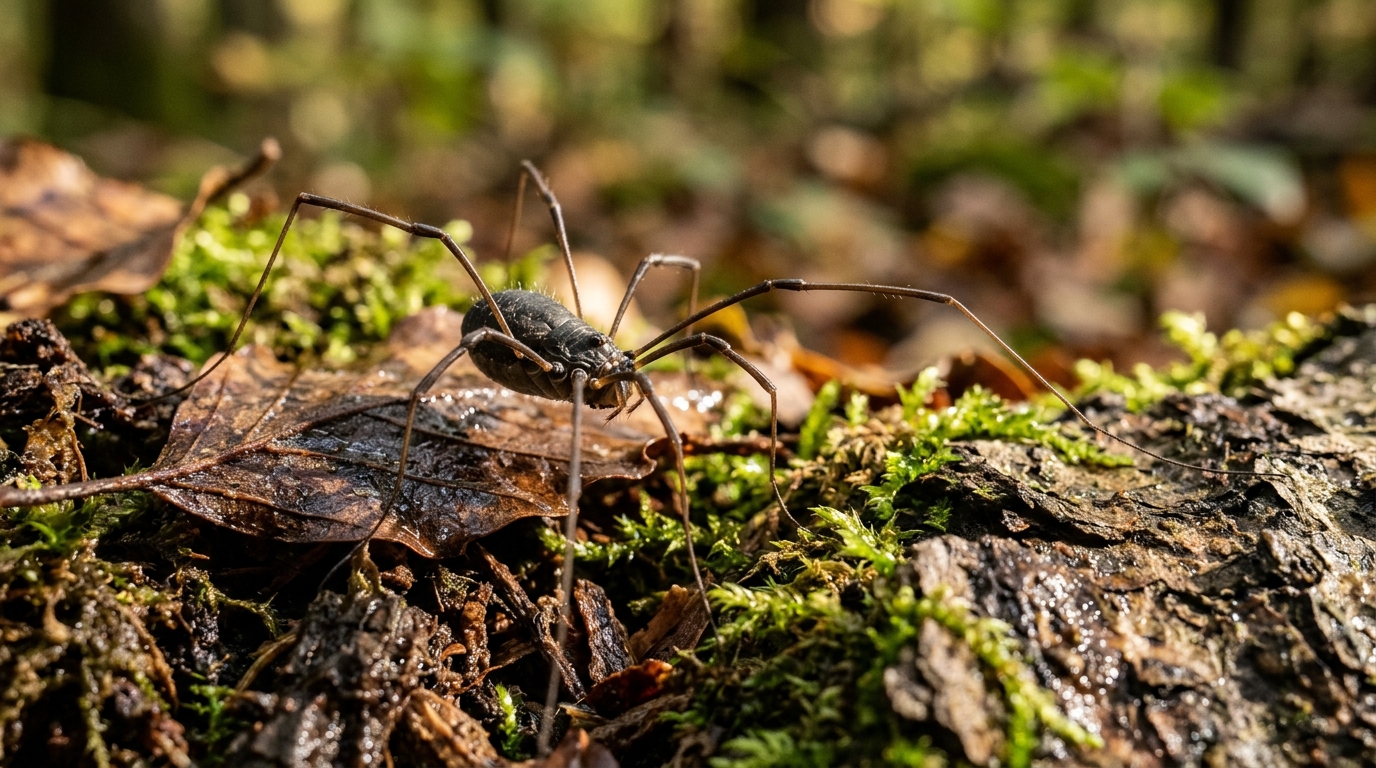
In a small, isolated patch of hardwood floodplain forest on the outskirts of Bratislava, the fate of harvestman communities rests less on how much habitat remains and more on how warm the ground surface gets. A year-long field study at the Jarovská bažantnica protected area in Slovakia has found that surface air temperature was the only statistically significant environmental predictor of overall harvestman assemblage composition, separating species that tolerate dry, warm microsites from those dependent on cooler, more humid conditions. The findings, drawn from 3,067 captured individuals representing 11 species, offer a fine-scale picture of how microclimate and vegetation structure shape ground-living arthropods in a fragmented agricultural landscape.
The study, published in the journal Nature Conservation, focused on an approximately 80-hectare biocentre of hardwood floodplain forest surrounded by farmland, cut off from the main Danube floodplain forest complex by a highway and a railway line with no wildlife crossing structures. Although the nearest continuous floodplain forests lie roughly two kilometres away, no functional corridor network connects them. Researchers established nine study sites: three at least 100 metres inside the forest, three at field-forest ecotones and three along linear vegetation elements designated as biological corridors in local landscape planning, with widths of 5, 10 and 15 metres.
Sampling ran from 30 March 2022 to 29 March 2023 using pitfall traps, with five traps per site arranged in a straight line and material pooled per plot and sampling date across 13 monthly events. Because capture rates reflect both density and surface activity, the authors treated catches as activity-density rather than absolute abundance, expressed as individuals per trap-day. Temperature and soil moisture were logged every 15 minutes at each site using TMS-4 data loggers, measuring soil temperature at 6 centimetres depth, air temperature at ground level and 15 centimetres above ground, and volumetric soil water content at roughly 11 centimetres depth. Vegetation cover and species richness were recorded for herb, shrub and tree layers within 150-square-metre survey areas, alongside litter thickness.
The most dominant species across the whole sample were Nelima sempronii at 24.49 percent, Egaenus convexus at 23.15 percent, Nemastoma bidentatum sparsum at 19.27 percent, Oligolophus tridens at 11.35 percent and Astrobunus laevipes at 10.89 percent. Captures varied dramatically between plots, from just 52 individuals at the narrowest corridor plot to 546 in one forest plot. A partial redundancy analysis on Hellinger-transformed abundance data, conditioned on spatial blocks, showed that average surface temperature at 2 centimetres above ground explained 35.10 percent of the total inertia in community composition, with a pseudo-F of 4.46 and a p-value of 0.007. Warmer microsites were occupied primarily by Opilio saxatilis, Trogulus agg. tricarinatus, Egaenus convexus and Nelima sempronii, while cooler conditions were preferred by Oligolophus tridens, Rilaena triangularis, Nemastoma bidentatum sparsum, Lacinius ephippiatus and Astrobunus laevipes.
This temperature-driven sorting aligns with the fundamental physiology of harvestmen, which as hygrophilous arthropods with high susceptibility to desiccation tolerate only narrow ranges of temperature and humidity. The authors interpret the pattern as microclimate acting as a primary environmental filter, sorting species according to their climatic niches. Species found in warmer microsites are often considered more tolerant of disturbed or open habitats, whereas those in cooler microhabitats are typically linked to stable, humid forest interiors. Notably, the invasive harvestman Opilio canestrinii, which has spread across parts of Europe, has not colonised this highly filtered environment.
Diversity metrics told a complementary story. Coverage-standardised species richness, calculated as Hill number q = 0 at a common sample coverage of 0.98, increased significantly with higher tree-layer cover and decreased with rising minimum surface temperature. Each additional 10 percentage points of tree-layer cover was associated with an estimated 5.9 percent increase in standardised richness, while each 1 degree Celsius increase in minimum surface temperature corresponded to an estimated 22.2 percent reduction. The model explained 95.3 percent of the variation in standardised richness. Effective Shannon diversity, Hill q = 1, was positively associated with litter depth, with each additional centimetre linked to an estimated 6.3 percent increase, and negatively associated with mean surface temperature, where each 1 degree Celsius rise corresponded to an estimated 10.1 percent reduction. That model explained 86.4 percent of the variation, though the authors caution that the litter-depth effect was less stable than the temperature effect in sensitivity analyses.
Perhaps the most counterintuitive result was a significant negative relationship between harvestman activity-density and average soil moisture. Each 10 percentage-point increase in volumetric soil water content was associated with an estimated 48.5 percent reduction in expected captures per trap-day, based on a negative-binomial mixed-effects model with an incidence-rate ratio of 0.515 and a 95 percent confidence interval of 0.414 to 0.642. The authors propose several non-exclusive explanations: high soil moisture in the forest core and lower-lying corridors may correlate with prolonged waterlogging or cooler soils that limit epigeic activity and prey availability; the highest activity occurred at plots with intermediate vegetation structure where slightly warmer, drier conditions may boost movement; and the dominant species may simply tolerate or even prefer less saturated soils compared with rarer specialists. The finding suggests that a simple rule of more moisture meaning more harvestmen does not hold in this landscape.
Among the three linear habitats examined, the widest corridor, at 15 metres, supported the highest coverage-standardised richness and effective diversity, and most closely resembled forest-interior conditions in vegetation structure and microclimate. The 5-metre and 10-metre corridors showed lower values, and the narrowest corridor plot stood apart in the community cluster analysis as a single-plot branch. Ecotone plots recorded the highest standardised richness, consistent with an edge effect where forest and open-habitat species co-occur, but the core forest plots maintained the highest effective Shannon and Simpson diversity, underscoring their irreplaceable value for the most diverse assemblages.
The authors are careful about what these corridor comparisons can and cannot show. Because each corridor width was represented by only one study plot, the effect of width cannot be separated conclusively from local environmental conditions, spatial position or block identity. The narrower corridors should not be considered categorically ineffective for forest specialists on the basis of the present data. The study is limited to a single forest fragment, and the environmental models of Hill diversity are interpreted as exploratory, site-specific relationships rather than definitive causal effects. Replicated studies across a broader and continuous range of corridor widths would be required to identify any true threshold, and the authors note that literature on other taxa spans everything from 4-metre corridors that channel butterfly movement to recommendations of up to 250 metres for grassland butterflies.
For conservation, the message is twofold. Preserving high-quality habitat structure within core fragments matters, and so does ensuring that connecting landscape elements are designed with adequate width and management to achieve the structural and microclimatic quality that forest-associated fauna need. In Slovakia, where monoculture fields average 12 hectares, the largest in the European Union, such ecological infrastructure may be critical for mitigating fragmentation. Yet the authors themselves stress that their recommendations remain conditional: further research across multiple fragments and landscapes is necessary to confirm the generality of these findings and to develop robust guidelines for corridor design in agricultural landscapes.
Subject of Research: Microclimate and vegetation structure as drivers of harvestman assemblages in an isolated Slovak floodplain forest fragment and adjacent potential biological corridors
Article Title: Microclimate and vegetation structure shape harvestman ( Opiliones ) assemblages in an isolated forest fragment and adjacent potential biological corridors
Article References: Litavský, J., Masarovič, R., Majzlan, O., Blaško, D., & Žarnovičan, H. (2026). Microclimate and vegetation structure shape harvestman (Opiliones) assemblages in an isolated forest fragment and adjacent potential biological corridors. Nature Conservation, 66, 39-64. https://doi.org/10.3897/natureconservation.66.198050
Image Credits: AI Generated
DOI: 10.3897/natureconservation.66.198050
Keywords: harvestmen, Opiliones, microclimate, forest fragmentation, biological corridors, Slovakia, floodplain forest, soil moisture, vegetation structure, species diversity, pitfall traps, ecotones
News Source: Drew Townsend. (November 5, 2026). Surface temperature filters harvestman communities in isolated Slovak forest fragment. Scienmag.