Proteins are the workhorses of living organisms, catalyzing biochemical reactions, supporting cellular energy metabolism, and carrying out the countless tasks that keep cells alive. What a given protein can do depends on two things: its amino acid composition and the three-dimensional structure that composition produces. Modern proteins typically draw on the full set of twenty amino acids, but the earliest proteins on Earth may have arisen at a time when far fewer amino acid types were chemically available. Understanding how proteins built from a more limited set of building blocks could still perform essential biochemical reactions therefore offers a potential window into the origins and evolution of life itself.
That question motivated a new experimental study from Japan, in which researchers deliberately rebuilt an ancient enzyme using a drastically reduced palette of amino acids. Professor Satoshi Akanuma and Assistant Professor Sota Yagi of Waseda University, together with Subrata Dasgupta and Shunsuke Tagami of the RIKEN Center for Integrative Medical Sciences, examined how restricting amino acid diversity affects both the structure and the function of an ancestral enzyme. Explaining the motivation behind the work, Akanuma said, “We were interested in what happens when an ancestral enzyme is rebuilt using a reduced set of amino acids that may resemble the chemical limitations of early life.” The study was published online in Angewandte Chemie International Edition on October 09, 2026.
The enzyme chosen for the experiment was nucleoside diphosphate kinase, or NDK, an enzyme involved in nucleotide phosphorylation. The researchers engineered variants of the ancestral NDK with progressively restricted amino acid repertoires, systematically trimming the chemical vocabulary available to the protein. They then evaluated enzyme activity and reaction products using biochemical assays, high-performance liquid chromatography (HPLC), and mass spectrometry. To investigate protein structure, nucleotide binding, and potential catalytic mechanisms, the team turned to X-ray crystallography, molecular dynamics simulations, and mutational analyses, combining structural and computational evidence with direct biochemical measurement.
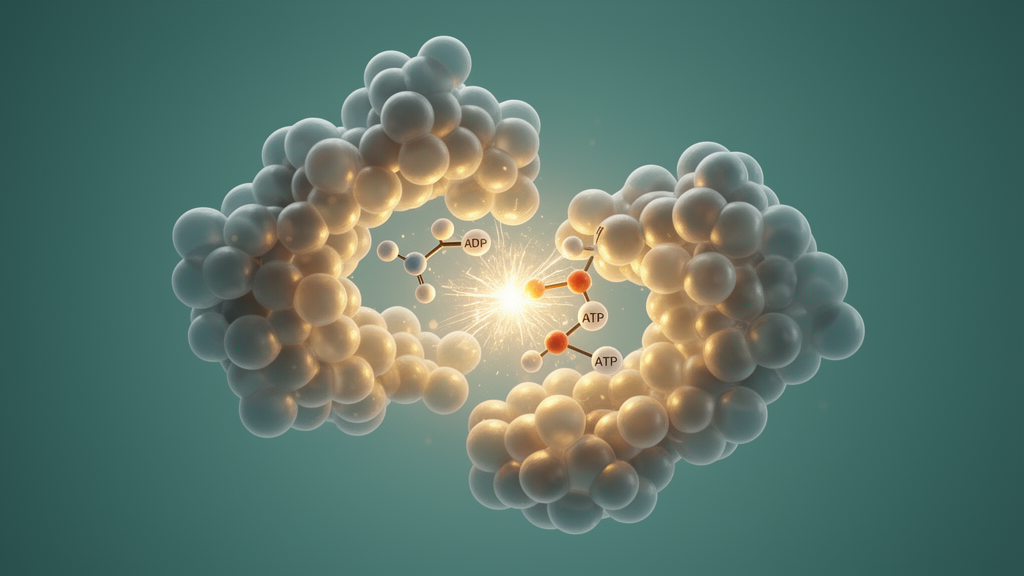
The results proved striking. One engineered variant, designated Arc1-12KR, retained the overall NDK protein fold even though it lacked the catalytic histidine that is typically required for the enzyme’s conventional activity. That absence alone would be expected to leave the protein catalytically inert in its normal role. Instead, the simplified enzyme unexpectedly acquired a different capability: it converted two molecules of adenosine diphosphate (ADP) into one molecule of adenosine triphosphate (ATP) and one molecule of adenosine monophosphate (AMP). HPLC analysis confirmed the formation of both products, establishing that the reaction products were genuinely generated by the engineered protein rather than appearing as artifacts of the assay.
Further analyses pointed to how this unexpected chemistry might be accomplished. The evidence indicated that aspartate and arginine residues, together with magnesium ions (Mg²⁺), may have helped position the nucleotide molecules and facilitate this alternative phosphoryl-transfer reaction. Structural modeling suggests that aspartate, arginine, and Mg²⁺ may support ATP formation from two ADP molecules in the engineered ancestral enzyme. In other words, residues that remained within the restricted amino acid repertoire, working in concert with a metal ion, appear to have taken over a role normally played by the missing catalytic histidine, enabling the protein to shuttle a phosphoryl group between two ADP molecules.
Molecular dynamics simulations lent additional support to this picture, indicating that the proposed binding site could accommodate two ADP molecules simultaneously. This capacity to hold two substrates at once is central to the disproportionation reaction, in which one ADP molecule serves as a phosphoryl donor and the other as an acceptor. The researchers were careful, however, to note the limits of the current evidence: the precise catalytic mechanism remains unresolved, and alternative pathways cannot be excluded. The simulations and structural data are consistent with the proposed mechanism, but they do not amount to a definitive demonstration of how the reaction proceeds at the atomic level.
The efficiency of the reaction was also notable. Arc1-12KR showed an ATP-forming turnover rate of approximately 1.5 s⁻¹. For comparison, that rate is about 7,500 times higher than the apparent turnover number reported for short p-loop prototype polypeptides that catalyze the same ADP disproportionation reaction.
Reflecting on the broader significance of the result, Akanuma noted, “Our finding that a simplified ancestral enzyme can form ATP from ADP suggests that early proteins with limited amino acid compositions may have supported primitive energy metabolism.” ATP formation from ADP lies at the heart of cellular energy metabolism, so the observation that a protein built from a restricted set of amino acids can carry out this chemistry speaks directly to questions about what the earliest protein catalysts might have been capable of. The finding suggests that the chemical barriers to primitive energy-related catalysis may have been lower than the full modern amino acid alphabet would imply.
At the same time, the researchers are explicit about what the study does not establish. The findings do not show that this particular engineered enzyme, or anything like it, actually existed on early Earth. Rather, Arc1-12KR provides an experimental model for exploring how simpler proteins may have supported energy-related chemistry under the chemical constraints that may have characterized the earliest stages of protein evolution. The work also points toward practical applications beyond evolutionary questions: the results could inform the design of artificial enzymes with reduced amino acid repertoires, potentially helping researchers identify new catalytic activities and develop minimal protein catalysts for biotechnology applications.
Overall, the study demonstrates that restricting amino acid diversity can reveal catalytic capabilities that lie beyond a protein’s conventional function. By showing that a simplified ancestral enzyme, stripped of its canonical catalytic residue and built from a reduced chemical vocabulary, can nonetheless form ATP from ADP at a substantial rate, the research offers a new experimental route into one of the deepest questions in biology: how the first proteins may have contributed to the evolution of biological energy metabolism.
Subject of Research: Engineering an ancestral enzyme with a reduced amino acid set to reveal alternative ATP-forming catalytic activity
Article Title: Ancestral enzyme redesigned with fewer amino acid types reveals new catalytic possibilities
Article References: Ancestral enzyme redesigned with fewer amino acid types reveals new catalytic possibilities. Original publication (Bibliographic details unavailable.)
Image Credits: AI Generated
DOI: Not provided
Keywords: ancestral enzyme, nucleoside diphosphate kinase, ATP, ADP, protein evolution, amino acid repertoire, enzyme engineering, Angewandte Chemie, Waseda University, RIKEN, molecular dynamics, origin of life
News Source: Drew Townsend. (October 29, 2026). Simplified Ancestral Enzyme Built From Fewer Amino Acids Unexpectedly Produces ATP From ADP. Scienmag.