


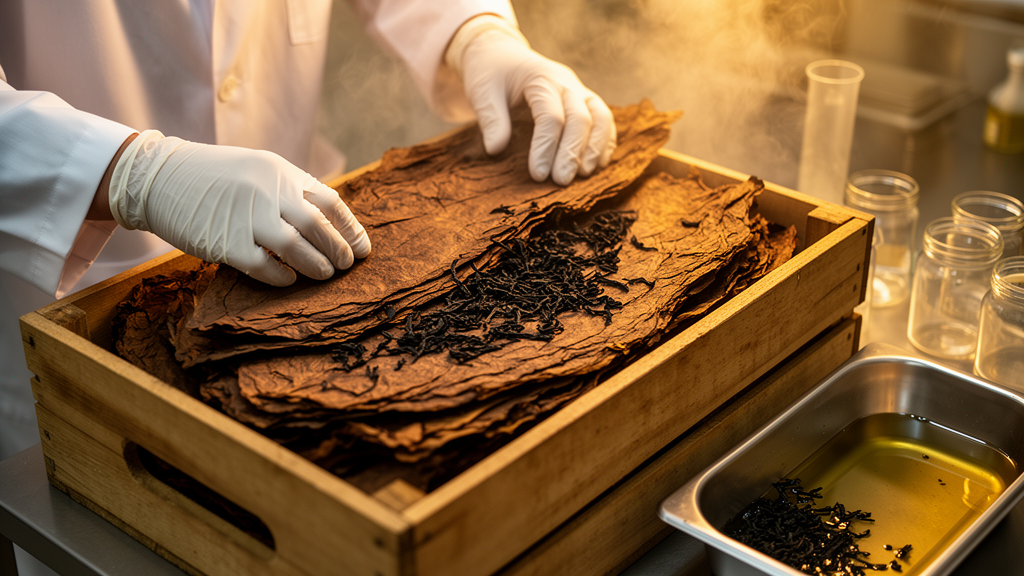
The quality of cigar tobacco leaves is largely decided during fermentation, a stage that growers have long managed with slow, traditional methods that can stretch on for extended periods, limit the range of aromas that develop, and allow residues to accumulate in the cured leaf. The team evaluated four black tea extracts, prepared from Pu-erh, Keemun, Dianhong, and Dahongpao teas, as supplements during cigar tobacco leaf fermentation, and reported measurable shifts in the leaf’s microbial communities, volatile aroma chemistry, and sensory scores.
To understand what each extract actually contained before it ever touched the tobacco, the researchers used ultra-high-performance liquid chromatography coupled with quadrupole-orbitrap tandem mass spectrometry, a high-resolution analytical setup capable of separating and identifying complex mixtures of plant-derived molecules. Correlation analyses later conducted in the study singled out three constituents, ferulate, theanine, and corilagin, as compounds whose presence tracked closely with changes in the leaf’s microbial and aroma profiles.
The microbial story was tracked with high-throughput sequencing, which allowed the team to map how the community of bacteria and other microorganisms on the leaves reorganized when tea extracts were added. Supplementation with the black tea extracts significantly restructured the microbial community, raising Shannon diversity—a standard index that combines the number of species present with how evenly they are distributed—by 20 to 40 percent. In the TQM treatment group, the Shannon index reached 4.82 ± 0.21, compared with 3.45 ± 0.18 in the untreated control, a difference the authors report as statistically significant at p < 0.05.
Sequencing data showed that the tea-treated leaves became enriched in potentially beneficial genera such as Sphingomonas, while spoilage-associated Staphylococcus was suppressed.
The aroma evidence came from headspace solid-phase microextraction combined with gas chromatography–mass spectrometry, a technique that concentrates volatile compounds released from the leaf surface before separating and identifying them by mass. Using HS-SPME-GC-MS, the researchers found that black tea extract supplementation markedly increased both the diversity and the abundance of volatile aroma compounds in the fermenting leaves.
Sensory evaluation provided the human check on the instrument data. Trained assessors scored the fermented leaves, and among the four extracts, Dahongpao and Keemun stood out with the most comprehensive improvements: overall quality scores of 8.6 ± 0.2 and 8.4 ± 0.2 respectively, against 5.9 ± 0.2 for the untreated control, with the differences significant at p < 0.05.
Tying the three data streams together, the team performed correlation network analysis to look for statistically robust associations among the tea constituents, the individual amplicon sequence variants observed in the sequencing data, and the key volatile aroma compounds. The analysis revealed significant associations linking ferulate, theanine, and corilagin to specific ASVs and to key aroma volatiles, with correlation coefficients above 0.8 and q-values below 0.05. In practical terms, this means the strongest statistical signals connected particular tea molecules to particular microbes and particular aroma outcomes, giving the authors a candidate mechanistic chain from tea chemistry to microbial ecology to finished-leaf flavor.
The study’s authors frame the work as a natural strategy for optimizing cigar tobacco leaf fermentation, one that supports cross-industry integration between the tea and tobacco sectors and provides a technical foundation for producing high-quality cigars.
There are limits worth keeping in view. The work examined four specific tea extracts under defined fermentation conditions, and the reported statistics describe comparisons between treated and control leaves within that experimental system; the abstract does not establish how the approach performs at industrial scale, across different tobacco varieties, or over repeated production cycles. The correlation coefficients, however strong, describe associations and do not by themselves prove causation between individual tea compounds and microbial changes.
For the tea and tobacco industries alike, the findings suggest that the chemistry of one agricultural product can be borrowed to improve another, with the specific constituents—ferulate, theanine, corilagin—now flagged as candidates for further mechanistic work. Whether those molecules can be standardized, dosed, and validated across commercial fermentation batches remains the next question, but the study offers a concrete, statistically supported starting point for that effort.
Subject of Research: Effects of black tea extracts on microbial communities, volatile aroma compounds, and sensory quality during cigar tobacco leaf fermentation
Article Title: Effects of black tea extracts on the quality of cigar tobacco leaves during fermentation
Article References: Shi, Y., Zheng, T., Guo, D., Zhang, C., Zhou, J., Zong, K., Ju, S., & Li, X. (2026). Effects of black tea extracts on the quality of cigar tobacco leaves during fermentation. Frontiers in Bioengineering and Biotechnology, 14, 1997135. https://doi.org/10.3389/fbioe.2026.1997135
Image Credits: AI Generated
DOI: 10.3389/fbioe.2026.1997135
Keywords: black tea extracts, cigar tobacco leaves, fermentation, microbial community, Shannon diversity, Sphingomonas, Staphylococcus, volatile aroma compounds, HS-SPME-GC-MS, sensory evaluation, corilagin, theanine
News Source: Morgan Morrow. (October 30, 2026). Black Tea Extracts Reshape Microbes and Aroma in Fermenting Cigar Tobacco Leaves. Scienmag.



