A fast-growing woody crop that thrives on marginal land in the northeastern United States can be converted into a biodegradable plastic by engineered bacteria, and a new study maps out exactly which processing choices matter most. Researchers produced polyhydroxybutyrate, or PHB, from shrub willow hydrolysate using a recombinant strain of Escherichia coli, and found that the temperature used to pretreat the biomass, the nitrogen source added to the fermentation broth, and the carbon-to-nitrogen ratio all shaped how much polymer the microbes accumulated. The work, published in Biotechnology for Sustainable Materials, was conducted in shake flasks at laboratory scale, so the results describe process conditions identified in controlled experiments rather than performance at industrial scale.
The team, led by Kalyani Ananthakrishnan and Deepak Kumar with collaborators including Timothy Volk and Bandaru V. Ramarao, ground shrub willow chips and subjected them to hot water pretreatment at four temperatures: 160, 180, 200, and 220 degrees Celsius, each for 10 minutes, followed by three cycles of disk milling. This two-step approach avoids harsh and costly chemicals while making cellulose more accessible to enzymes. After pretreatment, the biomass underwent enzymatic hydrolysis at 50 degrees Celsius for 72 hours, releasing sugars that the bacteria could consume. The hydrolysates contained between 18.8 and 52.2 grams per liter of glucose and 5.3 to 17.4 grams per liter of xylose, depending on the pretreatment temperature.
Temperature had a decisive influence on both sugar release and fermentation outcomes. The highest glucose yield during hydrolysis was observed at 200 degrees Celsius, and cellulose conversion efficiency peaked at 93.9 percent for biomass pretreated at 220 degrees Celsius. Yet the hottest condition proved problematic for fermentation. When hydrolysate from 220-degree pretreated biomass was fermented with an initial sugar concentration of 20 grams per liter, no biomass accumulation or metabolic activity was observed at all. The researchers attribute this to inhibitory compounds formed at extreme pretreatment severity. Furfural, a potent inhibitor produced by the dehydration of xylose, was undetectable at lower pretreatment temperatures but reached 0.2 grams per liter at 180 degrees and 2.22 grams per liter at 200 degrees in the team’s previous work, concentrations that exceed toxicity limits for many microbes by disrupting ATP production and NADH recycling.
The sweet spot turned out to be 180 degrees Celsius. Hydrolysate from willow pretreated at this temperature supported the most efficient PHB production, achieving a PHB titer of 1.63 grams per liter, the highest among the pretreated conditions, despite slightly lower sugar yields than higher temperatures. The researchers attribute this to a favorable balance between adequate sugar availability and limited inhibitor formation. Fermentation with 20 grams per liter of initial sugars improved overall cell dry weight by 1.3 to 1.5 folds and PHB yield by 1.8 to 2.1 folds compared with 10 grams per liter, and the team selected 180 degrees with 20 grams per liter of sugars as the condition for all subsequent optimization work. Interestingly, untreated willow hydrolysate actually yielded the highest single PHB titer in the fermentation comparison, 1.95 grams per liter, but because pretreatment dramatically increases the total sugar extracted per kilogram of biomass, the polymer yield per kilogram of biomass was significantly higher when pretreatment was included.
One curious biochemical detail emerged from the temperature comparison: PHB inclusion reached 32.7 percent at both 180 and 200 degrees, and the researchers suggest that acetic acid formed during pretreatment may have helped. Acetic acid concentrations in willow pretreated between 160 and 200 degrees ranged from 0.27 to 3.7 grams per liter, and prior studies indicate that acetic acid facilitates acetyl-CoA synthesis, an immediate metabolic precursor for PHB. However, that benefit reverses at higher concentrations, consistent with the decline in PHB content observed at 220 degrees. A control fermentation using a pure glucose and xylose mixture mimicking the hydrolysate composition produced 2.37 grams per liter of cell dry weight and 40.8 percent PHB inclusion, a PHB titer of 0.97 grams per liter, meaning both cell growth and PHB inclusion were higher in the hydrolysate fermentation, likely because the hydrolysate carries additional metabolic nutrients beyond the minimal medium.
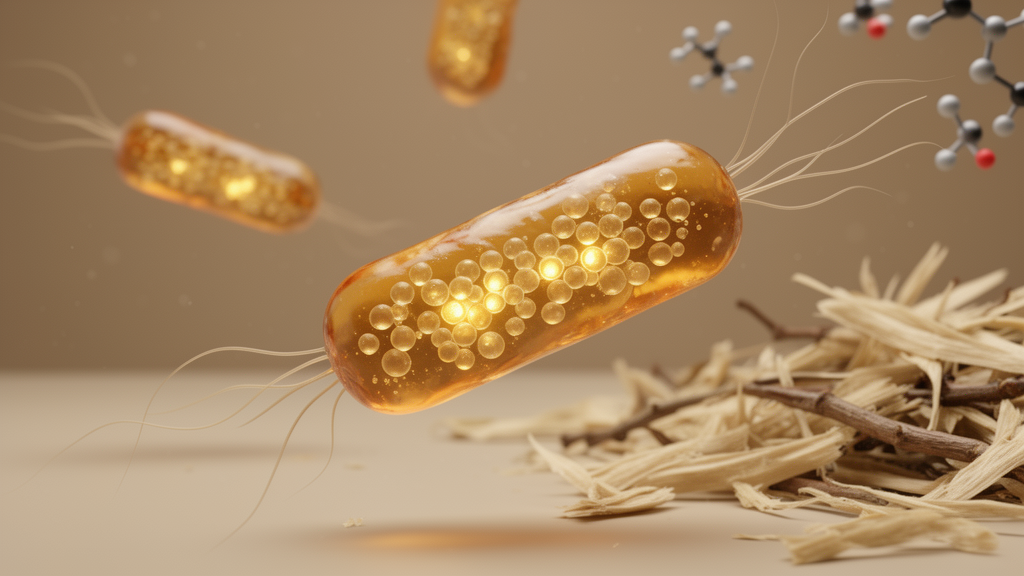
The bacterial workhorse in the study is E. coli LSBJ, which carries the PHB biosynthesis pathway on a plasmid called pBBRSTQKAB. Unlike native PHB-producing microorganisms, this strain lacks the PHA depolymerase gene, preventing intracellular degradation of the polymer and supporting enhanced accumulation. The strain has previously fermented sugars from acid whey, fiber rejects, brewer’s spent grains, and industrial hemp, but had never been tested on shrub willow hydrolysate. During fermentation, the cells were grown for 72 hours, harvested, lyophilized, and the PHB was extracted and quantified by gas chromatography with flame ionization detection.
Nitrogen supplementation emerged as the second major lever. The researchers tested two inorganic nitrogen sources, ammonium sulfate and ammonium chloride, and two organic sources, yeast extract and peptone, all loaded to achieve a molar carbon-to-nitrogen ratio of 20. Adding nitrogen increased cell growth by 1.6 to 2-fold compared with an unsupplemented control, which yielded the lowest cell density at 3.2 grams per liter. Organic nitrogen sources accelerated early growth, with yeast extract and peptone boosting the growth rate during the first 12 hours, likely because their rich content of peptides and amino acids spares the bacteria from synthesizing these compounds de novo. Ammonium chloride produced the highest final cell yield at 6.35 grams per liter, but yeast extract delivered the highest PHB accumulation and titers, with 47.18 percent PHB inclusion and titers improved by 1.3 to 2.0 folds over the control. The control condition, despite achieving 46.13 percent inclusion, produced far less polymer overall because its cell density was so much lower.
The timing of polymer accumulation also differed strikingly between conditions. In the nitrogen-supplemented fermentations, cells prioritized growth during the early phase, and PHB accumulated noticeably only after 24 hours, once nitrogen availability diminished and the cells shifted their metabolism toward carbon storage. Nitrogen supplementation also promoted nearly complete consumption of glucose, xylose, and acetic acid within the first 36 hours, whereas in the unsupplemented control, glucose was consumed preferentially and a significant amount of xylose remained after 72 hours. This suggests that enhancing xylose utilization through future strain engineering or process optimization could further increase PHB production from lignocellulosic hydrolysates, which contain substantial amounts of both sugars. A control experiment with yeast extract but no carbon source confirmed that the nitrogen source itself supported only limited growth, 0.5 grams per liter of cell dry weight, and no PHB production.
The final optimization stage explored carbon-to-nitrogen ratios from 5 to 80 by varying yeast extract concentrations. Cell growth rose steadily as nitrogen increased: cell dry weight reached 10.32 grams per liter at a ratio of 5, 9.1 grams per liter at a ratio of 10, 4.82 at a ratio of 40, and 3.91 at a ratio of 80. PHB inclusion followed a different pattern, peaking at 49.14 percent at a ratio of 40, with 45.2 percent at the most nitrogen-starved ratio of 80. The decisive metric was the final PHB titer, and the highest value, 4.06 grams per liter, was achieved at a carbon-to-nitrogen ratio of 10, closely followed by 4.03 grams per liter at a ratio of 5. Because those two values were not statistically different, the researchers identified a ratio of 10 as the optimal trade-off, delivering comparable polymer yields with less yeast extract, a nutrient they note is relatively expensive. A detailed techno-economic analysis of that trade-off, the team notes, lies beyond the scope of the study.
From a metabolic standpoint, the patterns fit known regulation of carbon and nitrogen metabolism in E. coli. Under balanced conditions, acetyl-CoA flows into the TCA cycle, generating free CoA, which inhibits phaA, a key enzyme in PHB biosynthesis. Under nitrogen limitation, acetyl-CoA accumulates and NADPH regeneration is triggered, and NADPH serves as the reducing agent for converting acetoacetyl-CoA to 3-hydroxybutyryl-CoA, the immediate precursor of PHB, in a reaction catalyzed by phaB. The authors caution that microbial strains exhibit varying preferences for nitrogen sources, so the yeast extract finding may not generalize to other organisms, and lower-cost alternatives such as corn steep liquor, soybean meal hydrolysate, or urea would require further investigation. Still, the study demonstrates that shrub willow, a crop suited to marginal lands, can serve as a viable carbon source for biodegradable plastic production, and that pretreatment temperature, nitrogen source, and carbon-to-nitrogen ratio together determine how much polymer the microbes deliver.
Subject of Research: Production of the bioplastic polyhydroxybutyrate from shrub willow hydrolysate using recombinant E. coli, examining pretreatment temperature, nitrogen source, and carbon-to-nitrogen ratio effects
Article Title: Impact of pretreatment severity and nutrient parameters on microbial PHB production from shrub willow hydrolysate using recombinant Escherichia coli
Article References: Ananthakrishnan, K., Froass, E., Juneja, A., Majumder, E. L. W., Therasme, O., Volk, T., Ramarao, B. V., & Kumar, D. (2026). Impact of pretreatment severity and nutrient parameters on microbial PHB production from shrub willow hydrolysate using recombinant Escherichia coli. Biotechnology for Sustainable Materials, 3(1), Article 6. https://doi.org/10.1186/s44316-026-00057-2
Image Credits: AI Generated
DOI: 10.1186/s44316-026-00057-2
Keywords: polyhydroxybutyrate, shrub willow, Escherichia coli, bioplastics, lignocellulosic biomass, hydrothermal pretreatment, fermentation, carbon-to-nitrogen ratio, yeast extract, enzymatic hydrolysis, biodegradable plastics, biorefinery
News Source: Denise Maddox. (October 29, 2026). Shrub Willow Hydrolysate Yields Bioplastic PHB in Engineered E. coli. Scienmag.