


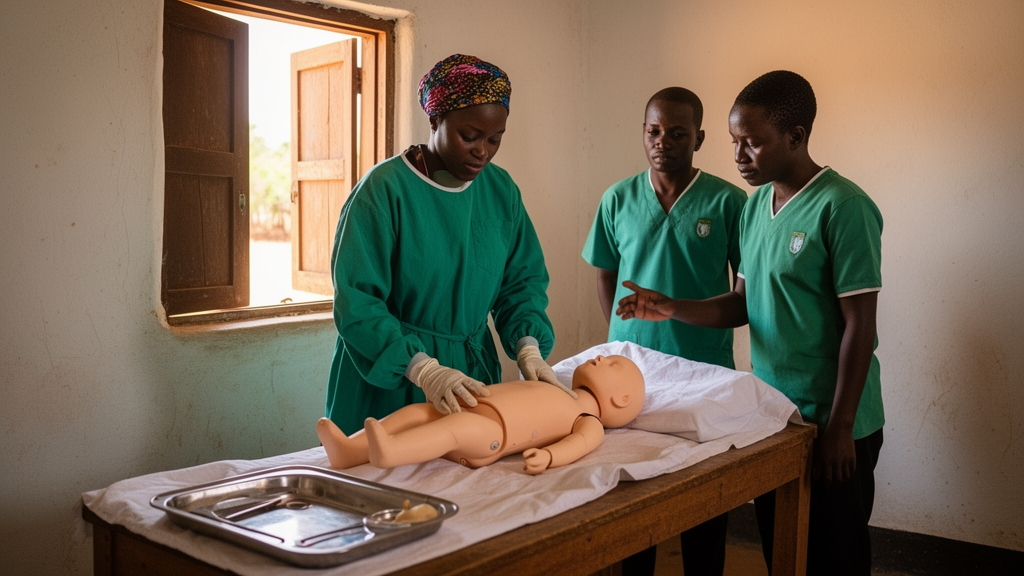
Healthcare providers in rural Tanzania who completed a basic emergency obstetric and neonatal care training program retained significantly more of their skills at six months when the initial workshop was followed by peer-to-peer simulation practice and regular mentorship visits, according to a quasi-experimental study conducted in the Kwimba district. The research, published in BMC Health Services Research, is the first to report skill retention at twelve months after BEmONC-based training using facility-based peer practice and mentorship visits every three months.
Neonatal and maternal mortality remain alarmingly high in rural areas like Kwimba, and the Basic Emergency Obstetric and Neonatal Care training program is designed to help reduce these rates by improving the knowledge and skills of the healthcare providers who attend births. Previous literature has shown that knowledge and skill improve immediately after training, but skill decay has been reported as early as one month later when providers are not given further facility-based opportunities to practice. The study team, led by Dismas Matovelo and including Jennifer L. Brenner, Nalini Singhal, Alberto Nettel-Aguirre, Edgar Ndaboine, Girles Shabani, Leonard Subi and Elaine Sigalet, set out to test whether a low-cost simulation package could counter that decay over a full year.
The researchers used a quasi-experimental design to evaluate a three-component simulation package. The first component was a five-day BEmONC-based training course. The second was low-dose, high-frequency peer-to-peer simulation practice guided by peer cards, allowing providers to rehearse emergency scenarios repeatedly within their own facilities. The third component was clinical mentorship delivered by visiting experts. Participants were midwives, nurses, clinical officers and a medical officer drawn from local hospitals and health centers in Kwimba. Facilities were purposely assigned to one of two clusters, and after the initial BEmONC-based training, Cluster A received the second and third components of the package immediately, while Cluster B’s access to those components was delayed until after the six-month assessment.
Knowledge and skill were measured using the training program’s objective structured clinical examinations, known as OSCEs, at four time points: baseline, immediately after the workshop, at six months and at twelve months. The researchers analyzed the results using R core statistics and considered p-values below 0.05 statistically significant. This design allowed the team to compare retention between a group that received the full package and a group that had completed only the initial training during the first six months.
The results showed that all participants demonstrated significant knowledge and skill improvements immediately after the initial workshop, confirming that the five-day course itself was effective in the short term. The critical difference emerged at the six-month assessment. At that point, Cluster A’s aggregate skill scores were significantly higher than those of Cluster B, whose members showed skill decay after completing only the initial workshop. This finding aligns with earlier reports that skills fade quickly when providers lack structured opportunities to practice after training ends.
By twelve months, the picture had changed. Aggregate skill scores between Cluster A and Cluster B were similar at that final assessment, a pattern consistent with the fact that Cluster B had received access to the peer practice and mentorship components after the six-month evaluation. The study’s conclusion states that there was a significant relationship between clusters receiving the second and third components of the simulation package and retention of skill sets at six and twelve months, indicating that the package supported skill retention over the full study period.
The authors highlight two features of the package as particularly novel. The first is the inclusion of post-training peer learning with simulation-equipped practice stations, which allows providers to rehearse emergency scenarios repeatedly within their own facilities using low-dose, high-frequency practice guided by peer cards. The second is mentorship visits by regional experts every three months, which reinforce skills and provide clinical oversight between formal training events. Together, the researchers conclude, these elements may constitute a low-resource educational option to support skill retention after BEmONC-based training.
The study’s design carries some limitations worth noting. Because facilities were purposely assigned to clusters rather than randomly allocated, the quasi-experimental approach cannot rule out all confounding factors that might differ between the two groups. The participant pool was limited to midwives, nurses, clinical officers and a single medical officer from hospitals and health centers in one district of Tanzania, so the findings describe one rural setting rather than a broad multi-region trial. The measurements relied on the training program’s own OSCE assessments, which capture performance under examination conditions rather than during actual clinical emergencies.
Even with those constraints, the study addresses a persistent gap in global health training. BEmONC programs are widely used to prepare providers for the leading causes of maternal and neonatal death in low-resource settings, but their long-term impact depends on whether skills survive beyond the workshop. By demonstrating that a package combining a five-day course, peer-to-peer simulation practice with peer cards and quarterly mentorship visits was associated with significantly better skill retention at six months, and by providing the first reported twelve-month retention data for this approach, the researchers offer evidence that structured, low-cost reinforcement can extend the life of emergency obstetric and neonatal training in rural facilities where expensive refresher courses are rarely feasible.
Subject of Research: Skill retention after basic emergency obstetric and neonatal care training with a low-resource simulation package in rural Tanzania
Article Title: A low resource simulation-based training package leads to increased knowledge and skill retention post basic emergency obstetric and neonatal care based training in rural Tanzania, a quasi-experimental research design
Article References: Matovelo, D., Brenner, J. L., Singhal, N., NettelAguirre, A., Ndaboine, E., Shabani, G., Subi, L., & Sigalet, E. (2026). A low resource simulation-based training package leads to increased knowledge and skill retention post basic emergency obstetric and neonatal care based training in rural Tanzania, a quasi-experimental research design. BMC Health Services Research. https://doi.org/10.1186/s12913-026-15984-z
Image Credits: AI Generated
DOI: 10.1186/s12913-026-15984-z
Keywords: BEmONC, simulation training, skill retention, neonatal care, maternal health, Tanzania, quasi-experimental study, peer-to-peer practice, clinical mentorship, rural health, health services research, midwives
News Source: Harold Sullivan. (October 30, 2026). Low-Cost Simulation Package Helps Rural Tanzanian Midwives Retain Emergency Skills. Scienmag.



