


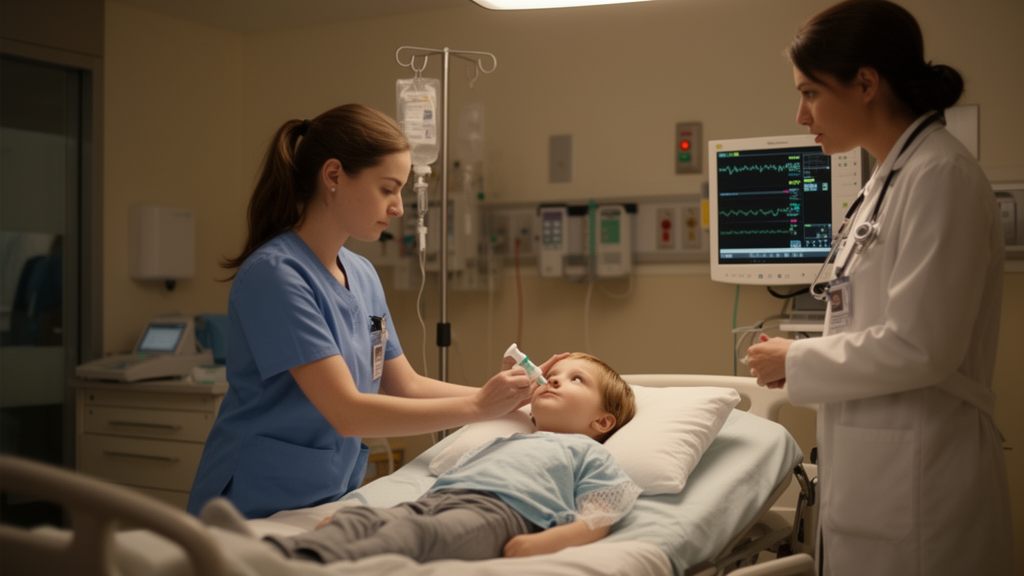
A Bayesian re-analysis of a randomized 2 × 2 crossover clinical trial has found that reducing the ketamine dose in an intranasal midazolam–ketamine sedation regimen did not materially change crying or oxygen saturation outcomes in young children undergoing dental treatment. The study, published in BMC Anesthesiology, re-examined data from twenty children aged three to six years who had completed both treatment periods of the original crossover trial.
Managing fear and uncooperative behavior in pediatric dentistry remains a persistent clinical challenge, and intranasal sedative combinations are one approach used to help young patients tolerate dental procedures. The original trial compared two regimens delivered across two separate treatment sessions: midazolam and ketamine at doses of 0.4 and 4 mg·kg⁻¹ respectively, and a reduced-ketamine combination of 0.5 and 3 mg·kg⁻¹. Each child received both combinations, allowing within-patient comparisons of the two dose levels.
Researchers measured two longitudinal outcomes at three time points: baseline, ten minutes, and twenty minutes. Crying was recorded as a binary outcome, while peripheral oxygen saturation (SpO₂) was captured continuously as a physiological safety indicator. Because the two outcomes were measured repeatedly in the same children, the analysis employed a Bayesian joint modeling approach, which allowed the investigators to estimate both the trajectory of each outcome and the association between them within a single statistical framework.
The re-analysis showed that SpO₂ remained within the recorded normal clinical range under both regimens throughout the observation period, indicating no detectable compromise in oxygenation attributable to either dose combination. Crying, by contrast, decreased over time in the children studied, consistent with the expected onset of sedative effect as the intranasal agents were absorbed. The estimated association between crying and SpO₂ was weak and negative, suggesting that the two outcomes varied largely independently of one another in this dataset.
Crucially, the Bayesian models found no clear evidence of a difference between the two regimens for either outcome. Reducing ketamine from 4 to 3 mg·kg⁻¹ while slightly increasing midazolam from 0.4 to 0.5 mg·kg⁻¹ did not produce a distinguishable change in crying frequency or in oxygen saturation measurements. Within the limits of this small crossover dataset, the authors concluded that the dose reduction did not materially alter the recorded outcomes.
The Bayesian framework offers particular advantages for re-analyzing small clinical trials. Rather than relying solely on point estimates and conventional significance thresholds, Bayesian joint modeling incorporates prior information and yields probability statements about parameter values, which can be informative when sample sizes are limited and frequentist methods may be underpowered. In this case, the approach also enabled simultaneous modeling of the two correlated longitudinal outcomes, capturing the within-child dependence structure that arises when each participant contributes repeated measurements under both treatment conditions.
The authors emphasized several limitations that warrant cautious interpretation. The dataset comprised only twenty children, a sample size that constrains the precision of any estimated treatment effect. Crying was analyzed as a binary outcome, which the authors noted may not fully capture the degree of behavioral control or the adequacy of sedation experienced by each child. Furthermore, this study represents a secondary Bayesian re-analysis of a previously conducted clinical trial rather than a new data collection effort, meaning the findings reflect a different statistical lens applied to existing data.
The crossover design itself carries both strengths and constraints. Because each child served as their own control, receiving both regimens in separate sessions, between-child variability in temperament, anxiety, and baseline cooperativeness is partially accounted for. However, carryover effects, session-order effects, and the practical demands of completing both treatment periods can limit the number of children who finish the full protocol, and only those who completed both periods were included in this re-analysis.
For clinicians considering intranasal midazolam–ketamine sedation in uncooperative pediatric dental patients, the re-analysis suggests that the higher ketamine dose of 4 mg·kg⁻¹ did not demonstrate a measurable advantage over the reduced 3 mg·kg⁻¹ dose with respect to crying or oxygen saturation in this small sample. At the same time, the absence of clear evidence for a difference should not be equated with proof of equivalence, given the limited sample size and the binary treatment of the behavioral outcome. The authors’ conclusion that the findings should be interpreted cautiously reflects both the secondary nature of the analysis and the inherent uncertainty of drawing firm clinical conclusions from twenty paired observations.
As intranasal sedation continues to be studied as an alternative to deeper sedation modalities in pediatric dentistry, re-analyses of this kind illustrate how Bayesian methods can extract additional insight from existing trial data. The weak negative association between crying and SpO₂ observed here adds a small piece to the broader picture of how behavioral distress and physiological stability interact under sedation, while the null finding on regimen differences underscores the need for larger trials before dose recommendations can be refined with confidence.
Subject of Research: Bayesian re-analysis of a crossover trial comparing two intranasal midazolam–ketamine doses for sedation in uncooperative children undergoing dental treatment
Article Title: Bayesian re-analysis of a randomized 2 × 2 crossover trial of ketamine dose reduction in the ketamine-midazolam combination in uncooperative children: effects on crying and oxygen saturation
Article References: Farjami, M., Zayeri, F., Abbasi-Asl, T., Fallahinejad Ghajari, M., Mohaveri, M., & Akbarzadeh Baghban, A. (2026). Bayesian re-analysis of a randomized 2 × 2 crossover trial of ketamine dose reduction in the ketamine-midazolam combination in uncooperative children: effects on crying and oxygen saturation. BMC Anesthesiology. https://doi.org/10.1186/s12871-026-04350-5
Image Credits: AI Generated
DOI: 10.1186/s12871-026-04350-5
Keywords: ketamine, midazolam, pediatric sedation, pediatric dentistry, Bayesian analysis, crossover trial, oxygen saturation, crying, intranasal sedation, dose reduction, uncooperative children, joint modeling
News Source: Ophelia Keating. (October 30, 2026). Lower ketamine dose with intranasal midazolam shows no clear benefit in sedated children. Scienmag.



