


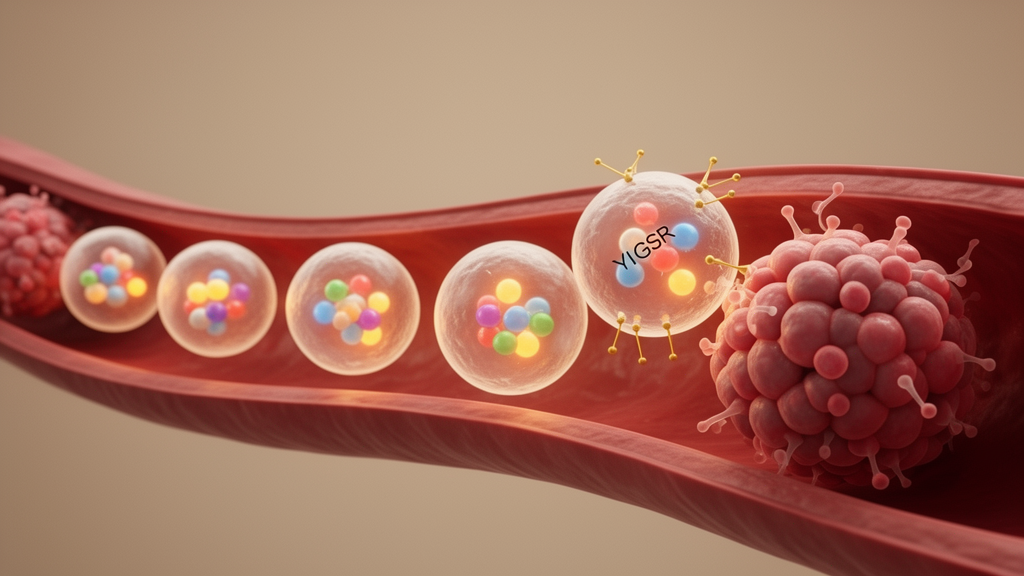
Researchers have developed a liposomal drug delivery system that carries two antitumor agents at once and is decorated with a peptide designed to steer it toward breast cancer cells. The formulation, described in BMC Biotechnology, encapsulates doxorubicin together with ent-11α-hydroxy-15-oxo-kaur-16-en-19-oic-acid, a compound abbreviated 5F, and modifies the liposome surface with the peptide sequence YIGSR. The work, led by Zhihong Duan, Xiaobing Hong, Zelin Yu, Hongbo Fu and Yanqiong Zhou, with Yanxia Huang as a co-author, was published as an open-access research article on 12 September 2026.
In the new formulation, designated YIGSR-(DOX-5F)-LP, the peptide is anchored to the liposome surface while the two drugs share the same carrier, an approach intended to combine the cytotoxic action of doxorubicin with the activity of 5F in a single particle that preferentially reaches tumor tissue.
The team first characterized the physicochemical properties of the dual-drug-loaded, peptide-modified liposomes. According to the abstract, the particles showed a uniform particle size, high encapsulation efficiency and a sustained release profile. These are key parameters for any liposomal medicine: a consistent size distribution supports reproducible behavior, high encapsulation efficiency means little drug is lost during preparation, and sustained release indicates that the payload leaves the carrier gradually rather than in a sudden burst.
The researchers then tested whether the formulation kills tumor cells more effectively than comparison formulations. In cytotoxicity assays conducted in vitro, YIGSR-(DOX-5F)-LP exerted the strongest cytotoxic effect and produced the highest levels of cellular apoptosis among the tested formulations in DOX-sensitive MCF-7 cells, a human breast cancer cell line. Apoptosis is a programmed form of cell death, and its measurement in these assays indicates that the co-loaded, peptide-targeted carrier triggered that death pathway in the cancer cells more effectively than the alternatives examined.
Targeting ability was assessed in two complementary ways. In vitro, the team performed cellular uptake assays in MCF-7 cells to see how much of the liposomal cargo entered the cells. In vivo, they carried out biodistribution studies in tumor-bearing nude mice, immunodeficient animals that accept human tumor implants and are a standard preclinical model for evaluating where a drug carrier travels in the body.
The results pointed in the same direction in both settings. Compared with non-targeted co-drug-loaded liposomes, called DOX-5F-LP, the YIGSR-modified version achieved higher cellular uptake in MCF-7 cells. In the mouse studies, the peptide-modified liposomes exhibited greater accumulation in tumor tissues relative to other major organs. That pattern matters because a major limitation of conventional chemotherapy is that a substantial fraction of the dose distributes to healthy tissues, causing side effects; a carrier that concentrates more of its payload in the tumor and less in vital organs could, in principle, widen the gap between efficacy and toxicity.
The authors conclude that YIGSR-(DOX-5F)-LP displayed prominent targeting activity toward MCF-7 cells both in vitro and in vivo, which they interpret as demonstrating potential for further preclinical investigation. It is important to read that conclusion at the right scale. The evidence comes from a single cell line and from biodistribution measurements in a mouse model; it shows where the carrier goes and what it does to cultured cells, not yet whether patients with breast cancer benefit from the treatment. Clinical efficacy, safety and dosing remain untested at this stage, and the formulation has not been evaluated in humans.
Co-encapsulation of two drugs in one particle can help ensure that both agents arrive at the same site in a coordinated ratio, which is difficult to achieve when two separate medicines are administered independently. Surface modification with targeting peptides is one of several strategies being explored to overcome the poor selectivity of conventional carriers, and the YIGSR sequence offers a relatively small and chemically tractable ligand compared with larger proteins or antibodies.
As published, the study is an early-access, peer-reviewed article that is citable and carries a permanent DOI, with a final version of record to follow. Its contribution is a concrete demonstration that adding the YIGSR peptide to a dual-drug liposome changes measurable outcomes in the laboratory and in a mouse model: more drug entering MCF-7 cells, more apoptosis in those cells, and more of the carrier ending up in tumor tissue rather than in other major organs. Whether those advantages translate into better treatment outcomes will depend on the preclinical and, eventually, clinical studies that the authors say the formulation warrants.
Subject of Research: Development and preclinical evaluation of YIGSR peptide-modified liposomes co-encapsulating doxorubicin and 5F for targeted breast cancer drug delivery
Article Title: In vitro and in vivo evaluation of YIGSR-modified liposomes co-loaded with doxorubicin and 5F
Article References: Duan, Z., Hong, X., Yu, Z., Fu, H., Zhou, Y., & Huang, Y. (2026). In vitro and in vivo evaluation of YIGSR-modified liposomes co-loaded with doxorubicin and 5F. BMC Biotechnology. https://doi.org/10.1186/s12896-026-01223-0
Image Credits: AI Generated
DOI: 10.1186/s12896-026-01223-0
Keywords: liposomes, YIGSR peptide, doxorubicin, 5F, drug delivery, MCF-7 cells, breast cancer, targeted therapy, biodistribution, tumor-bearing mice, combination therapy, preclinical study
News Source: Nathaniel Bowman. (October 30, 2026). Dual-Drug Liposomes With YIGSR Peptide Target Breast Tumor Cells in Mice. Scienmag.



