


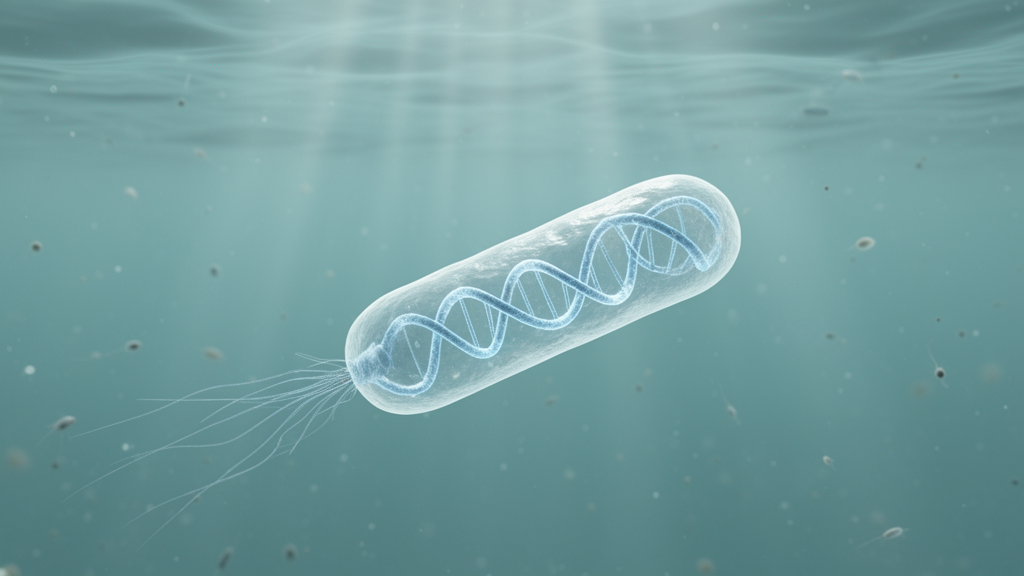
Researchers have assembled the first complete genome of Marinobacterium marisflavi, a marine bacterium originally isolated from coastal seawater of the Yellow Sea. The strain, designated IMCC4074 and flagged with the superscript T that marks it as the type strain of the species, was sequenced by Meora Rajeev, Yeonjung Lim, Ilnam Kang and Jang-Cheon Cho, who published the data note in BMC Genomic Data on 5 August 2026 as an open-access report.
The sequencing strategy combined short-read and long-read approaches, an approach that allows the small errors typical of high-throughput short reads to be corrected with the continuity offered by long reads. The result was a single circular chromosome of 3,091,487 base pairs, a size well within the range typical of free-living marine bacteria, with a guanine-plus-cytosine content of 52.45 percent. Because the assembly closed into one circular molecule, the researchers could place every gene in its exact order and orientation rather than leaving the genome fragmented across separate contigs.
Annotation of the chromosome identified 2,974 protein-coding sequences, the working instructions for the cell’s proteins, together with 15 ribosomal RNA genes and 60 transfer RNA genes. The complement of RNA genes indicates a bacterium equipped to translate proteins efficiently, a trait often associated with the ability to respond quickly to changing nutrient conditions in seawater. The protein-coding count gives researchers a defined starting point for predicting which metabolic pathways the organism can run and which substrates it can process in its coastal habitat.
Phylogenomic analyses confirmed the strain’s placement within the genus Marinobacterium. Members of this genus are widely distributed in marine environments and contribute to diverse ecological processes, yet genomic information for several of its species has remained limited, which is precisely the gap this data note addresses.
Comparative genomic analysis added a taxonomic dimension to the report. The genome showed sufficient divergence from previously described species within the genus, with average nucleotide identity at or below 95 percent, the threshold commonly used to distinguish bacterial species. This supports the strain’s standing as a distinct species and makes the report the first genome description for M. marisflavi, giving the species a fully assembled reference sequence for the first time.
The authors frame the resource as a foundation for understanding the potential ecological roles and adaptive strategies of M. marisflavi in marine ecosystems. A complete genome of a type strain is a practical tool for that purpose: other researchers can map newly sequenced environmental genomes onto it, search it for genes involved in carbon and nitrogen processing, and compare its repertoire with those of relatives from other marine settings to see which functions are shared and which are distinctive.
As a data note, the article reports the genome and its annotation rather than new experimental findings about the organism’s behaviour in the sea. The metabolic potential and environmental adaptation mentioned in the abstract are presented as insights the sequence can enable, not as demonstrated functions. Even so, the report closes a basic gap: a species described from coastal seawater now has a finished, circular genome that others can query, and the strain itself remains available as the reference point for future work on the genus.
Subject of Research: Complete genome sequence of the marine bacterium Marinobacterium marisflavi strain IMCC4074 isolated from coastal seawater
Article Title: Complete genome sequence of Marinobacterium marisflavi strain IMCC4074 isolated from coastal seawater
Article References: Rajeev, M., Lim, Y., Kang, I., & Cho, J.-C. (2026). Complete genome sequence of Marinobacterium marisflavi strain IMCC4074 isolated from coastal seawater. BMC Genomic Data, 27(1), Article 61. https://doi.org/10.1186/s12863-026-01454-2
Image Credits: AI Generated
DOI: 10.1186/s12863-026-01454-2
Keywords: Marinobacterium marisflavi, complete genome, Yellow Sea, coastal seawater, genome annotation, phylogenomics, average nucleotide identity, BMC Genomic Data, marine microbiology, type strain, Complete, genome
News Source: Juliet Wilcox. (October 30, 2026). Marine bacterium from the Yellow Sea yields its first complete genome. Scienmag.



