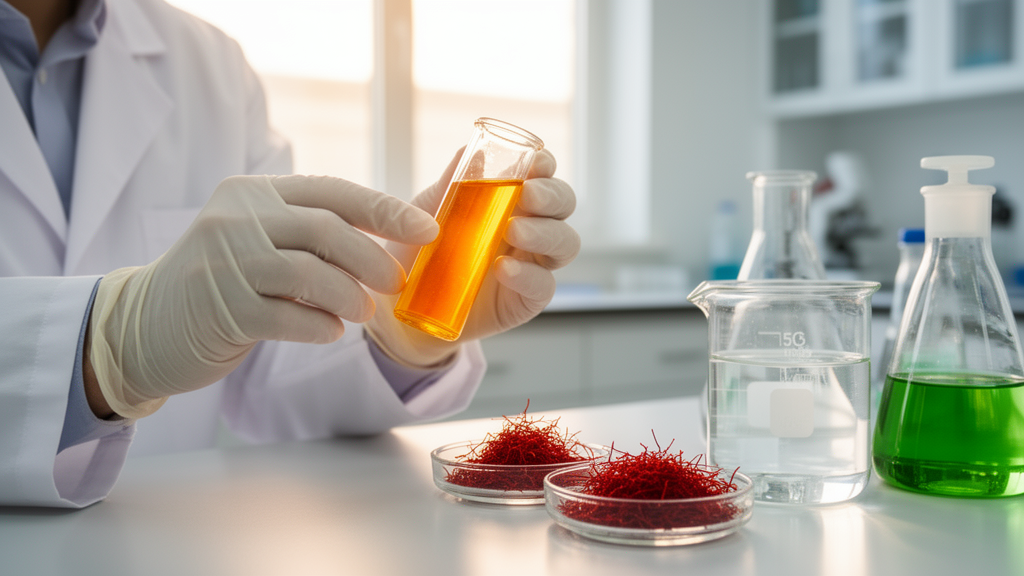
Researchers have developed and optimized a non-chromatographic process that converts crocins extracted from saffron stigmas into crocetin and its far more water-soluble sodium salt, disodium crocetinate, while recovering safranal as a co-product. The study, published in Frontiers in Sustainable Food Systems, reports that the optimized hydrolysis step achieved a conversion yield of 85.5% at 75% purity, and that the subsequent purification route delivered crocetin with an estimated purity of 99.3% based on HPLC-DAD and HPLC-MS analyses.
Saffron, Crocus sativus L., is among the world’s most valuable spices and is a potential source of bioactive compounds for food, pharmaceutical, nutraceutical, and cosmetic applications. Their aglycone, crocetin, has attracted attention in pharmaceutical sciences, but crocetin itself is poorly soluble in water. Its disodium salt, disodium crocetinate, dissolves far more readily, which is why the authors targeted this form as the end product of their process.
The workflow described by the team, based at Shahid Beheshti University in Tehran and the University of Bologna, proceeds through sequential conversion of saffron crocins by hydrolysis, purification, and crystallization. Hydrolysis of total crocin extracted from saffron stigmas was optimized using response surface methodology. In parallel, safranal was concentrated and isolated by liquid-liquid extraction.
A notable side result of the processing was that the safranal content increased twelvefold during the workflow, and the compound was successfully recovered as a valuable co-product. Because safranal is itself of commercial interest, recovering it alongside the main crocetin product improves the overall valorization of the saffron raw material rather than discarding one fraction to obtain another.
Their non-chromatographic procedure consisted of aqueous extraction to remove carbohydrates, methanolic extraction of polyphenolic impurities, and recrystallization in dimethylformamide. This sequence yielded a highly pure final product, with purity estimated at 99.3% by the two HPLC-based analytical methods.
Because sustainability was an explicit design goal, the team quantified the environmental and human safety profile of the purification process using greenness metrics. ChlorTox values were calculated for ethanol, dimethylformamide, and diethyl ether as 617478, 2982, and 1412, respectively, reflecting the very different toxicity burdens of these solvents. The AGREEprep score for the overall process was estimated at 0.52.
The authors position the resulting process as economical, efficient, simple, environmentally friendly, and potentially scalable. The claim of scalability rests on the removal of chromatographic steps and the use of standard unit operations such as extraction, hydrolysis, and crystallization, which are common in industrial processing. However, the published evidence at this stage describes an optimized laboratory process; the abstract reports yields, purities, and greenness calculations, and the final formatted article is noted as forthcoming, so independent scale-up performance remains to be demonstrated.
In this case, one saffron input stream yields both a water-soluble crocetin derivative of pharmaceutical interest and a concentrated aroma compound, with response surface methodology used to squeeze the maximum conversion out of the hydrolysis step.
For readers following saffron chemistry, the key numbers are straightforward to summarize. Hydrolysis converted 85.5% of the crocin input at 75% purity. Purification raised the final crocetin purity to an estimated 99.3%. Safranal content rose twelvefold and was recovered. The purification process scored 0.52 on the AGREEprep greenness scale, and the ChlorTox toxicity calculations for ethanol, dimethylformamide, and diethyl ether were 617478, 2982, and 1412 respectively. Whether this laboratory-optimized strategy translates into industrial production of disodium crocetinate will depend on validation at larger scales, but the work provides a detailed, quantified starting point for that transition.
Subject of Research: Development of a scalable non-chromatographic process for producing disodium crocetinate and safranal from saffron stigmas
Article Title: Optimized, sustainable and scalable strategy for producing disodium crocetinate from Crocus sativus L. stigmas
Article References: Soleimani, M., Mirzajani, F., Valli, E., Shabani Azin, F., Tabesh, A., & Rezadoost, H. (2026). Optimized, sustainable and scalable strategy for producing disodium crocetinate from Crocus sativus L. stigmas. Frontiers in Sustainable Food Systems, 10, Article 1958025. https://doi.org/10.3389/fsufs.2026.1958025
Image Credits: AI Generated
DOI: 10.3389/fsufs.2026.1958025
Keywords: saffron, crocetin, disodium crocetinate, crocins, safranal, response surface methodology, hydrolysis, green chemistry, HPLC, Crocus sativus, purification, biorefinery
News Source: Alan Morgan. (October 29, 2026). Scientists Turn Saffron Into a Water-Soluble Compound With a Greener Process. Scienmag.