


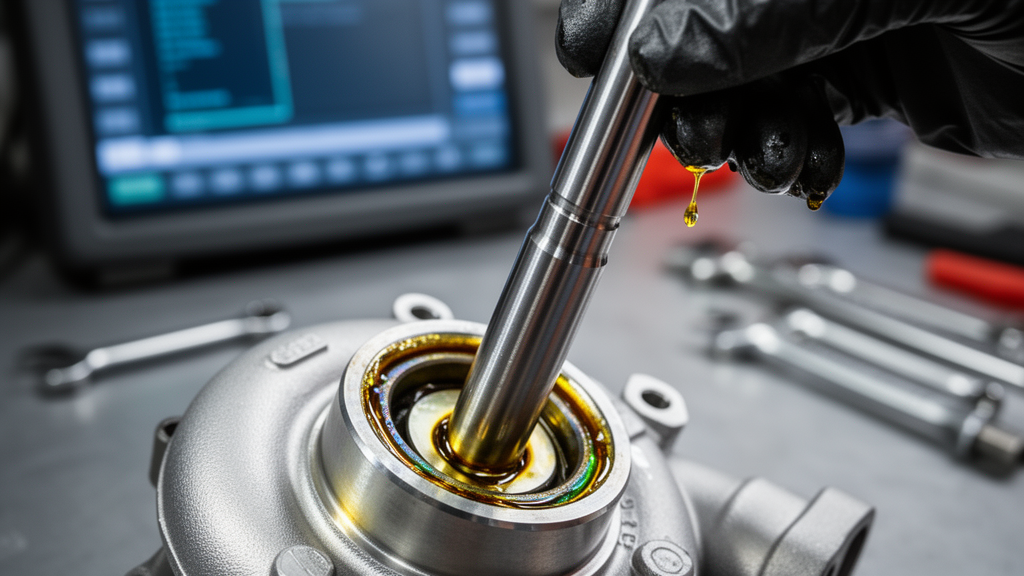
A tiny change in the clearance of the outer oil film inside a turbocharger’s floating ring bearing can swing the machine’s subsynchronous vibration by more than an order of magnitude, according to a new simulation and experimental study published in Frontiers in Mechanical Engineering. When researchers widened the outer oil film clearance from 0.030 mm to 0.036 mm, the maximum amplitude of the outer oil film’s subsynchronous vibration jumped from 0.01 mm to 0.16 mm, while the inner oil film’s subsynchronous vibration fell from 0.05 mm to 0.02 mm. The finding, reported by Xinli Zhong, Hui Xu, Shigang Qin and Xiaohua Chen, offers a practical lever for taming the self-excited vibrations that plague high-speed turbocharger rotors.
Turbochargers are among the fastest rotating machines in the automotive industry. A small-size turbocharger rotor can spin at up to 200,000 rpm, far above most other industrial rotating equipment. To keep such extreme speeds manageable, manufacturers typically mount the rotor on floating ring bearings rather than conventional plain journal bearings. These bearings are cheap, well suited to mass production, and bring two extra advantages: better damping and less friction loss, which together help reduce the cost of the whole vehicle.
A floating ring bearing works by inserting a free-spinning ring between the rotating journal and the fixed bearing housing. This ring splits the lubricant into two separate films: an inner oil film between the journal and the ring, and an outer oil film between the ring and the housing. The arrangement lowers the relative speed between the journal and the housing, cuts frictional power consumption, and improves the stability of the rotor system. But the same dual-film design makes the bearing highly nonlinear, and at high speeds turbocharger rotors can suffer severe subsynchronous vibrations driven by instability in the floating ring bearing.
Previous studies have documented a wide unstable operating region caused by high-speed operation, in which the rotor experiences strong subsynchronous motion. Yet the nonlinearity of the floating ring bearing can also generate a stable limit cycle above the linearly predicted instability threshold, with amplitudes low enough that the rotor can still run safely. The danger lies elsewhere: incorrectly designed bearing structural parameters can, under some conditions, lead to critical failure of the turbocharger, and various spectral bifurcations or nonlinear jumping phenomena are associated with uncomfortable noise. Undesired subsynchronous components can be suppressed by adjusting the bearing structure parameters, but the relationships between individual subsynchronous vibration amplitudes and the oil film clearances remained unclear.
To close that gap, the team combined theoretical analysis, finite element simulation and experimental verification. Starting from the Reynolds equation and fluid lubrication theory, they built a finite element model of the floating ring bearing that yields the pressure distribution and the dynamic characteristic coefficients of both oil films. They then constructed a finite element model of the full floating ring bearing rotor system for a high-speed gasoline engine turbocharger and computed its nonlinear transient response with the Newmark direct integration method, sweeping rotor speeds from 10 to 240 krpm.
The bearing parameters were held partly fixed to isolate the effect of interest. The shaft diameter was 6.000 mm and the inner diameter of the floating ring 6.020 mm, so the inner oil film clearance stayed constant throughout. The outer oil film clearance was set at four levels: 0.030, 0.032, 0.034 and 0.036 mm, achieved by pairing bearing housing diameters of 9.600 to 9.606 mm with floating ring outer diameters of 9.540 to 9.634 mm. The lubricant was 10W30 oil supplied at an inlet temperature of 90 °C.
The simulations revealed a clear chain of physical consequences. As the outer oil film clearance increased, the ring speed ratio rose, consistent with the theoretical speed-ratio formula. The outer oil film’s friction power consumption and temperature rise increased while its viscosity decreased, because the floating ring spun faster and its relative angular velocity against the housing grew. Conversely, the inner oil film’s temperature rise fell and its viscosity increased, since the ring’s relative angular velocity against the journal dropped. These viscosity shifts fed directly into the damping coefficients: the outer oil film damping coefficient fell to 0.3 times its original value, while the inner oil film damping coefficient rose to 1.1 times its original value. Because the outer film’s change was proportionally larger, the overall bearing damping coefficient followed the outer film and decreased.
Those damping changes translated directly into the rotor’s vibration behavior. With a small imbalance of 0.005 g mm applied at the same phase to four nodes of the rotor model as initial excitation, the vibration was dominated first by the inner oil film’s subsynchronous component. As the outer clearance grew, dominance gradually shifted to the outer oil film’s subsynchronous vibration, while the synchronous vibration stayed far smaller than the subsynchronous components and was barely visible in the waterfall diagrams. Quantitatively, raising the clearance from 0.030 mm to 0.036 mm not only raised the outer film’s peak amplitude from 0.01 mm to 0.16 mm but also lowered the speed at which the outer film subsynchronous vibration starts from 235 krpm to 110 krpm. Meanwhile the inner film’s peak amplitude dropped from 0.05 mm to 0.02 mm, and the speed at which its subsynchronous vibration ends fell from 190 krpm to 45 krpm.
To check the model against reality, the researchers built a turbocharger vibration test bench. Holes drilled in the compressor shell held a photoelectric speed sensor for rotor speed and two eddy current displacement sensors, placed vertically at the compressor wheel end and fixed 0.3 mm from the lock nut, to measure radial vibration displacement. The rig ran at room temperature with 10W30 lubricant, and the turbine was driven by exhaust gas at an inlet temperature of about 600 °C, pushing the rotor up to 250 krpm. Measurement quality was tightly controlled: sensor offset mounting error stayed below 0.2%, oil supply temperature error below 0.1%, foundation-transmitted vibration was negligible thanks to base isolation, and readings were taken only after the rotor reached thermal stability.
The tests with outer oil film clearances of 0.030 mm and 0.036 mm matched the simulations closely. In the small-clearance case, the inner oil film subsynchronous vibration was very significant and ended at about 190 krpm, while the outer film’s subsynchronous vibration was essentially absent. In the large-clearance case, the outer film subsynchronous vibration started at about 110 krpm and dominated, with the inner film’s subsynchronous motion appearing only a little below 45 krpm. One difference did emerge: the 1X frequency amplitude was more obvious in the experimental colormap than in the simulation, which the authors attribute to rotor thermal deformation and bending caused by the 600 °C exhaust gas, creating a new unbalanced force. Overall, the agreement confirmed that the finite element model and the research method are reasonable. The authors conclude that the outer oil film clearance should be deliberately designed to balance the inner and outer film subsynchronous vibrations, minimizing total vibration and improving system stability, and they note that further analysis across each speed range is needed because high-speed turbochargers operate over a wide range with complex subsynchronous behavior.
Subject of Research: How the outer oil film clearance of a floating ring bearing governs subsynchronous vibration in a turbocharger rotor system
Article Title: The influence of floating ring bearing outer oil film clearance on subsynchronous vibration of turbocharger rotor system
Article References: Zhong, X., Xu, H., Qin, S., & Chen, X. (2026). The influence of floating ring bearing outer oil film clearance on subsynchronous vibration of turbocharger rotor system. Frontiers in Mechanical Engineering, 12, 1937848. https://doi.org/10.3389/fmech.2026.1937848
Image Credits: AI Generated
DOI: 10.3389/fmech.2026.1937848
Keywords: turbocharger, floating ring bearing, outer oil film clearance, subsynchronous vibration, damping coefficient, rotor dynamics, finite element simulation, Newmark integration, oil film viscosity, experimental verification, influence, floating
News Source: Denise Maddox. (October 30, 2026). Oil Film Clearance Shifts Turbocharger Subsynchronous Vibration Between Oil Films. Scienmag.



