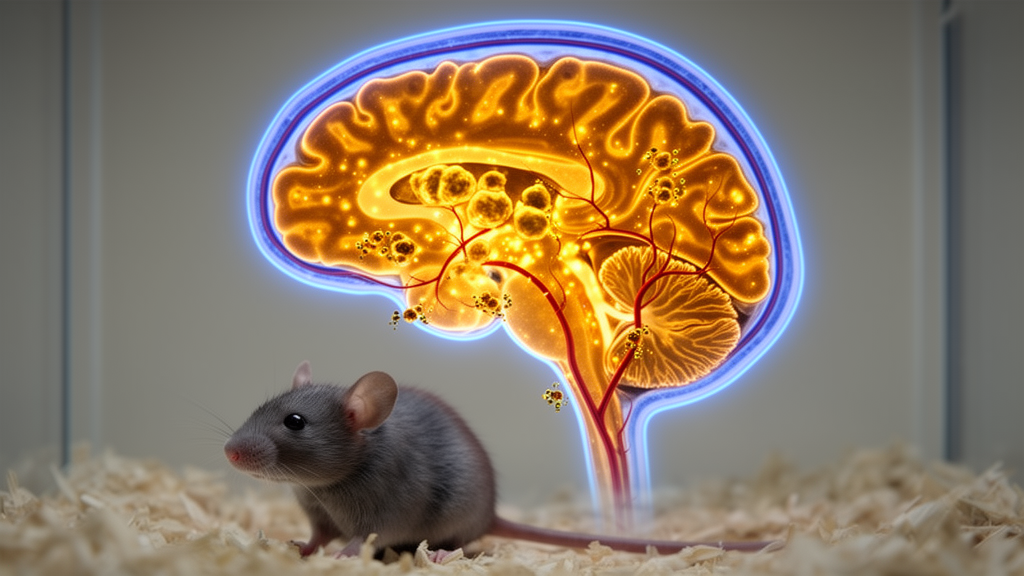
A single bout of influenza early in life can leave a lasting imprint on the brain, and new research suggests that this imprint interacts with Alzheimer’s disease in ways that are far from straightforward. In a study published in Frontiers in Behavioral Neuroscience, a team based at Peter the Great St. Petersburg Polytechnic University and the Smorodintsev Research Institute of Influenza reports that mice carrying an Alzheimer’s-like genetic mutation show markedly altered behavioral and neuroinflammatory profiles after recovering from a sublethal H1N1pdm influenza infection. Yet, unexpectedly, the virus did not deepen the synaptic damage that the transgenic animals already carried. Instead, the interplay between systemic inflammation and neurodegeneration followed a non-additive pattern, with the infection amplifying some deficits while leaving established synaptic impairment essentially unchanged.
The experimental design hinged on the 5xFAD mouse, a widely used model of Alzheimer’s disease that carries five human familial AD mutations and develops rapid amyloid-beta accumulation alongside early deficits in learning and memory. Because homozygous 5xFAD animals die early, the researchers crossbred male 5xFAD mice with female M-line mice carrying the Thy1-GFP reporter, generating heterozygous 5xFAD animals and wild-type littermates. At two months of age, mice were infected intranasally with a mouse-adapted strain of influenza A/California/7/09 (H1N1)pdm09 at a dose equal to one median lethal dose, which had been determined in preliminary experiments to be identical for transgenic and wild-type animals. The infection caused significant morbidity and mortality in both groups, and the surviving animals were then carried forward into a lengthy battery of behavioral testing beginning at seven months of age, roughly five months after recovery from the acute illness.
The behavioral results revealed a complex picture of social and affective change. In the three-chamber social test, infected 5xFAD mice spent substantially less time in the chamber containing an unfamiliar mouse than infected wild-type controls, while paradoxically increasing the time and number of visits directed at a non-social object. A parallel social interaction test confirmed reduced social sniffing and increased walking in the infected transgenic group. In the open field, infected 5xFAD mice explored a novel non-social object far less than infected wild-type mice, although the authors caution that the central placement of stimuli in that arena makes it difficult to distinguish reduced curiosity from anxiety-driven avoidance of the center. Together, the social findings point toward a shift in preference away from social stimuli, a change reminiscent of the apathy and social withdrawal often observed clinically in Alzheimer’s patients.
Affective behavior told a similarly nuanced story. In the tail suspension test, total immobility did not differ between groups, but a time-resolved analysis showed that infected 5xFAD mice froze significantly more during the first minute of the trial, indicating an early onset of depressive-like responding. No differences emerged in the forced swim test or in the sucrose preference test, suggesting that anhedonia was not involved. The authors note that water temperature critically influences forced swim behavior and may have masked differences in that paradigm. Meanwhile, in the light-dark place preference test, infected transgenic mice unexpectedly spent more time in the brightly lit compartment, an apparent anxiolytic-like profile, but the sharply reduced number of transitions between compartments hinted at diminished exploratory activity or impaired behavioral flexibility rather than a genuine easing of anxiety.
Memory testing strengthened the case that prior infection exacerbates cognitive decline in the Alzheimer’s model. All groups learned the location of the hidden platform in the Morris water maze during training, but the probe trial separated the genotypes sharply. Infected 5xFAD mice crossed the former platform location far fewer times than uninfected transgenic animals, and the deficit occurred without any difference in swimming speed, ruling out motor explanations. Fear conditioning extended the finding: while all groups acquired fear associations on day three, both 5xFAD groups failed to demonstrate significant contextual freezing on day ten, and infected transgenic mice also showed reduced cued freezing relative to infected wild-type controls. The pattern suggests that influenza infection preferentially compromises the later stages of memory consolidation in animals whose hippocampal circuits are already compromised by amyloid pathology.
Electrophysiology in acute hippocampal slices supplied a mechanistic anchor for these behavioral observations. Long-term potentiation at CA1 synapses, the canonical cellular substrate of hippocampal memory, was significantly reduced in 5xFAD mice compared with wild-type controls, consistent with prior literature. Infection alone reduced dendritic spine density in wild-type animals and shifted the spine population toward immature thin and stubby morphologies at the expense of mature mushroom spines. Remarkably, however, infected 5xFAD mice showed no further reduction in LTP or spine density relative to their uninfected transgenic counterparts. The authors interpret this as a floor-like or occlusion effect: because amyloid-driven pathology has already disrupted glutamatergic signaling, NMDA receptor-dependent calcium influx, ryanodine receptor-mediated calcium release, and store-operated calcium entry through STIM2, there may simply be little remaining dynamic range for an additional infection-induced decrement to become measurable.
Where the synapses plateaued, the glial response did not. Western blotting of hippocampal lysates revealed that both amyloid pathology and viral infection independently elevated expression of GFAP, a marker of reactive astrocytes, and Iba1, a marker of activated microglia, with the strongest signal detected in infected 5xFAD mice, whose Iba1 levels more than doubled those of infected wild-type animals. Quantitative immunohistochemistry confirmed elevated amyloid plaque burden in the transgenic hippocampus, modestly increased in infected 5xFAD mice, alongside astrocyte hypertrophy. High-magnification morphometric reconstruction of individual cells revealed that astrocytes in 5xFAD mice expanded their arbor, gaining branch points, Sholl complexity, and surface area, while infection selectively lengthened astrocytic branches without uniformly adding complexity. Microglia, by contrast, underwent a dramatic loss of ramification after infection, with infected 5xFAD mice showing roughly a third of the branch points of uninfected transgenic animals, a shift toward a compact, ameboid phenotype most pronounced when the two pathologies were combined.
The dissociation between behavioral, synaptic, and glial outcomes carries real weight for translational research. Clinical studies have long shown that systemic infections accelerate cognitive decline in Alzheimer’s patients, that hospitalization and delirium raise the risks of institutionalization and mortality, and that people with dementia suffer a disproportionate burden of infection-related hospitalization. The new mouse data suggest that such clinical deterioration may not reflect a uniform worsening of every pathological process at once. Rather, a peripheral viral insult may preferentially amplify neuroinflammation and behavioral disturbance while the synaptic substrate, already near its pathological floor, changes little. This reframing implies that infection-associated decline in patients could be driven largely by inflammatory mechanisms and reduced neural reserve, rather than by direct viral effects on the brain, which the influenza virus does not typically invade.
The study is not without caveats. The authors acknowledge that open field interpretation is constrained by stimulus placement, that no molecular markers of specific astrocytic or microglial activation states were measured, and that the proposed calcium-signaling explanation for the synaptic occlusion remains a hypothesis requiring direct experimental validation. Nevertheless, the translational message is clear and actionable. In a large nationwide cohort of older adults with dementia, influenza vaccination was associated with lower hospitalization and mortality rates, and the present findings offer a biological rationale for aggressive infection prevention, vigilant post-infectious monitoring, and therapies aimed at restraining excessive glial activation or preserving synaptic resilience. The work ultimately reframes the relationship between viral illness and neurodegeneration: systemic inflammation does not simply add injury upon injury, but reshapes the phenotype of the disease in ways that depend critically on how far the neurodegenerative process has already progressed.
Subject of Research: Effects of prior H1N1pdm influenza infection on behavior, synaptic plasticity, and neuroinflammation in a mouse model of Alzheimer's disease
Article Title: Influenza A (H1N1)pdm infection exacerbates behavioral, cognitive, and synaptic impairments in 5xFAD mice
Article References: Rakovskaya, A., Lozhkov, A., Tverdokhlebova, V., Zabrodskaya, Y., Vinokurov, E., Kirenskaya, V., Erofeev, A., Garshinina, A., Zryacheva, V., Shtro, A., Pchitskaya, E., Vlasova, O., Elpaeva, E., Dav, P., Bezprozvanny, I., & Vasin, A. (2026). Influenza A (H1N1)pdm infection exacerbates behavioral, cognitive, and synaptic impairments in 5xFAD mice. Frontiers in Behavioral Neuroscience, 20, Article 1955816. https://doi.org/10.3389/fnbeh.2026.1955816
Image Credits: AI Generated
DOI: 10.3389/fnbeh.2026.1955816
Keywords: Alzheimer's disease, influenza A H1N1pdm, 5xFAD mice, neuroinflammation, synaptic plasticity, long-term potentiation, dendritic spines, microglia, astrocytes, hippocampus, behavioral neuroscience, viral infection
News Source: Cassandra Pierce. (October 15, 2026). Prior Flu Infection Reshapes Brain Inflammation and Behavior in Alzheimer’s Mice. Scienmag.