People living with serious mental illness are two to three times more likely to develop type 2 diabetes than the general population, and they lose an estimated 15 to 20 years of life expectancy as a result of preventable physical illness. Yet the technologies that have transformed diabetes care for millions remain largely untested in this group, who are routinely excluded from research and often miss out on innovations in routine care. A new exploratory study from the UK now offers the first dedicated evidence that one of those technologies, the continuous glucose monitor, can be both workable and genuinely welcomed by people living with conditions such as schizophrenia, psychosis, and bipolar disorder.
The research, led by Jennifer V.E. Brown of the University of Sheffield and colleagues at the University of York, University of Leeds, and other institutions, was published in Frontiers in Clinical Diabetes and Healthcare. It was embedded within the larger DIAMONDS feasibility study, which recruited community-dwelling adults with serious mental illness and type 2 diabetes from six NHS mental health trusts in the north of England. After participants completed a 16-week self-management support programme, they were invited to wear a blinded FreeStyle LibrePro sensor for 14 days. In a blinded system, the wearer never sees the readings; the data are downloaded by healthcare professionals after the sensor is removed, which allowed the team to test whether people with serious mental illness could tolerate the device without the psychological risk of being overwhelmed by real-time glucose numbers.
The feasibility results were strikingly positive. Of the 21 participants eligible to be offered a sensor, 16 agreed to wear one, an uptake rate of 76.2 percent. Participants wore the sensors for an average of 11 days out of the intended 14, and of the sensors returned with usable data, 92.8 percent captured at least five days of readings. No adverse events, either diabetes-related or mental-health-related, were reported throughout the study. Two participants experienced premature sensor detachment, and seven sensors were lost or discarded for various reasons, but the overall picture was of a technology that this population could engage with reliably and safely.
The sensor data themselves revealed the clinical challenge the technology could help address. Among those who wore a device, time in the target glucose range of 3.9 to 10.0 mmol/L averaged just 56.1 percent, with 39.2 percent of time spent above range, and participants’ average body mass index stood at 37.5 kg/m². These figures underscore why researchers are keen to bring sophisticated monitoring into a population whose diabetes tends to be poorly controlled and more prone to serious complications than in the general population.
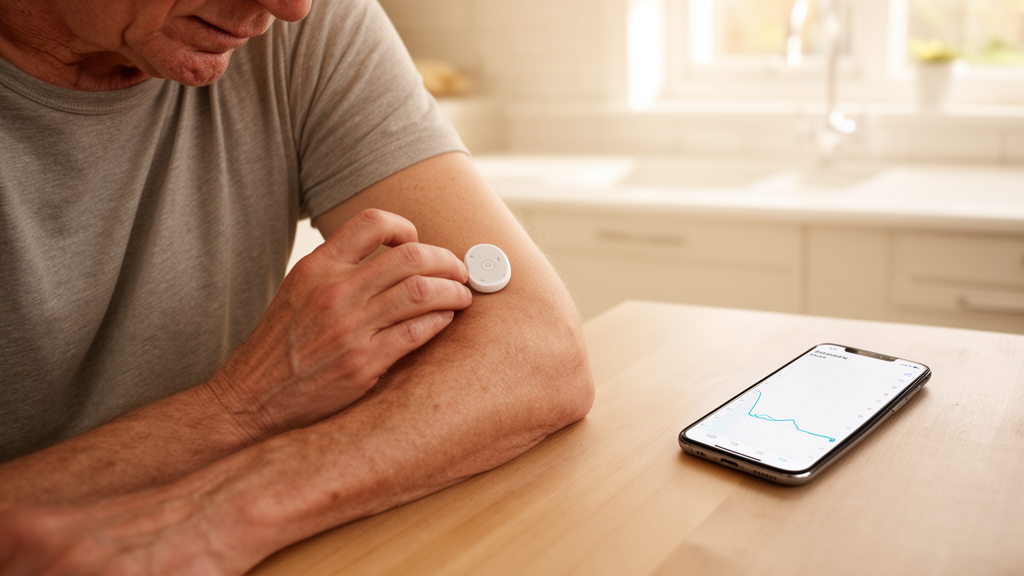
To understand what wearing a sensor actually felt like, the team conducted semi-structured interviews with nine participants. Participants described near-seamless integration into daily life. One said they forgot the sensor was even there; another reported no side effects and no pain, noting they could shower or bathe normally. Initial apprehension, common in people who have grown used to needles through regular diabetes care, gave way to curiosity and satisfaction. One participant was so enthusiastic that they announced to friends they would be wearing a fancy-pants glucose monitor, and another said they kept checking for the sensor after it was removed, having missed its presence.
The most compelling theme was the dramatic reduction in burden compared with traditional finger-prick testing. Participants with experience of self-monitoring of blood glucose described CGM as far less intrusive than jabbing a needle into a finger several times a day, comparing the discreet arm patch to a nicotine patch. This matters because the effort and friction of diabetes self-management has been repeatedly shown to be a barrier to engagement, and people with serious mental illness already face substantial demands managing psychiatric medications, appointments, and the day-to-day effects of their symptoms on top of diabetes care.
The adhesive was the main weakness. Several sensors fell off prematurely after minor knocks, and some participants resorted to do-it-yourself fixes such as bandaging the device in place. Yet even participants who lost sensors were willing to try again with replacement devices, which the researchers read as evidence of persistence and positive engagement. In the theoretical framework the team used, developed by Sekhon and colleagues, these experiences mapped onto two dominant domains: affective attitude, meaning how people felt about the technology, and burden, meaning the effort it required. Both clustered strongly on the positive side.
The study also pioneered a hybrid human-artificial intelligence analysis. The researchers first coded interview transcripts manually using reflexive thematic analysis, then trained a custom generative pre-trained transformer to map the resulting codes onto two established behavioural frameworks: the Theoretical Framework of Acceptability and the Theoretical Domains Framework. A researcher reviewed and corrected every mapping, preserving human oversight while exploiting the pattern-recognition strengths of large language models. This cross-framework analysis produced three insights into why the sensors were accepted: the low-friction physical design reduced perceived effort, positive beliefs about the data’s usefulness turned initial nervousness into enthusiasm, and the discreet device aligned with a proactive identity as a contributor to research rather than imposing a stigmatising medical identity.
That identity dimension may be the study’s most novel finding. Many participants said the best part of wearing the sensor was contributing to research that could help others, with one describing the desire to help the next generation. The sensor did not conflict with participants’ sense of self; instead it reinforced feelings of self-worth and social utility. For a population long subjected to the outdated assumption that people with serious mental illness cannot or do not want to engage with health technology, this finding directly challenges stigma and suggests willingness is not the barrier it is often assumed to be.
The authors caution against an unsupported rollout. The study was small, exploratory, and conducted within a research setting where participants had already built relationships with the study team and were partly motivated by altruism. The blinded sensor used is licensed for research but not clinical use in the UK, and the study did not test the real-time unblinded systems that patients would encounter in practice. Researchers also did not record diagnostic subtypes within the serious mental illness category, which encompasses conditions with very different symptom profiles, so acceptability across subgroups remains unknown. Nonetheless, the findings provide a robust foundation for designing structured, theory-informed CGM interventions with wrap-around education and support, precisely the kind of low-burden approach that could help close the mortality gap for a population in which, despite decades of effort, preventable physical illness continues to shorten lives.
Subject of Research: Acceptability and feasibility of blinded continuous glucose monitoring in people with serious mental illness and type 2 diabetes
Article Title: Acceptability of blinded continuous glucose monitoring for people with serious mental illness and type 2 diabetes: findings from an exploratory mixed-methods study
Article References: Brown, J. V., Ajjan, R. A., Siddiqi, N., & Coventry, P. A. (2026). Acceptability of blinded continuous glucose monitoring for people with serious mental illness and type 2 diabetes: findings from an exploratory mixed-methods study. Frontiers in Clinical Diabetes and Healthcare, 7, Article 1923186. https://doi.org/10.3389/fcdhc.2026.1923186
Image Credits: AI Generated
DOI: 10.3389/fcdhc.2026.1923186
Keywords: continuous glucose monitoring, serious mental illness, type 2 diabetes, acceptability, feasibility, mixed methods, health technology, behaviour change, mortality gap, NHS, Theoretical Framework of Acceptability, generative AI
News Source: Ophelia Keating. (October 15, 2026). Glucose Sensors Win Over People With Serious Mental Illness, Study Finds. Scienmag.