Breast cancer that spreads to the lungs remains a major driver of treatment resistance and cancer-related death, and a new review argues that the reason may lie not in tumor cells alone but in a self-reinforcing partnership between two blood components: platelets and neutrophils. Writing in Breast Cancer Research, the authors synthesize mechanistic and translational evidence on how this platelet-neutrophil axis helps build a permissive environment for pulmonary colonization, and they assess whether hydrogel-based biomaterials could eventually interrupt it.
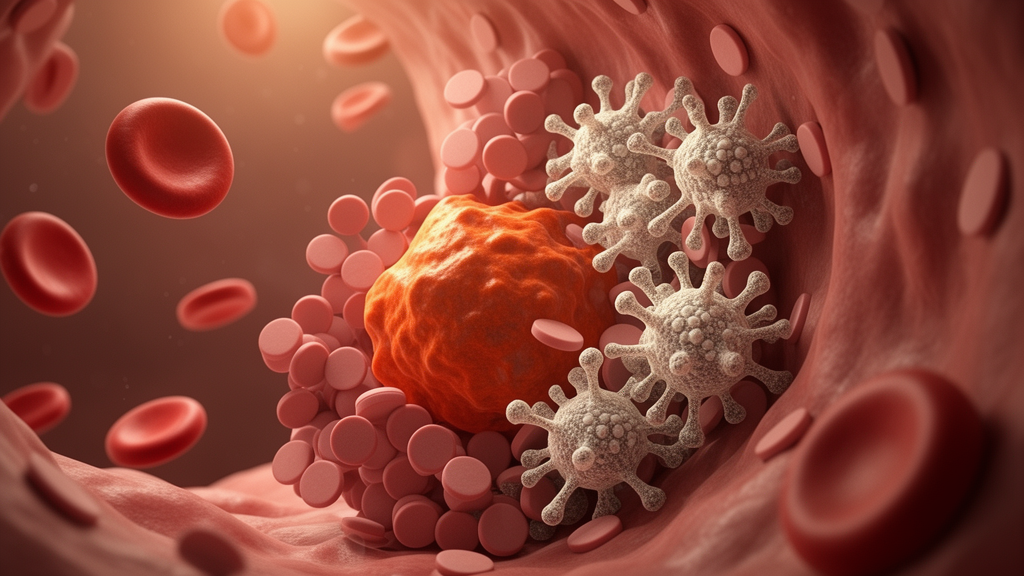
The review’s central concept is a thromboinflammatory circuit. Activated platelets often shield circulating tumor cells from immune attack and mechanical stress in the bloodstream, and they facilitate the adhesion of these cells to blood vessel walls and their arrest in the lungs. Some tumor-entrained neutrophil states may actually restrict the seeding of new metastases, while cytokine-reprogrammed states, and especially neutrophils that release neutrophil extracellular traps (NETs), web-like structures of DNA and granule proteins, promote matrix remodeling, endothelial activation, immunosuppression, and colonization.
Crucially, the authors emphasize that platelets and neutrophils do not act independently. Reciprocal signaling between the two cell types establishes what they describe as a self-reinforcing circuit characterized by selectin-mediated adhesion, chemokine amplification, NETosis, and microvascular immunothrombosis. In practical terms, platelets recruit and activate neutrophils, neutrophil products in turn activate more platelets, and the resulting loop generates a pre-metastatic and metastatic lung niche in which arriving tumor cells can survive and expand.
The evidence base is not purely preclinical. The review notes that human findings in metastatic breast cancer include platelet-coated circulating tumor cells, clusters of circulating tumor cells bound to neutrophils, NETs detected in tissues, and circulating NET markers that carry prognostic relevance. These observations anchor the proposed circuit in clinical material, although the authors are careful to frame the axis as an important, context-dependent contributor rather than a universally acting mechanism.
That caution extends to the biology itself. The review repeatedly stresses that platelet effects vary by target, timing, metastatic route, and organ, so interventions aimed at platelets cannot be assumed to work identically across metastatic sites. Similarly, because neutrophils can both restrain and promote colonization depending on their functional state and the evolving niche context, therapeutic strategies would need to target specific neutrophil states rather than neutrophils as a whole.
The second half of the review turns to biomaterials, evaluating hydrogel-enabled interventions through an evidence-tiered framework that separates breast cancer-specific in vivo efficacy from cross-tumor proof of concept and from mechanistically motivated design alone.
What the evidence actually supports is narrow. Direct evidence for circuit-oriented hydrogel therapy in breast cancer is currently limited to a localized NET-degrading combination treatment applied after incomplete resection of 4T1 tumors, a mouse breast cancer model, where the review’s article highlights describe proof-of-concept efficacy in postoperative models while noting that the evidence remains limited. In contrast, the authors state that genuinely NET-triggered materials and platelet-mimetic hydrogels have not yet demonstrated efficacy against breast cancer lung metastasis. These emerging architectures are therefore presented as testable strategies rather than established precision antimetastatic platforms.
The review also situates the circuit within the broader formation of the pre-metastatic lung niche, which its article highlights attribute to exosomal signaling, stromal remodeling, and endothelial activation. Within this ecosystem, the platelet-neutrophil loop functions as a dynamic thromboinflammatory layer that prepares lung tissue for arriving tumor cells, challenging the traditional view of metastasis as a process driven by tumor-cell autonomy alone.
By integrating metastatic immunobiology with advanced biomaterials engineering, the authors position the platelet-neutrophil axis as both a mechanistically relevant circuit in breast cancer lung metastasis and a potentially actionable therapeutic vulnerability for precision antimetastatic intervention. The practical takeaway for the field is twofold: the circuit offers a coherent framework linking immunothrombosis, endothelial dysfunction, inflammatory signaling, and NET-mediated metastatic trapping; and translating that framework into therapy will require direct validation in breast cancer models before hydrogel-guided strategies can be considered more than promising designs. As a review, the article synthesizes existing evidence and proposes a research agenda rather than reporting new experimental results, and its authors note that the published version is an early shared version subject to further edits.
Subject of Research: The role of the platelet-neutrophil immunothrombotic circuit in breast cancer lung metastasis and hydrogel-guided therapeutic strategies
Article Title: The platelet-neutrophil metastatic circuit in breast cancer: from pulmonary pre-metastatic niche formation to hydrogel-guided therapeutic intervention
Article References: Heydari, F., Fahmi, S., Hamblin, M. R., & Naghinezhad, J. (2026). The platelet-neutrophil metastatic circuit in breast cancer: from pulmonary pre-metastatic niche formation to hydrogel-guided therapeutic intervention. Breast Cancer Research. https://doi.org/10.1186/s13058-026-02399-1
Image Credits: AI Generated
DOI: 10.1186/s13058-026-02399-1
Keywords: breast cancer, lung metastasis, platelets, neutrophils, neutrophil extracellular traps, circulating tumor cells, pre-metastatic niche, immunothrombosis, hydrogels, biomaterials, tumor microenvironment, platelet-neutrophil
News Source: Nathaniel Bowman. (October 29, 2026). Platelets and Neutrophils Team Up to Drive Breast Cancer Lung Metastasis. Scienmag.