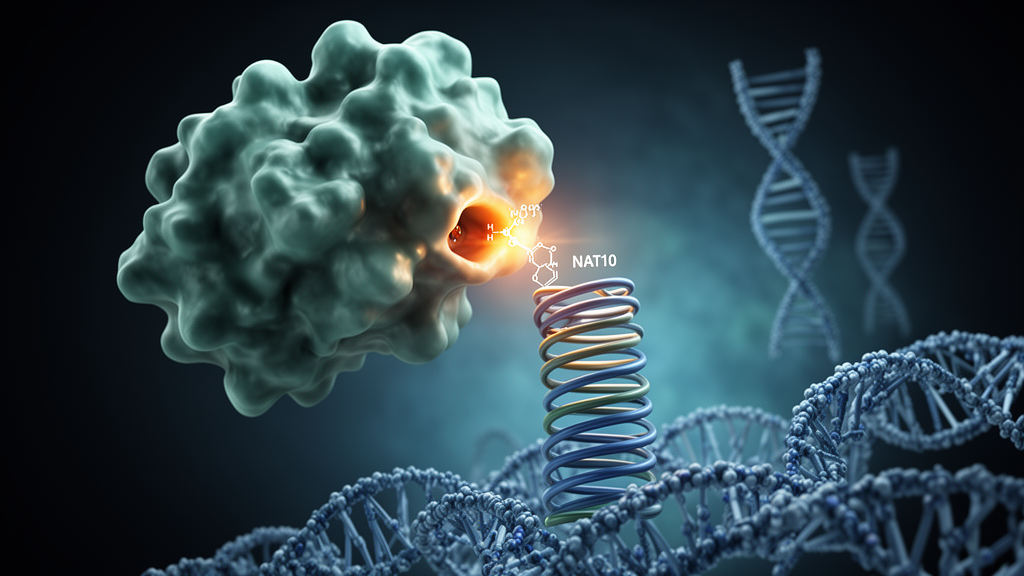
An enzyme best known for chemically modifying RNA has now been shown to place a ketone-body-derived tag on histones, the proteins around which DNA is wrapped, according to a study published in Epigenetics & Chromatin. The modification, lysine β-hydroxybutyrylation (Kbhb), is derived from β-hydroxybutyrate (BHB), a ketone body, and the new work reports that it plays a direct role in how cells copy their DNA.
The researchers found that N-acetyltransferase 10 (NAT10), previously characterized for its role in RNA acetylation, acts as a β-hydroxybutyryltransferase that catalyzes histone Kbhb at multiple lysine residues. This enzymatic activity was abolished by specific NAT10 mutants, G641E and K989R, and by inhibition with the drug remodelin, indicating that the catalytic function of NAT10 is required for the modification.
Functionally, the team reports that NAT10-mediated Kbhb accelerates replication fork speed and shortens the duration of S phase, the stage of the cell cycle in which DNA is replicated. Notably, this occurred without affecting origin firing, meaning the activation of starting points for DNA replication was unchanged even as the forks themselves moved faster.
When cells were treated with BHB, the resulting NAT10-dependent Kbhb was associated with reduced levels of replication stress markers, including γH2AX, single-stranded DNA, RPA2 and phosphorylated CHK1. The treatment also reduced indicators of genomic instability, including micronuclei, anaphase bridges and chromatid breaks. These effects were abolished when NAT10 was depleted or when remodelin inhibited its activity, tying the protective outcome to the enzyme’s catalytic function.
Mechanistically, the study reports two changes associated with the modification: Kbhb reduces the amount of chromatin-bound NAT10 and enhances chromatin accessibility, findings supported by ChIP-seq and ATAC-seq analyses.
The findings were validated in primary human fibroblasts, using the WI-38 and 2BS cell lines, which extends the results beyond transformed laboratory cell models. The authors conclude that NAT10-mediated histone Kbhb constitutes a metabolic-epigenetic mechanism that promotes DNA replication fidelity while maintaining genome stability.
The work connects cellular metabolism to the epigenetic regulation of replication: the histone tag is derived from the ketone body BHB, linking this metabolic molecule to chromatin modification during DNA synthesis. The authors suggest this pathway offers a potential therapeutic target for replication stress-associated pathologies, including cancer and aging-related conditions, while noting that this remains a proposed direction rather than a demonstrated clinical application.
As with all cell-based findings, the results describe mechanisms observed in cultured human cells and do not by themselves establish effects in patients. The article was published as a peer-reviewed, accepted manuscript shared early, a version subject to further edits before the final Version of Record appears.
Subject of Research: NAT10-mediated histone β-hydroxybutyrylation and its role in DNA replication and genome stability
Article Title: NAT10-mediated histone β-hydroxybutyrylation facilitates DNA replication and maintains genomic stability
Article References: Jiang, S., Li, J., Ai, H., Zhang, Q., Li, S., & Zhao, W. (2026). NAT10-mediated histone β-hydroxybutyrylation facilitates DNA replication and maintains genomic stability. Epigenetics & Chromatin. https://doi.org/10.1186/s13072-026-00699-6
Image Credits: AI Generated
DOI: 10.1186/s13072-026-00699-6
Keywords: NAT10, histone β-hydroxybutyrylation, DNA replication, genomic stability, epigenetics, β-hydroxybutyrate, replication stress, chromatin accessibility, S-phase, remodelin, NAT10-mediated, histone
News Source: Juliet Wilcox. (October 28, 2026). NAT10 enzyme adds ketone-derived tag to histones to speed DNA replication. Scienmag.