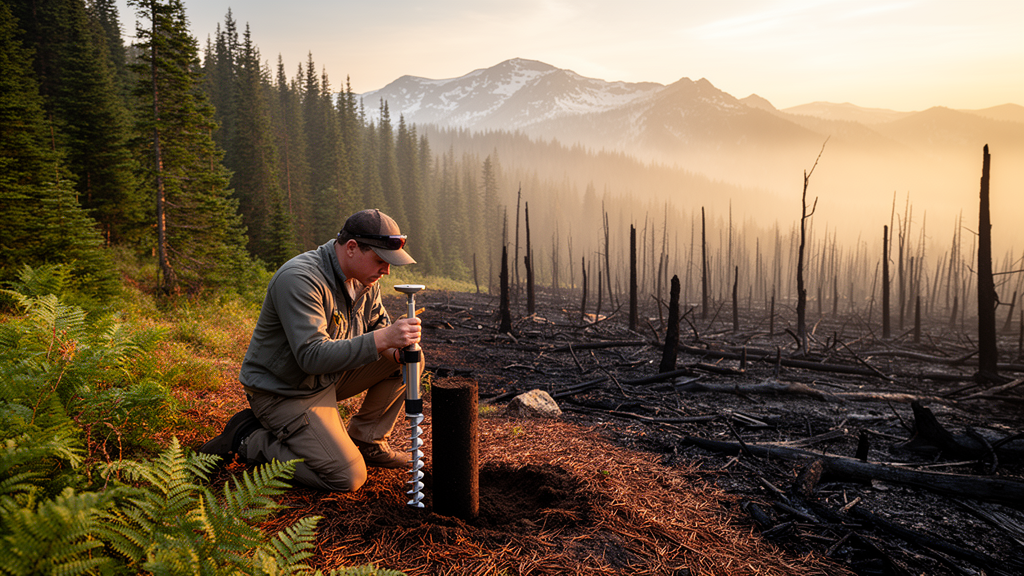
Six years after a wildfire swept through a subalpine forest in northwestern Sichuan, China, researchers report that the amount and composition of soil organic carbon did not simply rise or fall with fire severity — instead, the response was distinctly nonlinear, with low- and high-severity fires increasing soil carbon while moderate-severity fire reduced it.
The study, published in Frontiers in Forests and Global Change, examined four fire-severity classes: an unburned control, low-severity fire, moderate-severity fire, and high-severity fire. Soil samples were collected from two depths, 0–10 centimeters and 10–20 centimeters, and analyzed for total soil organic carbon (SOC) alongside labile fractions such as dissolved organic carbon, microbial biomass carbon, and readily oxidizable carbon, intermediate-turnover fractions including particulate organic carbon and light-fraction organic carbon, and persistent fractions such as mineral-associated and heavy-fraction organic carbon.
The results showed that both low-severity and high-severity fire increased the content of SOC and of the intermediate-turnover and persistent carbon fractions. High-severity fire additionally raised microbial biomass carbon by 90.22 to 93.96 percent relative to the unburned control. In contrast, moderate-severity fire reduced SOC and most intermediate-turnover and persistent fractions, while significantly increasing readily oxidizable carbon, the most labile of the measured pools.
Depth mattered as well. Carbon fractions in the upper soil layer were generally more responsive to fire severity than those deeper down, yet the relative increase in SOC under high-severity fire was actually greater at 10–20 centimeters, reaching 514.02 percent, than at 0–10 centimeters, where it reached 234.28 percent.
The researchers also assessed carbon-pool stability using the carbon pool management index, which tracks how active or persistent a soil carbon pool is. Moderate-severity fire produced the highest carbon-pool activity and the highest index value, but with lower carbon persistence, meaning its carbon was skewed toward faster-cycling fractions. By contrast, the carbon pools under low- and high-severity fire were dominated by persistent fractions and exhibited higher carbon pool indices, suggesting more stabilized carbon stores.
Soil physicochemical properties were associated with these carbon-fraction patterns. Available potassium explained 63.5 percent of the variation in the upper layer, while total porosity explained 48.5 percent of the variation in the deeper layer, indicating that different physical and chemical controls operate at different depths.
Structural equation modeling added a possible mechanism: particulate organic carbon exerted the strongest direct positive association with SOC. The authors suggest that fresh organic matter inputs during post-fire vegetation recovery may contribute to the observed SOC increase, linking the return of plants after fire to the rebuilding of the soil carbon stock.
The team notes that these findings reveal a nonlinear response of subalpine forest soil organic carbon and its components to fire severity and offer data support for post-fire ecosystem management and regional carbon sink assessments. Because the work covers a single forest site six years after one fire event, the patterns describe conditions at that location and time rather than universal outcomes, but they underscore that fire severity shapes not only how much carbon soils hold, but also how stable that carbon is likely to be.
Subject of Research: Nonlinear responses of soil organic carbon fractions to wildfire severity in a subalpine forest
Article Title: Wildfire severity reshapes soil organic carbon fractions and stabilization pathways in a subalpine forest
Article References: Peng, B., Zeng, R., Zhang, Y., Li, X., Yang, W., & Li, X. (2026). Wildfire severity reshapes soil organic carbon fractions and stabilization pathways in a subalpine forest. Frontiers in Forests and Global Change, 9, Article 1991068. https://doi.org/10.3389/ffgc.2026.1991068
Image Credits: AI Generated
DOI: 10.3389/ffgc.2026.1991068
Keywords: soil organic carbon, wildfire severity, subalpine forest, carbon fractions, carbon pool management index, particulate organic carbon, soil carbon stability, post-fire recovery, Sichuan China, structural equation modeling, Wildfire, severity
News Source: Alan Morgan. (October 28, 2026). Fire Severity Drives Nonlinear Shifts in Subalpine Forest Soil Carbon. Scienmag.