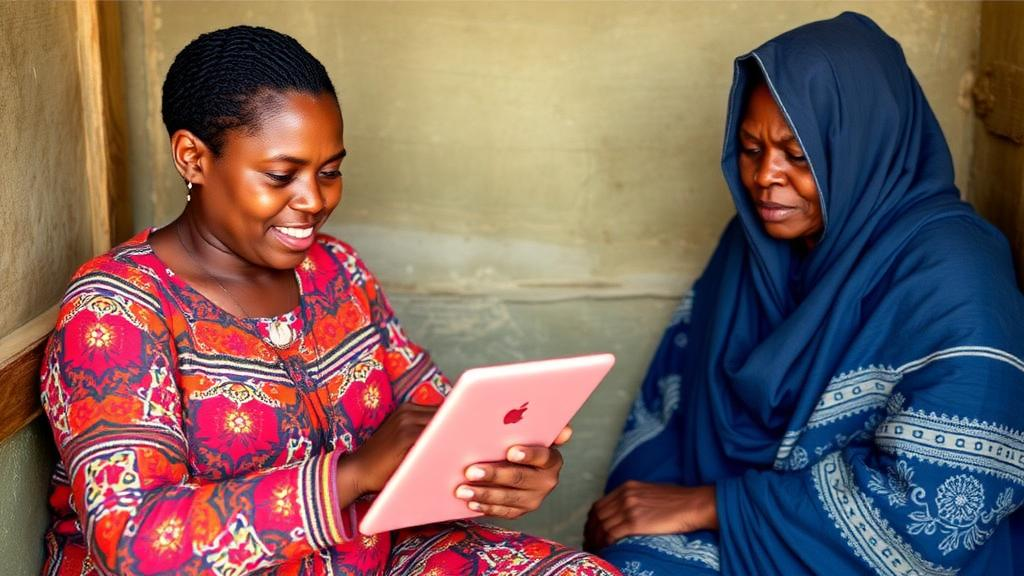
Only 7.2 percent of women small-scale farmers in rural South Africa had access to the internet within their households, according to an analysis of the 2019 General Household Survey published in Agriculture & Food Security.
The dataset was filtered to exclude metropolitan and urban populations, so the analysis reflects only rural women farmers across all nine provinces. The survey used a multi-stage design with stratified selection of primary sampling units proportional to size, followed by systematic sampling of dwelling units, with secondary stratification by geography and population attributes based on the 2011 census. Face-to-face interviews were conducted in multiple languages by enumerators trained by Statistics South Africa, and sampling weights were applied so that responses could be extended to represent the national population. The researchers analysed the data using SPSS, applying descriptive statistics, chi-square tests, Phi and Cramer’s V measures of association, and binary logistic regression.
The headline finding is stark: 92.8 percent of the sampled rural women farmers, some 345,518 people, reported no access to the internet in the household, while 26,672, or 7.2 percent, said they did. The survey also asked to whom households sold most of their produce. About 88.9 percent, or 330,711 respondents, sold to local buyers from their own district, while 11.1 percent, or 41,479, reached buyers from neighbouring cities and towns, formal markets in South Africa, or export agencies in international markets. The authors note that lack of market information leads farmers to sell produce at farm gate prices to middlemen or in local markets, which they link to the continuation of poverty among farming communities.
Patterns differed sharply by population group. Among farmers with household internet access who sold to local buyers, 57.4 percent were White and 42.6 percent were Black, while Coloured farmers in this category had no recorded access. Among those reaching buyers beyond the district, Whites with in-house internet accounted for 94.3 percent and Blacks for 5.7 percent. Among farmers without internet who nonetheless reached buyers beyond their district, 78.7 percent were Black and 21.3 percent were White. The Phi and Cramer’s V statistic of 0.504 indicated a very strong relationship between race and household internet access, and the authors connect these disparities to South Africa’s dual agricultural system, historically dominated by well-developed, largely white commercial farming alongside less-developed smallholder farming by black farmers.
Age also mattered. Among farmers with internet access who sold to local buyers, about 44 percent were aged 34 to 44 years and 38 percent were aged 12 to 22, while only about 7 percent were aged 45 to 55. Among those with internet access who reached buyers beyond their district, 36.5 percent were aged 34 to 44, 31.3 percent were aged 23 to 33, and 15.1 percent were aged 56 to 66. Notably, 6.3 percent of farmers aged 67 and older who lacked household internet still managed to reach buyers beyond their district. The association between age group and internet access was statistically significant, with a Phi and Cramer’s V value of 0.183, which the authors describe as a strong relationship.
Education and income showed clear associations as well. Farmers with secondary education made up 58.0 percent of those with internet access who sold locally, followed by those with tertiary education at 31.3 percent and primary education at 10.7 percent, and no farmers without schooling were recorded among those with household internet. Only farmers with secondary education, at 69.6 percent, and tertiary education, at 30.4 percent, reached buyers beyond their district through internet access. On income, 49.4 percent of connected farmers selling locally earned salaries, wages or commission, 34.9 percent received grants including the old age grant, and about 16 percent had business income. All farmers with internet access who reached markets beyond their district reported business income. Overall, 44.5 percent of the sample relied on grants, 27.6 percent on salaries and wages, 18.5 percent on business income, 7.7 percent on remittances and 2.2 percent on pensions, which the authors suggest may make daily internet connectivity unaffordable for many.
The binary logistic regression identified age, population group, marital status and metro-coding as the leading factors associated with household internet access. Being White increased the odds of household internet access 11,575-fold relative to being African or Black, and living in rural Free State increased the odds 6,033-fold relative to Western Cape. Farmers with tertiary education were 7,141 times more likely to use internet in the household than those with no education, although the authors report that while the education variable was significant overall, its individual subgroups did not each reach the p < 0.05 threshold against the reference category. Unmarried farmers were 0.457 times less likely to use household internet than married farmers. The model’s Nagelkerke R squared of 0.648 indicated that the predictors accounted for 64.8 percent of the variation in the dependent variable, though the Cox and Snell value of 0.261 was described as weak, and the Hosmer-Lemeshow test returned p = 0.000, which the authors state indicates the data did not fit the model well.
Geography produced some of the more striking contrasts. Among connected farmers selling locally, 42.8 percent were from Western Cape and 42.6 percent from KwaZulu-Natal, with Mpumalanga at 8.0 percent and Northern Cape at 3.1 percent. Among connected farmers reaching markets beyond their district, 37.6 percent were from Free State and 25.7 percent from Eastern Cape, while none of the connected farmers in KwaZulu-Natal, North West or Mpumalanga reached buyers beyond their district. Among farmers without internet who nonetheless reached markets beyond their district, 19.1 percent were from North West, 17.2 percent from KwaZulu-Natal, 17.1 percent from Limpopo and 4.1 percent from Western Cape. The Phi and Cramer’s V value of 0.556 indicated a very strong correlation between location and internet access. The authors also note that in rural Gauteng there was no noticeable record of women smallholders with household internet connections.
Marital status showed a more moderate pattern, with a Phi statistic of -0.143 and Cramer’s V of 0.143. Among connected farmers selling locally, 67.0 percent were unmarried and 33.0 percent married, while among unconnected farmers selling locally, 73.2 percent were unmarried. Only married farmers with household internet reached buyers beyond their district, at 100 percent, and among unconnected farmers reaching those markets, 64.7 percent were unmarried and 35.3 percent married. The authors suggest this may reflect household cooperation, with spouses in off-farm employment providing income for routers and data contracts, and cite prior research indicating that marriage can increase the likelihood of adopting information and communication technologies.
The authors are careful to note the limitations of the work. The data are cross-sectional, which limits the drawing of causal inferences, and the survey is a secondary dataset collected by Statistics South Africa rather than primary research by the study team. They also point to the need for more recent and primary data to observe structural changes over time, and for research into whether the agricultural knowledge women receive online affects farm returns, productivity and profit. As a recommendation, the study proposes that government establish internet access platforms that farmers can use free of charge or at affordable rates to obtain agricultural and market information, alongside public wifi installations in community halls, capacity-building strategies for using ICT to gain market information, and encouragement of small-scale farmers to work in community groupings. The findings are intended to help policymakers redesign ICT access policies that could motivate women farmers to reach agricultural markets.
Subject of Research: Factors associated with household internet access among women small-scale farmers in rural South Africa using 2019 General Household Survey data
Article Title: Exploring factors influencing the use of internet in the household by women small-scale farmers in rural South Africa: evidence from GHS 2019
Article References: Mbamba, F. S., & Nsengiyumva, P. (2026). Exploring factors influencing the use of internet in the household by women small-scale farmers in rural South Africa: evidence from GHS 2019. Agriculture & Food Security, 15(1), Article 49. https://doi.org/10.1186/s40066-026-00638-4
Image Credits: AI Generated
DOI: 10.1186/s40066-026-00638-4
Keywords: South Africa, women farmers, smallholder agriculture, internet access, digital divide, General Household Survey 2019, agricultural markets, ICT adoption, logistic regression, rural development, Statistics South Africa, market participation
News Source: Alan Morgan. (October 28, 2026). Only 7% of Rural South African Women Farmers Have Household Internet, National Survey Finds. Scienmag.