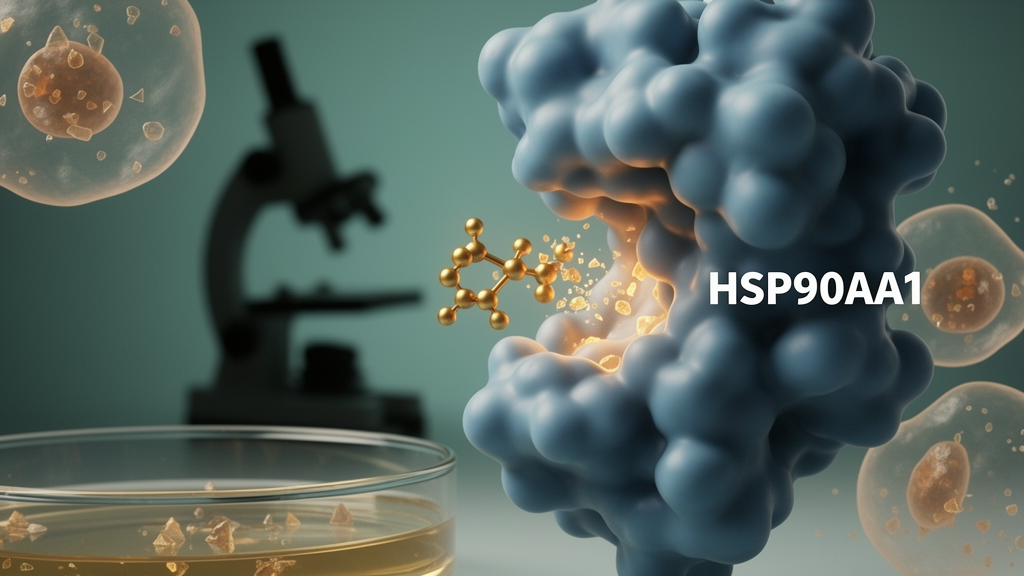
Myricetin, a natural compound derived from the red bayberry tree Myrica rubra, has been identified as a promising lead against bladder cancer in a new multi-omics study published in Biological Procedures Online. The research, released as a peer-reviewed accepted manuscript on 9 October 2026, combines computational screening, network pharmacology, single-cell transcriptomics and laboratory experiments to map how the compound acts on the chaperone protein HSP90AA1 and the PI3K–Akt signaling pathway.
The team evaluated twelve metabolites from Myrica rubra using computational ADMET profiling, reverse virtual screening, protein–protein interaction network analysis and molecular docking. Myricetin emerged as the top candidate. Docking simulations showed that it binds directly to the ATP-binding pocket of HSP90AA1, achieving a Vina score of −8.9 kcal/mol through hydrogen bonds with the residues TYR-139, ASP-93 and ASN-51. Gene dependency analysis was used to validate the core target, and public single-cell RNA sequencing datasets were used to examine where HSP90AA1 is expressed across bladder cancer cell populations.
In laboratory experiments with two human bladder cancer cell lines, UM-UC-3 and T24, myricetin treatment significantly suppressed cell viability, reduced colony formation, inhibited migration and invasion, and induced apoptosis in a concentration-dependent manner. These effects were accompanied by downregulation of the cell-cycle protein CCND1 and the anti-apoptotic protein BCL-2, upregulation of the pro-apoptotic protein BAX, and activation of caspase-3. Flow cytometric analysis further confirmed that myricetin induces G1 phase cell cycle arrest in the cancer cells.
The mechanistic findings point to a specific signaling axis. Myricetin reduced HSP90AA1 expression and selectively suppressed phosphorylation of PI3K and AKT without affecting the total levels of those proteins, indicating that the compound interferes with pathway activation rather than protein abundance. Rescue experiments using tamoxifen confirmed that these effects were mediated at least in part through HSP90AA1 engagement, strengthening the causal link between the target and the observed anti-cancer activity.
The compound also showed activity in a living model. In a subcutaneous xenograft model, myricetin administered at 60 mg/kg significantly suppressed the growth of UM-UC-3 tumors without causing body weight loss in the animals, a preliminary safety signal that the authors note requires further pharmacokinetic optimization.
Single-cell transcriptomic analysis added a layer of tumor biology to the findings. HSP90AA1 was found to be preferentially enriched in the BC_3 and BC_4 subpopulations of bladder cancer cells, which occupy the root of the developmental trajectory and exhibit elevated PI3K–Akt pathway activity. The authors describe this as a potential subpopulation-specific vulnerability that warrants further investigation, rather than a confirmed therapeutic target in patients.
Bladder cancer remains a therapeutically challenging malignancy with limited targeted treatment options, a gap the study’s authors cite as motivation for exploring natural products from food–medicine homology resources, which may offer bioactive compounds with favorable safety profiles whose mechanisms are often incompletely characterized. The new work positions myricetin as a lead compound from that reservoir and provides a mechanistic framework linking HSP90AA1 binding to suppressed PI3K–Akt signaling and inhibited cancer progression.
It is important to note the scope of the evidence. All anti-cancer effects were demonstrated in cell lines and in a mouse xenograft model; no human clinical data are reported. The article was shared early to provide faster access to peer-reviewed, accepted research and is subject to further edits before the final Version of Record. The authors state that the findings warrant further pharmacokinetic optimization and clinical investigation before any therapeutic application can be considered.
Subject of Research: Preclinical evaluation of myricetin as an HSP90AA1-targeting inhibitor of PI3K–Akt signaling in bladder cancer
Article Title: HSP90AA1-Targeting Myricetin Suppresses Bladder Cancer by Attenuating PI3K-Akt Signaling
Article References: Li, Y., Sun, R., Dong, X., Yan, Y., Yi, Z., Zuo, L., & Liu, H. (2026). HSP90AA1-Targeting Myricetin Suppresses Bladder Cancer by Attenuating PI3K-Akt Signaling. Biological Procedures Online. https://doi.org/10.1186/s12575-026-00367-9
Image Credits: AI Generated
DOI: 10.1186/s12575-026-00367-9
Keywords: myricetin, HSP90AA1, bladder cancer, PI3K-Akt signaling, Myrica rubra, molecular docking, single-cell transcriptomics, xenograft model, apoptosis, natural products, network pharmacology, preclinical study
News Source: Nathaniel Bowman. (October 28, 2026). Myricetin Targets HSP90AA1 to Curb Bladder Cancer Growth in Preclinical Models. Scienmag.