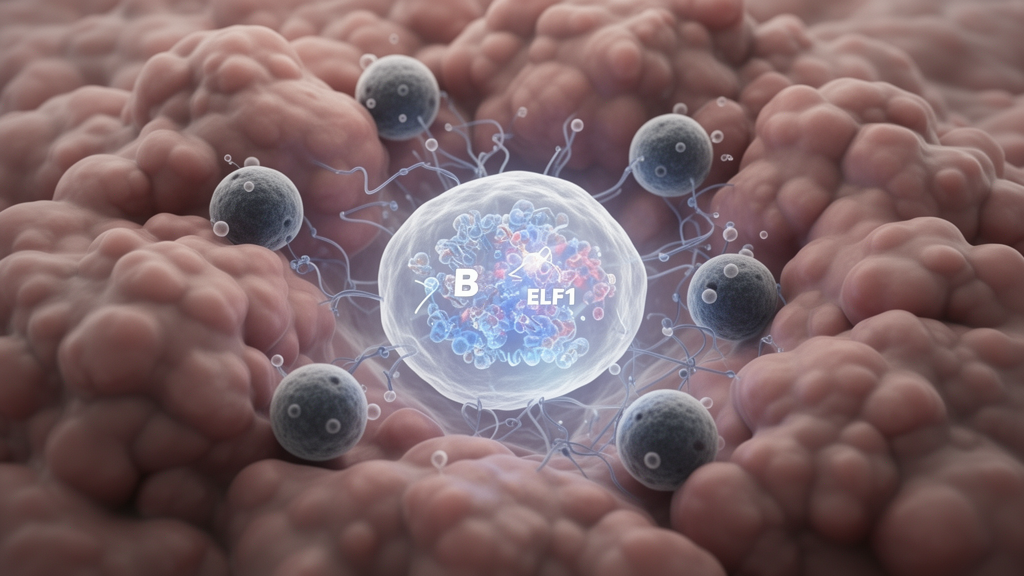
An integrated multi-omics study identified ELF1 as a candidate B-cell-associated prognostic biomarker in breast cancer, combining genetic association analysis, single-cell transcriptomics, machine learning and laboratory experiments. The researchers first used transcriptome-wide association data to identify 65 genetically regulated genes associated with breast cancer susceptibility, then mapped their activity across the GSE176078 single-cell atlas. B cells showed the strongest enrichment for these genes, and ELF1 was the only candidate consistently prioritized by four machine-learning methods. In two breast cancer cohorts, low ELF1 expression was associated with worse overall survival in one cohort, while the second showed a consistent survival trend.
The study began with a transcriptome-wide association study, or TWAS, using FinnGen summary statistics to identify candidate genes whose genetically regulated expression may be associated with breast cancer susceptibility. The researchers then mapped this information onto the GSE176078 single-cell atlas. Three scoring approaches—AUCell, UCell and AddModuleScore—were used to assess whether the candidate genes were active in particular cell populations. B cells consistently displayed the highest enrichment, prompting the investigators to examine the biological programs accompanying a high TWAS score. High-dimensional weighted gene co-expression network analysis, abbreviated hdWGCNA, identified co-expression modules linked to that state and enriched for pathways involving RNA splicing and B-cell activation.
To narrow the candidate list, the researchers combined LASSO regression, Random Forest, Boruta and XGBoost analyses. ELF1 was the only feature prioritized by all four algorithms, making it the central candidate for subsequent evaluation. Its prognostic and immunological associations were examined in GSE96058, which included 3,273 breast cancer samples, and in METABRIC, which included 2,509 samples. Low ELF1 expression was associated with inferior overall survival in GSE96058, and METABRIC showed a consistent survival trend. These observational cohort results do not by themselves establish that ELF1 causes survival differences, but they indicate that ELF1 expression may carry prognostic information in breast cancer. The authors also reported that ELF1 expression correlated positively with infiltration by naive B cells and negatively with plasma cells and M0/M1 macrophages.
Laboratory experiments provided functional evidence for the proposed connection between ELF1 and immune behavior. The researchers modulated ELF1 in B-cell models, including Raji and GM12878 cells, and measured effects on cell proliferation, activation-marker expression and molecules associated with RNA splicing. Direct co-culture with MDA-MB-231 breast cancer cells was then used to examine the consequences for tumor-cell behavior. ELF1 modulation affected B-cell proliferation and activation markers as well as RNA-splicing-related molecules, while also changing the proliferative and invasive behavior of breast cancer cells in the co-culture system. Together, these experiments support a functional role for ELF1 in B-cell states and in their interactions with cancer cells, although the work used cell models rather than patients.
The findings position ELF1 as a possible molecular link between genetically regulated expression patterns and B-cell-related states in the breast cancer tumor microenvironment. The strategy combines susceptibility-associated genetic signals, cell-type-specific activity, network analysis, ensemble feature selection and two large expression cohorts. The immune correlations further connect ELF1 with distinct cell populations, including naive B cells, plasma cells and M0/M1 macrophages. The evidence remains limited by the observational nature of the survival analyses and the use of modified cell lines and co-culture systems. The authors therefore characterized ELF1 as a B-cell-associated prognostic biomarker with preliminary experimental support, rather than presenting it as an established clinical biomarker or therapeutic target.
Subject of Research: ELF1 as a B-cell-associated prognostic biomarker in breast cancer
Article Title: Integrated multi-omics analysis identifies ELF1 as a B-Cell-associated prognostic biomarker in breast cancer
Article References: Zhang, S., Cui, J., Cheng, Y., & Wang, X. (2026). Integrated multi-omics analysis identifies ELF1 as a B-Cell-associated prognostic biomarker in breast cancer. BMC Cancer. https://doi.org/10.1186/s12885-026-16904-4
Image Credits: AI Generated
DOI: 10.1186/s12885-026-16904-4
Keywords: ELF1, breast cancer, B cells, tumor microenvironment, multi-omics, single-cell transcriptomics, prognostic biomarker, immune infiltration, machine learning, RNA splicing, Integrated, analysis
News Source: Nathaniel Bowman. (October 25, 2026). Multi-omics study links ELF1 to B-cell states in breast cancer. Scienmag.