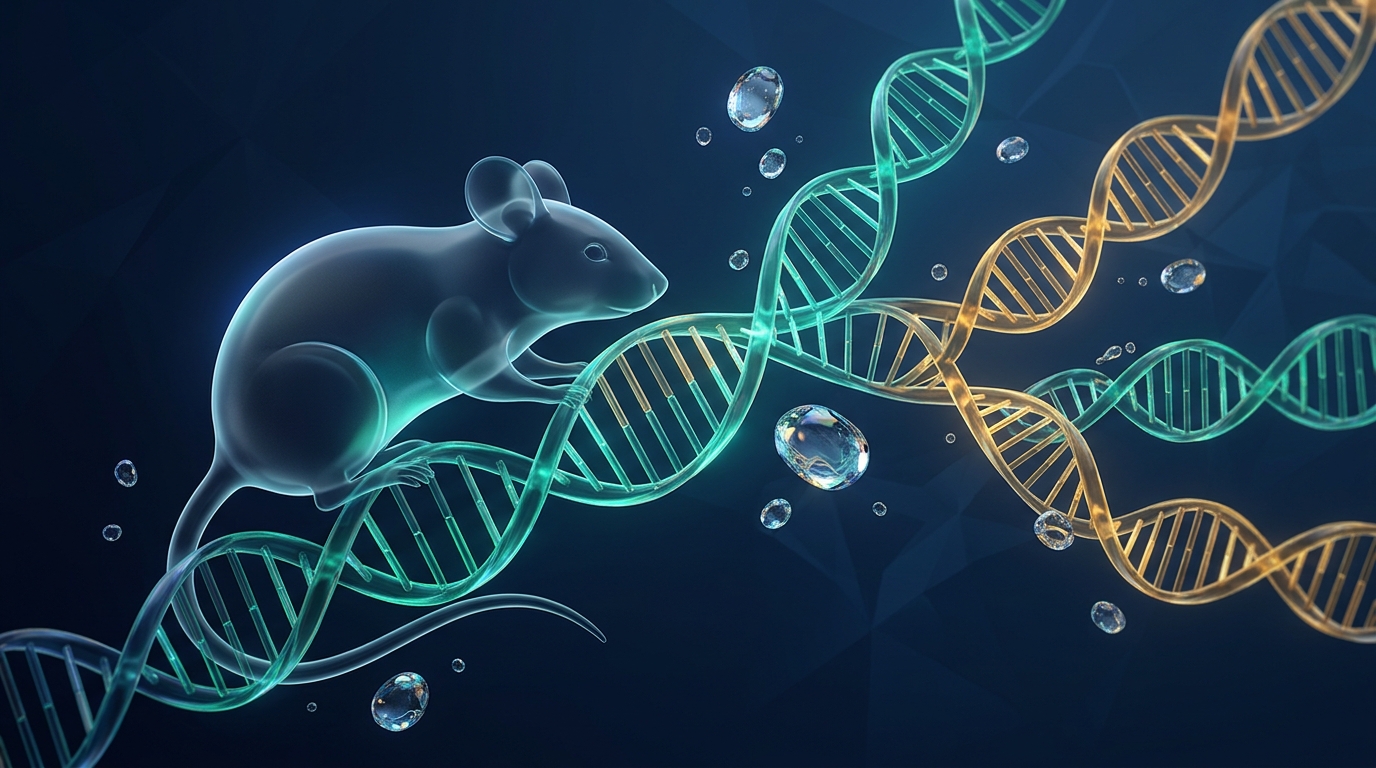
Saliva is far more evolutionarily restless than most tissues, according to a new genomic study of mice. Researchers compared the salivary glands and secretions of mice and humans at the genomic, transcriptomic and proteomic levels, and found that a striking share of mouse salivary gene expression comes from genes that exist only in the mouse lineage, with no one-to-one counterpart in humans.
In the submandibular and sublingual glands, 68% and 73% of expression from genes encoding secreted proteins, respectively, derives from lineage-specific genes lacking one-to-one human orthologs. That figure runs against the prevailing view that gene expression is largely conserved across tissues, and it positions saliva as an unusually dynamic system of molecular evolution.
The study also documented pronounced sexual dimorphism in the mouse submandibular gland. The team counted 1,537 tissue-specific sex-biased genes in that gland, 3.8 times higher than in the liver, a classic model of sex-biased expression, with the difference reported as statistically significant (p < 0.001). Sex differences in saliva, the authors suggest, arise both from transcriptional differences in secreted proteins and from sex-specific post-translational modifications.
One of those modifications involves sugar chemistry. The researchers identified sex-specific expression of glycosylation genes associated with differential sialylation of Muc19, a salivary mucin. In other words, male and female mice do not simply make different amounts of salivary proteins; their saliva also carries different sugar attachments on the same molecules.
The genes driving these sex biases are not scattered randomly across the genome. Differentially expressed genes in the submandibular gland cluster in genomic regions shaped by recent gene duplication, most notably the kallikrein gene cluster, a mouse-specific expansion that accounts for roughly 16.4% of male-biased submandibular gland expression.
How does a duplicated gene cluster become male-biased? The analyses point to regulatory changes amplified by duplication. The team reports the spread of a testosterone-associated regulatory motif across the cluster and the expansion of a shared chromatin domain that promotes coordinated gene regulation, so that multiple copies of kallikrein genes appear to be switched on together in a sex-specific manner.
Taken together, the authors conclude that lineage-specific genes disproportionately shape the mouse salivary transcriptome, and that gene duplication and regulatory rewiring contribute to the rapid evolution of sex-biased expression in the submandibular gland. They describe this as a novel mechanism through which lineage-specific duplication and regulatory change drive rapid, sex-specific evolution of mammalian saliva.
The findings also fit a concept known as developmental systems drift, in which similar phenotypes across species are maintained even as their underlying gene-regulatory programs diverge substantially. Mouse and human saliva may look functionally comparable, yet the genetic machinery producing it can differ dramatically.
Because the work is a comparative genomics study in mice and humans, its conclusions concern evolutionary mechanisms rather than clinical applications. Even so, it reframes a familiar fluid: saliva, essential for digestion, immunity and host-microbiome interactions, emerges as a model system for watching gene expression evolve quickly, and differently in each sex.
Subject of Research: Evolutionary genomics of mouse saliva and sex-biased gene expression
Article Title: Rapid and sex-specific evolution of mouse saliva through regulatory rewiring and gene expansions
Article References: Landau, L. J. B., Jain, S., Griffin, N., Saikia, A., Kramer, J. M., Knox, S., Ruhl, S., & Gokcumen, O. (2026). Rapid and sex-specific evolution of mouse saliva through regulatory rewiring and gene expansions. BMC Genomics. https://doi.org/10.1186/s12864-026-13524-x
Image Credits: AI Generated
DOI: 10.1186/s12864-026-13524-x
Keywords: saliva, mouse genomics, gene duplication, kallikrein cluster, sex-biased expression, submandibular gland, regulatory rewiring, Muc19, glycosylation, developmental systems drift, lineage-specific genes, BMC Genomics
News Source: Juliet Wilcox. (November 4, 2026). Mouse Saliva Evolves Fast, Driven by Gene Duplication and Sex-Biased Regulation. Scienmag.