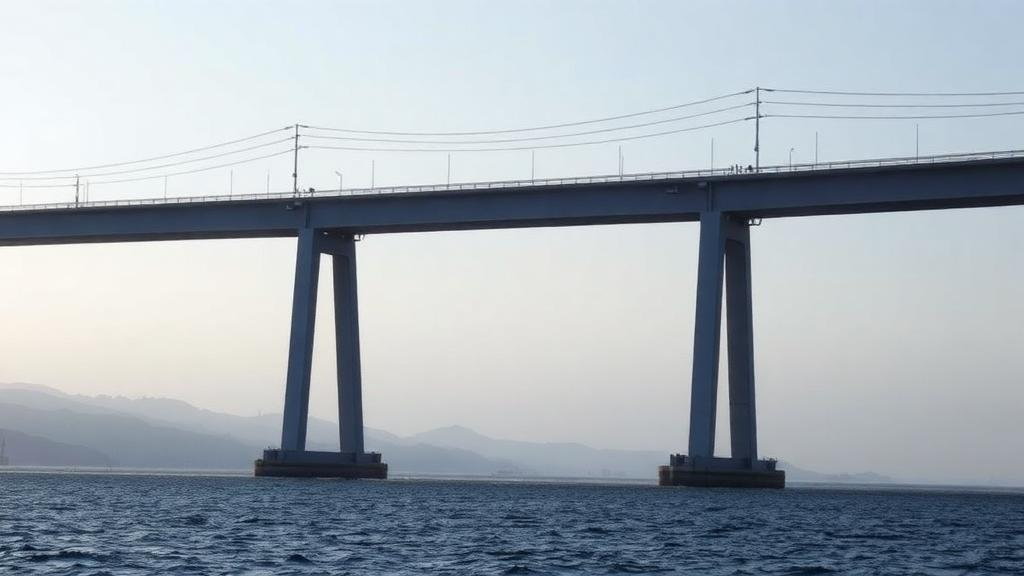
Engineers have built a deep learning model that predicts how long-span bridges sway in strong winds, using five years of real monitoring data from one of the world’s longest suspension bridges rather than wind tunnel experiments or computer simulations. The model, called CA-Buffeting Net, was developed for the Xihoumen Bridge in Zhejiang Province, China, a suspension bridge with a main span of 1,650 metres that connects the Zhoushan archipelago to the mainland. The work, published in Advances in Bridge Engineering, reports that the model reduces the mean squared error of predictions by 29.7 percent and the mean absolute error by 20.2 percent compared with an existing baseline model, while improving the shape fidelity of predicted vibration spectra by 1.2 percentage points in cosine similarity.
The problem the researchers tackled is buffeting: the random forced vibration of a bridge caused by atmospheric turbulence. Buffeting is the most common and persistent form of wind-induced vibration over a bridge’s service life, and severe episodes can accelerate structural fatigue damage, disrupt traffic and, in extreme cases, threaten structural safety. Classical buffeting analysis, built on the theories of Davenport and Scanlan, has well-known drawbacks. Aerodynamic coefficients must be extracted from costly and time-consuming wind tunnel tests, the underlying equations assume stationary winds and linear aerodynamic forces that poorly capture real nonlinear fluid–structure interaction, and finite-element models inevitably deviate from the actual structure, introducing modelling error. Field studies have highlighted systematic discrepancies between classical multimode buffeting analysis and full-scale measurements.
Structural health monitoring systems have changed the picture by accumulating vast long-term records of in-situ wind speed and structural vibration. The Xihoumen Bridge, which sits in a strait exposed to strong seasonal monsoons and complex typhoon conditions, is equipped with six ultrasonic anemometers installed on both sides of the quarter-span, mid-span and three-quarter-span cross-sections, measuring longitudinal, lateral and vertical wind components. Twelve single-axis servo accelerometers at four cross-sections—the side-span midpoint, the main-span quarter-point, mid-span and the main-span three-quarter-point—capture vertical, lateral and torsional accelerations. Because the mid-span anemometer is affected by the main cable, the study used wind data only from the quarter-span and three-quarter-span sections.
Turning raw monitoring records into a usable training dataset required careful filtering. The team applied a strong-wind criterion, excluding 10-minute samples with mean wind speeds below 11 metres per second so the model would focus on the conditions that govern structural safety assessments. Missing or erroneous records were repaired by interpolation and outliers removed using a turbulence intensity threshold. Isolating the buffeting component of the acceleration signals took two further steps. A low-pass filter with a 1-hertz cutoff suppressed high-frequency traffic-induced vibration, since buffeting energy under strong winds is confined to 0–1 hertz while traffic energy concentrates in the 0–0.5 and 2–5 hertz bands. Vortex-induced vibration samples were then identified and removed using thresholds on the root-mean-square vertical acceleration and the ratio of the second-largest to the largest spectral peak. The result was 12,207 valid samples from the 2013–2017 dataset, split 8:1:1 into training, validation and test sets.
What distinguishes the new model is that its architecture is dictated by physics rather than chosen arbitrarily. Guided by the Davenport–Scanlan buffeting theory, the authors note that the buffeting force spectrum is proportional to the square of the mean wind speed and to linear combinations of the fluctuating wind power spectral densities, while the structural acceleration spectrum follows from the buffeting force spectrum through the frequency response function. This suggests a natural two-stage decomposition: first map wind field features—fluctuating wind spectra, turbulence intensities, mean wind speed, wind direction and angle of attack—to a buffeting force spectrum representation; then map that representation, together with structural natural frequencies and wind parameters, to the acceleration response spectrum. The prediction is performed in the frequency domain, which directly yields the power spectral density of the response, a quantity more useful for fatigue assessment and wind-resistant design than point-in-time time-series predictions.
Two custom modules carry out these mappings. The first, Att-FCN, is a frequency convolutional network that replaces the causal convolution of temporal convolutional networks with bidirectional convolution, because predicting the response at a given frequency benefits from information on both lower and higher frequency neighbours. Dilation rates set to successive powers of two let the receptive field grow exponentially with depth, and residual connections ease the training of deep layers. A channel–frequency dual attention mechanism, inspired by established attention architectures, lets the model weight individual input channels—such as the mean wind speed channel—and individual frequency points, which matter most near structural resonance peaks. The second module, Res-BiGRU, stacks bidirectional gated recurrent units with residual connections and layer normalisation to extract temporal features from fluctuating wind data stably.
The two stages are fused by a cross-attention mechanism borrowed from the Transformer architecture. Query vectors come from the second stage, carrying structural frequency and aerodynamic information, while keys and values come from the first stage’s buffeting force spectrum features. This lets the response-stage extraction dynamically attend to the most relevant parts of the force-spectrum features, mirroring the physical logic that structural response depends on the match between the frequency distribution of the wind force and the structure’s frequency response function.
Tested against the baseline Buffeting-Net, the first data-driven model to directly predict acceleration response power spectra in the frequency domain, the full model delivered the largest gains. Improvements were consistent across all four instrumented cross-sections, with the largest gain at the main-span three-quarter point, where the mean squared error fell from 0.0350 to 0.0234 and where complex wind–vibration coupling makes prediction hardest.
The model also proved interpretable. When the trained network’s attention coefficients were averaged over training samples, the channel attention assigned the highest weights to mean wind speed, followed by wind direction and angle of attack, with turbulence intensity weighted lowest—a ranking consistent with classical buffeting theory, in which the buffeting force scales with the square of mean wind speed. An ablation study in which each input feature was removed and the model retrained confirmed the hierarchy: dropping the vertical fluctuating wind spectrum caused the largest mean squared error increase, 41.0 percent, and a 3.4 percentage-point drop in cosine similarity, while removing mean wind speed produced the second-largest degradation in mean absolute error, 29.1 percent. On the frequency side, attention weights were elevated in the 0–0.2 hertz band, matching where the bridge’s acceleration energy concentrates, and showed local peaks near structural natural frequencies such as the first vertical bending mode—helping suppress spurious spectral peaks predicted where no resonance exists in the measured spectrum.
The authors caution that the method is not yet a turnkey solution for every bridge. Because the learned parameters encode bridge-specific dynamic characteristics, directly transferring trained weights to a structure of a different type or wind climate would require retraining or fine-tuning, and future work will examine transferability to other locations and structural types, generalisation under extreme winds such as typhoons, and extension to extreme-value predictions including peak accelerations and fatigue damage indicators. The SHM data themselves are proprietary to the bridge’s management and not publicly available, with model code available from the corresponding author on reasonable academic request. Still, by operating directly on in-situ monitoring data without wind tunnel tests or finite-element modelling, the approach offers a practical pathway for rapid buffeting response prediction and may serve as a technical tool for monitoring-based wind-resistance assessment and structural safety evaluation of long-span bridges.
Subject of Research: Frequency-domain deep learning prediction of wind-induced buffeting response in long-span bridges using structural health monitoring data
Article Title: Cross-attention based frequency-domain prediction method for buffeting response of long-span bridges
Article References: Wu, D., Li, X., Xu, N., Li, Y., Jin, Y., He, S., Xu, W., Li, N., chen, W., & Laima, S. (2026). Cross-attention based frequency-domain prediction method for buffeting response of long-span bridges. Advances in Bridge Engineering, 7(1), Article 36. https://doi.org/10.1186/s43251-026-00227-2
Image Credits: AI Generated
DOI: 10.1186/s43251-026-00227-2
Keywords: buffeting response, long-span bridges, structural health monitoring, deep learning, frequency-domain prediction, Xihoumen Bridge, cross-attention, wind engineering, power spectral density, attention mechanisms, suspension bridge, vibration prediction
News Source: Blake Davidson. (November 4, 2026). Deep learning model predicts wind-induced bridge vibrations from five years of monitoring data. Scienmag.