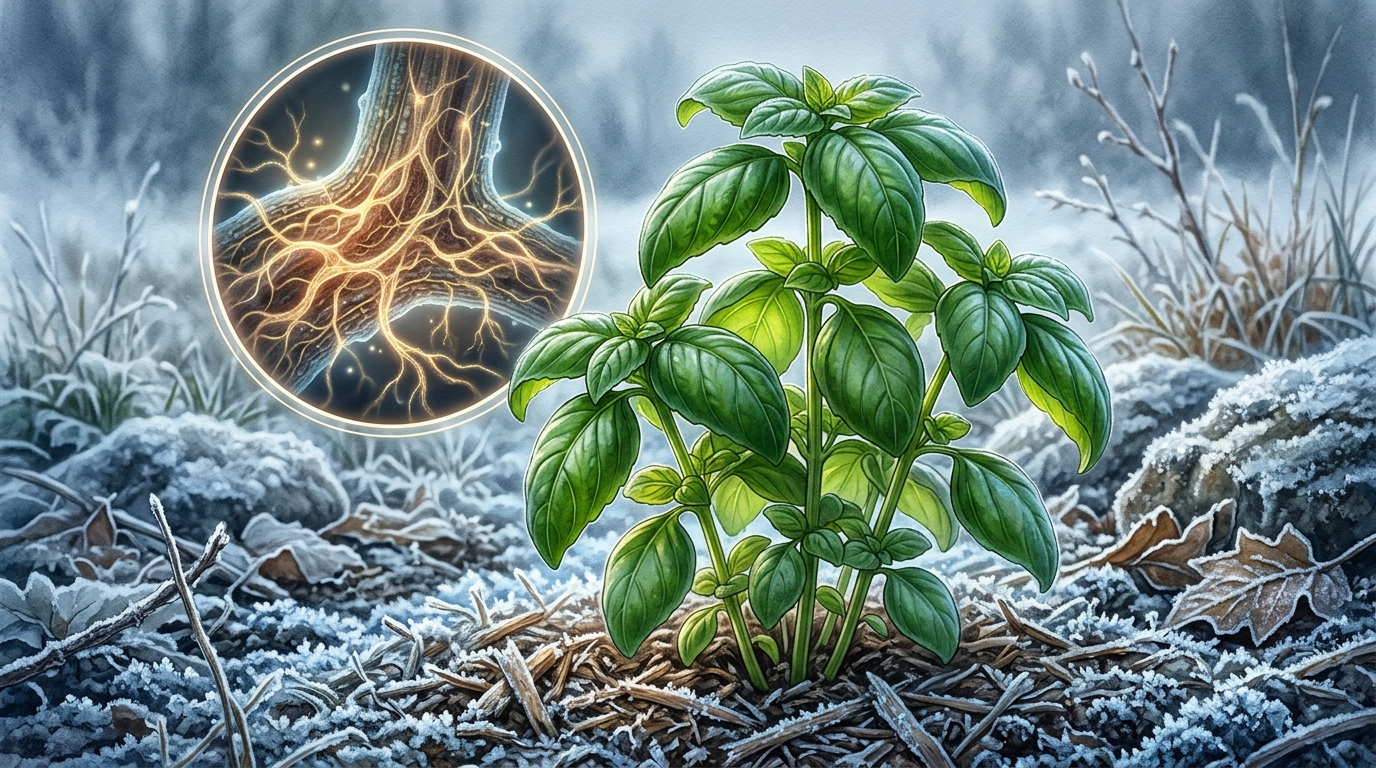
Basil is famously intolerant of the cold, and even a single night of chilling can leave seedlings stunted and damaged. A new study from Iranian researchers suggests a biological route around that weakness: inoculating basil roots with the endophytic fungus Piriformospora indica. In experiments with two Iranian landraces, the fungus markedly reduced chilling injury and triggered strong expression of the plant’s own cold-responsive genes, pointing to a potential biostimulant for growers facing low-temperature conditions.
The research team, led by Alireza Pouyesh and Farshad Dashti, compared a cold-tolerant landrace from Tehran with a cold-sensitive landrace from Khash. Plants of both were inoculated with P. indica and then exposed to cold stress of 3 degrees Celsius for 18 hours. The design allowed the scientists to separate the effects of the fungus from the effects of temperature, and to see whether the symbiont’s benefits differed between a landrace that naturally copes with cold and one that does not.
Growth measurements showed how hard the cold hit. In non-inoculated plants, chilling reduced every measured trait in the Tehran landrace, while in Khash it cut shoot height, shoot fresh weight, and root length. Inoculation changed that picture substantially. Under cold stress, treated plants of both landraces regained shoot height equal to that of non-stressed plants, and they also showed greater root length. In the Tehran landrace, the fungus was additionally associated with higher shoot and root fresh and dry weights under cold, indicating that the tolerant landrace gained more in biomass than the sensitive one.
The most striking result was the near-elimination of visible chilling injury. Inoculation lowered chilling injury scores from 1.0 to 0 in Tehran and from 3.5 to 0.33 in Khash. Because the sensitive Khash landrace began with far more severe damage, the fungus delivered the larger absolute improvement there, effectively rescuing plants that would otherwise have been badly harmed by the treatment.
Physiological measurements traced that protection to reduced membrane and oxidative damage. Inoculated plants under cold stress showed lower electrolyte leakage and lower malondialdehyde, a marker of lipid peroxidation, in both landraces, with larger absolute reductions in Khash. Relative water content improved in the Khash landrace only. Hydrogen peroxide levels, however, were not significantly reduced by the fungus, which suggests that the protection came through pathways other than a simple drop in that reactive oxygen species.
The fungus also enriched the plants’ chemical defenses. Soluble carbohydrates, soluble proteins, phenolics, and DPPH radical scavenging activity were higher in inoculated plants of both landraces, while flavonoids increased in Khash only. These osmoprotectants and antioxidants help cells retain water and neutralize damaging molecules when temperatures fall, so their accumulation is consistent with the improved growth and reduced injury the researchers recorded.
Enzyme assays revealed landrace-specific patterns of antioxidant reinforcement. Compared with non-inoculated stressed plants, inoculation raised the activities of catalase, guaiacol peroxidase, and superoxide dismutase in Tehran, and of catalase, ascorbate peroxidase, and superoxide dismutase in Khash. Ascorbate peroxidase in Tehran and guaiacol peroxidase in Khash did not change significantly. The largest increases in ascorbate peroxidase and superoxide dismutase occurred in the cold-sensitive Khash landrace, implying that the fungus mobilized the strongest antioxidant response precisely where the plants needed it most.
The molecular core of the study came from quantitative real-time PCR on cold-responsive genes. Under cold stress, inoculated plants expressed CBF1 at 9.48-fold higher levels in Tehran and 9.54-fold higher in Khash, relative to non-inoculated, non-stressed plants. CBF3 expression rose even more sharply, at 19.79-fold in Tehran and 9.17-fold in Khash, and COR47 was upregulated 4.64-fold in Tehran and 15.90-fold in Khash. CBF transcription factors sit upstream of the cold-acclimation pathway and COR47 is a dehydrin-type protective protein, so the coordinated upregulation indicates that P. indica primes the basil plants’ intrinsic cold-signaling machinery rather than simply shielding the roots.
Taken together, the findings link the fungus’s physical protection, antioxidant support, and osmoprotectant accumulation to activation of the CBF-COR pathway. The authors conclude that P. indica improved cold tolerance in basil and suggest its potential as a biostimulant for maintaining basil performance under chilling conditions. Because the study was conducted on two Iranian landraces under a single controlled cold treatment, further work would be needed to confirm the effect across other genotypes and field settings, but the results offer a concrete biological tool for a crop that has long been at the mercy of the weather.
Subject of Research: Endophytic fungus Piriformospora indica improving cold tolerance in basil through cold-responsive gene expression
Article Title: Effects of endophytic fungus Piriformospora indica on cold tolerance in basil (Ocimum basilicum L.): insight into the expression of cold-responsive genes
Article References: Pouyesh, A., Dashti, F., Ghaemizadeh, F., & Rokni, N. (2026). Effects of endophytic fungus Piriformospora indica on cold tolerance in basil (Ocimum basilicum L.): insight into the expression of cold-responsive genes. BMC Plant Biology. https://doi.org/10.1186/s12870-026-10365-4
Image Credits: AI Generated
DOI: 10.1186/s12870-026-10365-4
Keywords: basil, Piriformospora indica, cold stress, chilling injury, CBF1, CBF3, COR47, antioxidant enzymes, osmoprotectants, endophytic fungus, biostimulant, Ocimum basilicum
News Source: Roger Howard. (November 4, 2026). Endophytic Fungus Boosts Cold Tolerance in Basil by Activating Cold-Response Genes. Scienmag.