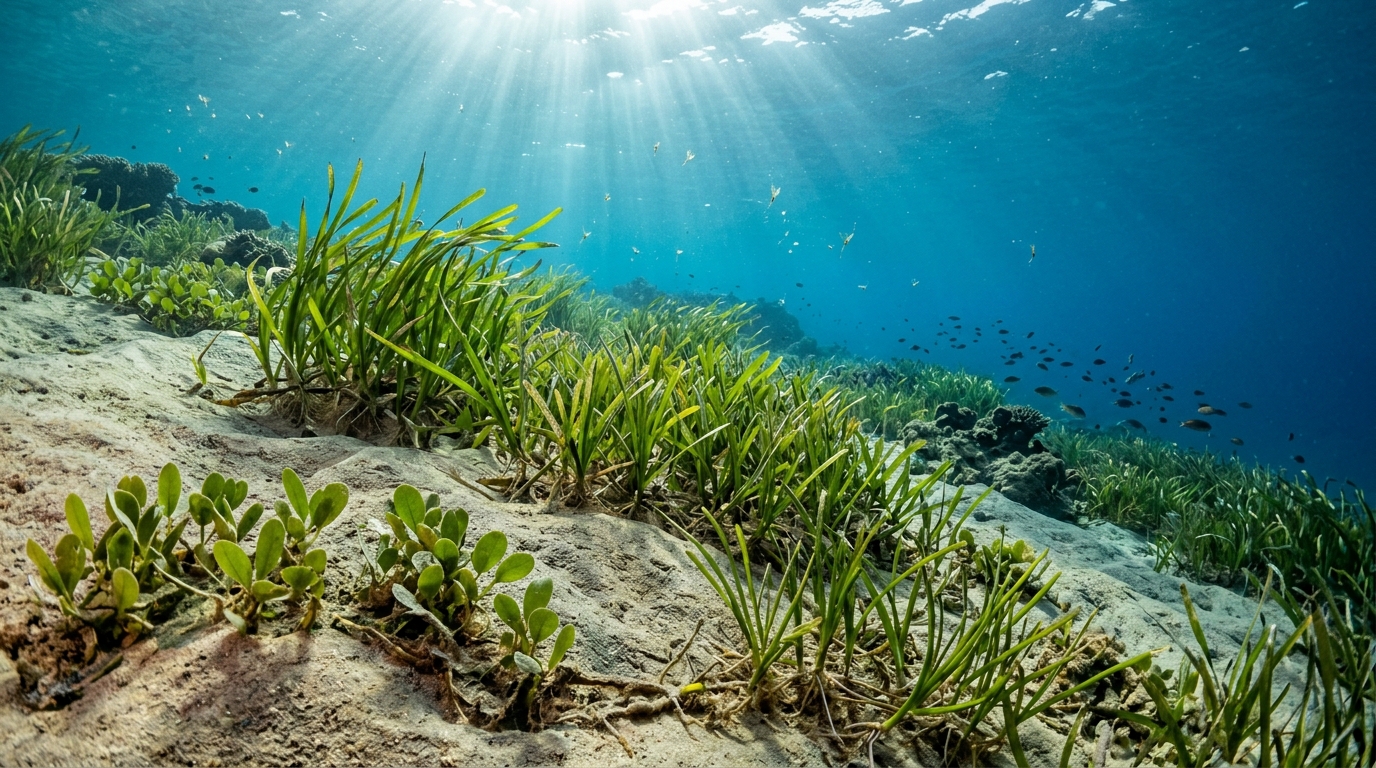
Two seagrass species that spread through the ocean in fundamentally different ways respond surprisingly alike to the same environmental gradient, according to a new study of turtlegrass (Thalassia testudinum) and shoalgrass (Halodule wrightii) along Florida’s Gulf coast. The work, published in Ecology and Evolution, combined field surveys, a common garden experiment, and microsatellite genetic analyses to ask whether a species’ dispersal strategy predicts how its populations differ in body form and genes across a landscape.
The research focused on four coastal riverine systems—Waccasassa, Crystal, Homosassa, and Weeki Wachee—where water column total phosphorus declines persistently from north to south along the peninsular Florida Gulf coast. Both seagrass species grow across this gradient, making it a natural laboratory for testing how nutrient availability shapes plants with contrasting life histories. Turtlegrass is a long-lived climax species with low shoot turnover and high disturbance resistance, producing buoyant fruits that can drift 100 to 1000 kilometers, although its seeds sink and travel less than 1 to 10 meters and do not form a seed bank because they lack dormancy. Shoalgrass, by contrast, is a short-lived pioneer with high shoot turnover that releases fruits at or beneath the sediment surface, limiting dispersal, while its seeds can remain dormant and viable in seed banks exceeding 5000 seeds per square meter for at least four years.
Field data collected from 2010 to 2012 showed that leaf length in both species generally increased from the southernmost system to the northernmost ones, tracking the rise in phosphorus. Leaves were shortest in Weeki Wachee, where phosphorus concentrations are lowest, averaging 161.9 millimeters in turtlegrass and 115.4 millimeters in shoalgrass. Turtlegrass leaves were longest in Waccasassa at 577.9 millimeters, and shoalgrass leaves were longest in Crystal at 311.2 millimeters. Linear mixed models detected differences in leaf length across systems and across years within systems, with the strongest consistent differences between Waccasassa and Weeki Wachee appearing in turtlegrass. Shoalgrass leaf lengths differed significantly between Crystal and Weeki Wachee only in some years. Notably, turtlegrass showed far greater morphological variability overall, with a coefficient of variation of 62.1 percent compared with 39.0 percent for shoalgrass.
To separate environmental from inherited influences, the team transplanted ramets collected in July 2021 from Crystal, Homosassa, and Weeki Wachee into a common garden in Cedar Key, north of the gradient, where seawater is more balanced in nitrogen and phosphorus. Plants grew in an open, flow-through system for roughly eleven months, from August 2021 to June 2022, with leaf lengths measured approximately weekly. At the start of the experiment, leaves from Homosassa and Crystal were longer than leaves from Weeki Wachee in both species. By the midpoint, leaf lengths had converged across systems for both species. By the end, differences remained statistically indistinguishable in turtlegrass, but in shoalgrass a pairwise comparison showed leaves from Crystal were longer than leaves from Weeki Wachee, with a median difference of 67.1 millimeters and a rank-biserial effect size of 0.74.
The genetic results pointed in the opposite direction from the morphological ones. Using eight microsatellite loci and leaves collected in July 2019 from one to three sites per system, the researchers found greater genetic differentiation among systems in shoalgrass than in turtlegrass across most pairs of systems, although the difference in G’ST values between the species was not statistically significant. Isolation by distance was evident in shoalgrass, with genetic distance correlated with geographic distance (r = 0.73, p = 0.002), but not in turtlegrass (r = 0.10, p = 0.283). Bayesian clustering identified two genetic clusters in turtlegrass, with one cluster dominant in the three southernmost systems and the other dominant in Waccasassa, while shoalgrass showed at least three clusters, one prevalent in the two northern systems, one dominating Homosassa, and one dominating Weeki Wachee.
Genetic diversity levels, however, did not follow the dispersal-based expectations as cleanly. Clonal richness was lowest in Waccasassa for both species—0.29 in turtlegrass and 0.20 in shoalgrass—and highest in Weeki Wachee, at 0.59 and 0.69 respectively. Across both species and all systems, the mean number of alleles per locus ranged from 3.13 to 6.00, expected heterozygosity ranged from 0.54 to 0.63, and inbreeding coefficients varied between −0.19 and 0.16, with negative values indicating heterozygote excess occurring more often in shoalgrass. Mean expected heterozygosity was moderately high in both species, at 0.57 in turtlegrass and 0.59 in shoalgrass, and inbreeding coefficients were close to zero. Genotypic richness and allele numbers in turtlegrass were low relative to other Florida Bay and Caribbean populations, though the authors caution that differences in sample size and spatial scale prevent direct comparison across studies.
Taken together, the findings suggest that dispersal strategy can predict broad patterns in genetic structure and trait variation, but not in a simple one-to-one way. Turtlegrass, with its long-distance fruit dispersal, showed weak population structure and no isolation by distance, consistent with high gene flow homogenizing populations, yet it displayed the greater morphological variability in the field and complete convergence of leaf lengths in the common garden—patterns the authors interpret as evidence of stronger environmental control over its traits. Shoalgrass, with restricted dispersal, showed stronger genetic differentiation, isolation by distance, and finer population structure, along with lower trait variability and partial re-emergence of leaf length differences in the common garden, supporting the hypothesis that limited dispersal favors local adaptation over plasticity.
The authors emphasize that differentiation measured with neutral genetic markers does not necessarily reflect adaptive processes, and that non-hereditary mechanisms could also contribute. Accumulated somatic mutations can drive population differentiation through somatic genetic drift, and epigenetic changes such as DNA methylation can alter fitness-related traits including photosynthetic performance. Genetic mosaicism, in which individual shoalgrass plants contain cells with different genotypes, can also elevate diversity metrics. Disentangling the relative roles of local adaptation, plasticity, and these non-genetic mechanisms will require additional common garden and transplant experiments testing provenance effects across more than a single growing season.
The results carry practical weight for restoration and conservation planning. If further work confirms that turtlegrass’s high trait variability is a plastic response, restoration practitioners could select source populations flexibly, since the species may adjust quickly to new conditions and its high dispersal limits the risk of displacing locally adapted genotypes. For shoalgrass, source selection may demand more care because of its lower dispersal and stronger population structure, even though the species may recover faster from extreme events such as storms. Turtlegrass, by contrast, disperses farther and resists disturbance better but grows slowly and recovers from disturbance more slowly, making protection of existing meadows especially important for its long-term persistence. As environmental variability intensifies under climate change, the study suggests that both plastic responses and standing genetic variation will matter for the persistence of these foundation species, and that the two cannot be traded off against each other in restoration planning.
Subject of Research: Genetic and morphological differentiation of two seagrass species with contrasting dispersal strategies along a phosphorus gradient
Article Title: Linking Morphological and Genetic Differentiation Among Populations in Seagrass Species With Contrasting Dispersal Strategies
Article References: Reynolds, L. K., Bijak, A. L., Barry, S. C., Frazer, T. K., Jacoby, C. A., Rohal, C. B., & Roth, J. (2026). Linking Morphological and Genetic Differentiation Among Populations in Seagrass Species With Contrasting Dispersal Strategies. Ecology and Evolution, 16(11), Article e74571. https://doi.org/10.1002/ece3.74571
Image Credits: AI Generated
DOI: 10.1002/ece3.74571
Keywords: seagrass, Thalassia testudinum, Halodule wrightii, dispersal strategy, population genetics, phosphorus gradient, common garden experiment, phenotypic plasticity, local adaptation, Florida Gulf coast, restoration, genetic structure
News Source: Juliet Wilcox. (November 4, 2026). Seagrass Species With Different Dispersal Styles React Alike to Nutrient Gradients. Scienmag.