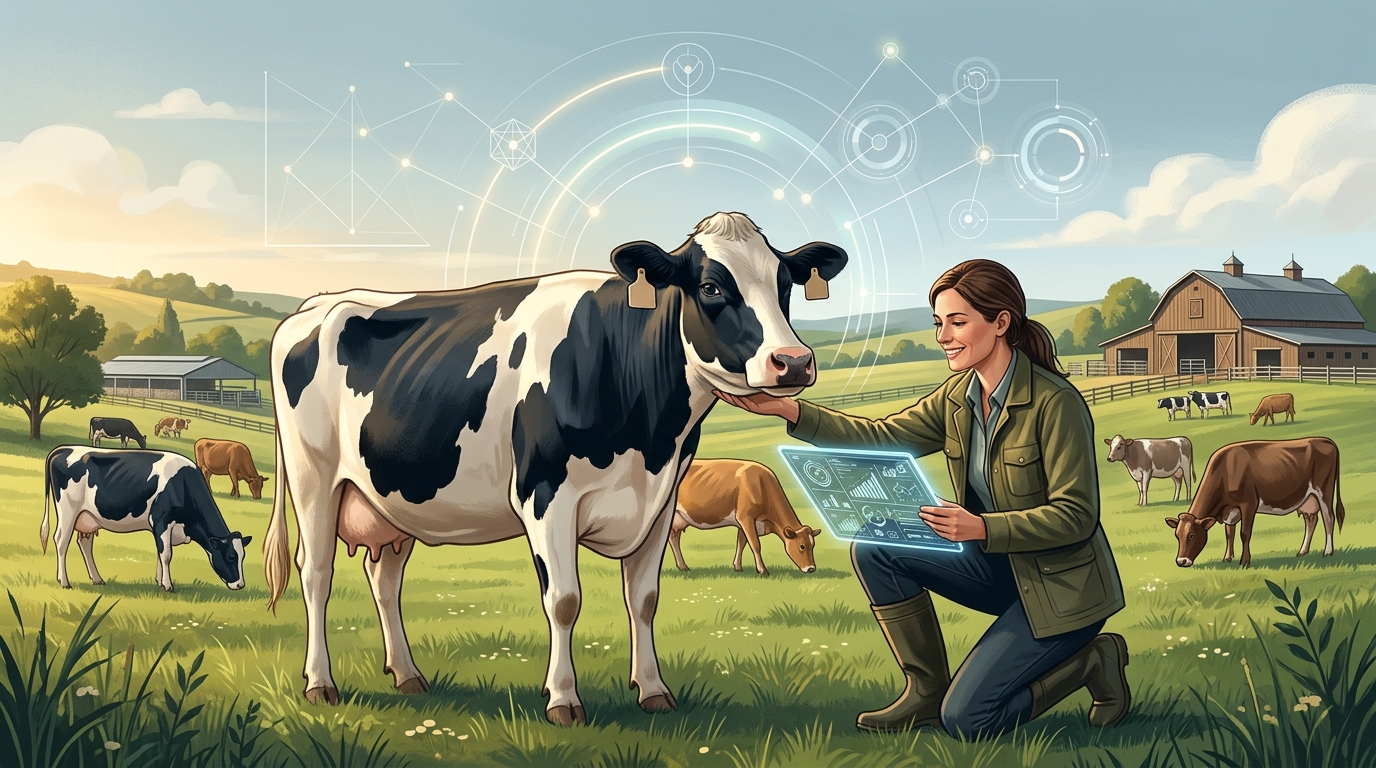
Veterinarians have advised livestock herds at the population level for decades, yet the field they practice has never had a settled definition. A narrative review published in Acta Veterinaria Scandinavica now proposes one, describing herd health management as a continuous, cyclic process of planning, implementing and evaluating decisions that aim to promote herd health, understood as normal biological function, including homeostasis and the absence of disease, among the animals populating a given farm, in order to achieve the producer’s goals regarding productivity, animal health and externalities. The review, based on a search of Web of Science using the term “herd health” with no restriction on publication date, argues that the scientific literature uses herd health management and related terms inconsistently and that theoretical deliberations around its practice have been lacking.
The authors, Esben Østergaard Eriksen, Ken Steen Pedersen and Jens Peter Nielsen, trace the origins of the discipline to the intensification of livestock production in the decades after the Second World War. In Danish pig production, antimicrobial supplements in the diet, climate-controlled pens, enhanced biosecurity and better knowledge about feed paved the way for a noticeably lower age at which producers separated piglets from the sow; the common weaning age dropped from 7 to 10 weeks to approximately 4 weeks during the 1970s. This intensification introduced herd health management into pig production according to principles first developed in dairy production. The role of veterinarians shifted from single animal-oriented and treatment-oriented work to a population-level oriented and prevention-focused approach, a development reflected in the establishment of the European College of Bovine Health Management and the European College of Porcine Health Management in 2003 and 2004.
To build their definition, the authors first decomposed the term into its components. A herd, they note, is a group of animals, typically cattle, pigs, poultry or related wild animals, that live together as a consequence of a natural behavioural pattern or because it is imposed by humans; in this context, a herd is a group of livestock living on the same farm, which makes clear that working with a herd means working at the population level. Animal health is difficult to define: a review of 500 veterinary textbooks identified 39 heterogeneous definitions, emphasizing one or more of five domains: normality, biological function, homeostasis, physical and psychological well-being, and productivity, including reproduction. The authors deliberately excluded productivity from their definition of herd health. Improving health is often viewed as a means to improve productivity, so keeping the terms separate is considered wise, and the inclusion of productivity in animal health definitions is an old idea that today is rarely done and seems to rely on a logical fallacy and an anthropocentric viewpoint.
The exclusion has a practical rationale. Poor health will often impair productivity, since disease hampers growth, so animals suddenly displaying low productivity are likely to have poor health. Because of this association, it is tempting to define health based on productivity measures. Yet there are well documented cases of animals kept in production systems where high productivity has direct and severe negative impacts on their health, for example high milk yield in cattle. The noun management, meanwhile, has been defined in ways related to the process of dealing with or controlling things or people. In an agricultural context, farm management science has used management, decision-making and problem solving interchangeably, and farm management can be defined as a continuous process dealing with planning, implementing and evaluating decisions regarding production, finance, marketing and human resources at a strategic, tactical and operational level.
The review documents how fragmented the terminology has been. Blood and colleagues gave one of the first definitions in 1978, describing a health program as a planned and coordinated approach to achieving and maintaining optimal health and productive efficiency of livestock, and a year later Blood defined herd health as a coordinated program of preventive measures to maintain the health of the herd. Later definitions framed the goal as maintaining animal health and production at the most efficient level that provides maximum economic returns to the farmer, or as regular scheduled farm visits that go beyond one-off tasks such as pregnancy diagnosis, castrations and dehorning, with the purpose of preventing disease or improving animal health and production through long-term strategies focusing on the herd as a whole. The authors conclude that the literature contains a plethora of definitions and that the field lacks common terminology.
From these building blocks, the review proposes a set of concise definitions. Herd health is the presence of normal biological function, including homeostasis and the absence of disease, among the animals populating a given farm. Herd health consultancy is the task of providing expert assessments and advice to a livestock producer on how to promote herd health, and veterinary herd health consultancy specifies that the advice is delivered by a veterinarian. A herd health management program is a more or less flexible outline for the delivery of such consultancy, defining items such as themes and services to be covered, intervals of herd visits and specific data to be collected and evaluated. A herd health management concept is a flexible draft of how a certain herd health problem should be assessed or solved, typically based on evidence or expert opinions. The authors also recommend avoiding the term veterinary herd health management, since it is unclear what distinguishes it from herd health management, while noting that distinguishing between porcine and bovine health management remains relevant because context and biology differ among species.
The theoretical framework at the heart of the paper describes how the work is actually practiced. Herd health management includes decisions at strategic, tactical and operational levels. Tactical planning decisions are made at regular herd visits, guided by the veterinarian’s advice; in between visits, the livestock producer and herd personnel implement the plan and make smaller operational decisions in accordance with it; evaluation is carried out at the next herd visit. The steps involved in tactical decisions are an evaluation of the current situation, defining goals, identifying risks, planning new practices to be implemented, and establishing a way to monitor indicators of success. The framework draws on models from farm management, environmental management science and earlier herd management models, all of which describe cyclic, continuous processes with corresponding decision stages.
Goals, the review proposes, fall within three domains: health, productivity and externalities. Livestock producers often put strong emphasis on health in their view of animal welfare, and good health can lead to increased work satisfaction, but the producer’s goal is often the expected benefits of enhanced health, such as improved growth or yield or reduced costs for feed, medicine or labour. Goals should be formulated according to the S.M.A.R.T. model, meaning specific, measurable, assignable, realistic and time-related. The review highlights evidence that veterinarians commonly fail to align expectations on goals: in 2007, only 50% of Dutch dairy producers reported that their veterinarian was both aware of their goals and sought to achieve them with the advice provided. Producers often silently expect consultancy to focus on items such as prudent antimicrobial use, animal health and animal welfare, and their goals are shaped by values other than monetary gain, including social norms, emotions, experience, fear, perception of risk, economic situation, local culture, legislation, media and consumer opinions. Aligning expectations, the authors stress, means explicitly discussing goals rather than uncritically conforming to them.
Once the current status is clarified and goals defined, the difference between the two may be termed a herd health problem, and the first step toward resolving it is risk identification, exploring the possible causes, which requires the veterinarian’s expertise and a profound understanding of causation. The next stage is to develop and select alternative management practices, weighing which alternative is believed to remove the identified risk most efficiently at the lowest possible cost in resources, labour time, negative externalities and compliance with the producer’s personal values. Prevention can be applied at different levels: primary prevention seeks to remove the animal’s exposure to an infectious agent, for example through cleaning and disinfection, specific pathogen free production systems and biosecurity, while secondary prevention seeks to prevent colonization from developing into clinical disease, for example through vaccination programs or prophylactic antibiotic treatment. The final planning decision is a monitoring scheme, choosing indicators directly related to the defined goals, ideally reliable and valid, whether measuring performance itself, such as growth rate, or the causes behind it.
The cycle closes with evaluation, and here the review is candid about the limits of common practice. Simply measuring and comparing a herd health indicator before and after adopting a new management practice does not allow strong inferences, because production fluctuates over time and more than the new practice will have changed. The herd-specific randomized trial, in which tagged animals or groups such as pens are allocated randomly to the usual or the new practice and the effect is the difference between the groups, is the strongest approach to establishing a causal relationship, but it is rarely applied in practical consultancy because it requires great resources and is not always possible. Alternatives include evolutionary operation designs borrowed from industrial process management, process behaviour charts showing time-series of a moving average with natural process limits, and state space models that combine a priori expectations with observed data to forecast future development. Often, the authors note, evaluation still relies on simple comparisons of descriptive summary statistics before and after a change, and the advanced methods introduced are not widely applied in herd health management.
Subject of Research: A narrative review proposing a definition and theoretical framework for herd health management in livestock production.
Article Title: What is herd health management? A narrative review
Article References: Eriksen, E. Ø., Pedersen, K. S., & Nielsen, J. P. (2026). What is herd health management? A narrative review. Acta Veterinaria Scandinavica, 68(1), Article 25. https://doi.org/10.1186/s13028-025-00849-y
Image Credits: AI Generated
DOI: 10.1186/s13028-025-00849-y
Keywords: herd health management, livestock, veterinary consultancy, farm management, animal health, swine production, dairy production, disease prevention, HACCP, risk identification, monitoring indicators, narrative review
News Source: William Thompson. (November 4, 2026). Scientists define herd health management in new framework for farm veterinarians. Scienmag.