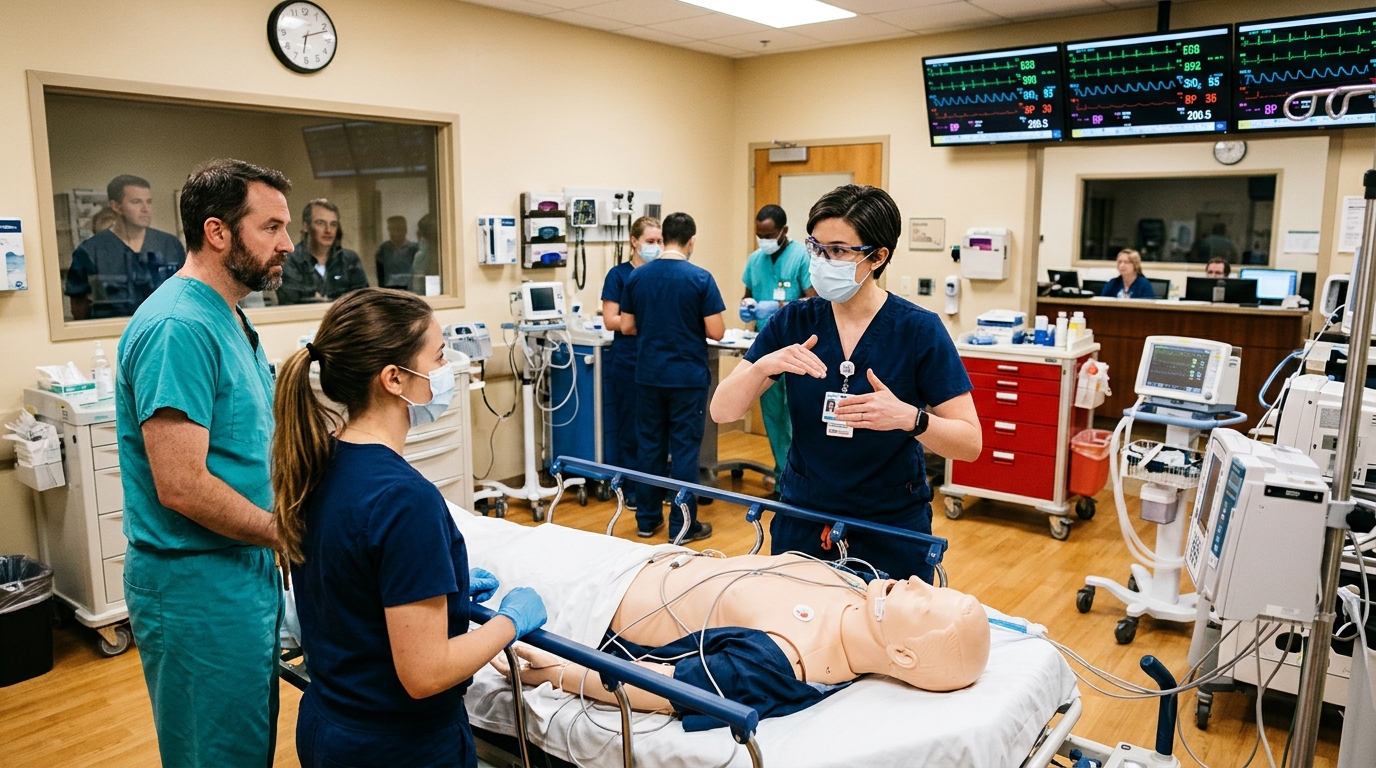
Interprofessional emergency teams trained in a real clinical setting performed no better on observed nontechnical skills than teams trained in a simulation center, according to a cross-sectional study conducted in a Brazilian healthcare setting. The study, published in Advances in Simulation, compared nontechnical skills performance between in situ simulation, which takes place in the actual clinical workplace, and simulation center–based simulation, and found no statistically significant differences between the two settings.
Nontechnical skills, which include leadership, communication, teamwork and task management, are considered essential for safe and effective performance in emergency care. Simulation-based training is widely used to develop these competencies, but the extent to which the physical training setting influences team performance has remained uncertain. The research team set out to examine whether in situ simulation and simulation center–based simulation were associated with differences in observed nontechnical skills performance among interprofessional emergency teams.
The study was quantitative and cross-sectional in design. It included interprofessional healthcare professionals taking part in emergency simulation training. Sixteen teams were studied, with eight trained through in situ simulation and eight through simulation center–based simulation. All sixteen teams were video recorded during their simulation sessions, and their performance was assessed using the Brazilian Portuguese version of the Team Emergency Assessment Measure, known as bp-TEAM.
Each video recording was evaluated independently by seven expert raters, producing 112 independent bp-TEAM assessments across the sixteen teams, which together comprised 71 participants. Interrater reliability was good, with an intraclass correlation coefficient of 0.798 and a 95% confidence interval of 0.590 to 0.919, indicating substantial agreement among the expert evaluators.
When the researchers compared performance between the two settings, they found no statistically significant differences. Global ratings averaged 7.73 for in situ teams and 7.32 for simulation center–based teams, a difference that was not statistically significant, with a p value of 0.5251. Total bp-TEAM scores averaged 33.7 for in situ teams and 30.38 for simulation center–based teams, which also did not reach statistical significance, with a p value of 0.3062.
The study also gathered participants’ own views on the training. Participants completed a questionnaire assessing their perceptions of nontechnical skills learning and its applicability to professional practice. The content validity of this questionnaire was established through expert review before use, and the questionnaire itself demonstrated excellent content validity, with an agreement coefficient of 0.963.
Among the 48 questionnaire respondents, most reported a high likelihood of applying learning related to leadership, communication, teamwork and task management in their professional practice. In addition, 97.9% of respondents indicated that such training should occur more frequently. Both settings were associated with positive perceptions regarding the applicability of nontechnical skills to clinical practice.
The authors concluded that no statistically significant differences in nontechnical skills performance were observed between the simulation settings. They suggested that factors such as participant experience, team composition and institutional simulation culture may have a greater influence on team performance than the physical training environment itself. The findings indicate that where simulation takes place may matter less than who is being trained and how the training is embedded within an institution.
As a cross-sectional study of sixteen teams in a single Brazilian healthcare setting, the research captures observed performance at one point in time rather than tracking changes over a training period. The measured performance differences between settings were small and not statistically significant, and the study does not establish whether either setting would produce different long-term learning outcomes. The questionnaire results reflect participants’ self-reported perceptions rather than independently measured behavior change in clinical practice.
Subject of Research: Nontechnical skills performance of interprofessional emergency teams during in situ versus simulation center–based simulation training
Article Title: Does training setting matter? Nontechnical skills performance in interprofessional emergency teams during in situ and simulation center–based simulation
Article References: Fuzari, G. S., Couto, T. B., Galetti, M. M., Generoso Junior, J. R., Paiva, P. R., de Almeida, A. L. N. R., da Cruz, P. P. P., Nemer Bou Ghosn, D. S., Pontes, M. C., & Shimocomaqui, G. B. (2026). Does training setting matter? Nontechnical skills performance in interprofessional emergency teams during in situ and simulation center–based simulation. Advances in Simulation. https://doi.org/10.1186/s41077-026-00503-1
Image Credits: AI Generated
DOI: 10.1186/s41077-026-00503-1
Keywords: simulation, in situ simulation, nontechnical skills, emergency teams, interprofessional training, bp-TEAM, team performance, Brazil, healthcare education, cross-sectional study, Does, training
News Source: Courtney Benton. (November 4, 2026). Simulation setting may not shape emergency team nontechnical skills. Scienmag.