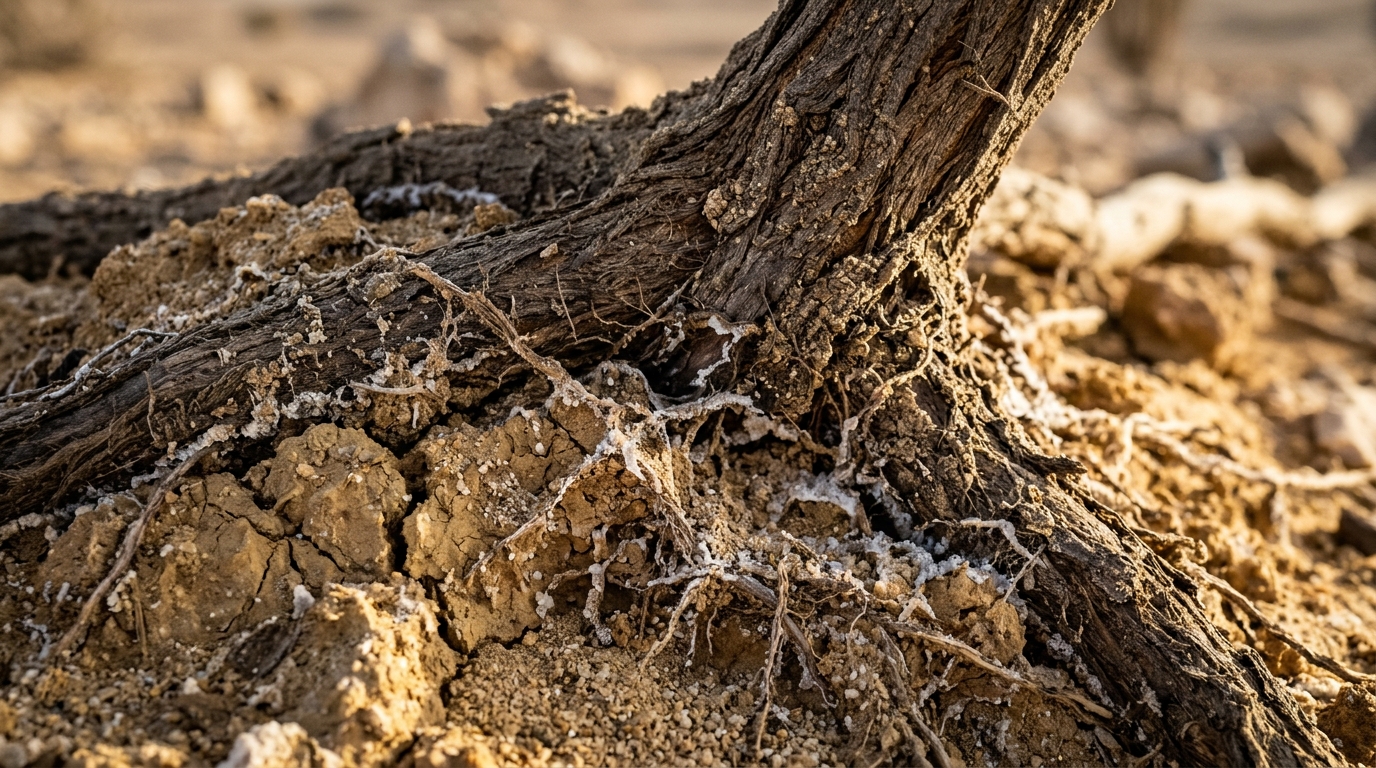
Beneath the Saharan tree Vachellia tortilis subsp. raddiana, in the arid soils of southern Morocco, bacteria survive conditions that would kill many of their relatives. A new open-access study in Discover Bacteria has now mapped how six of these isolates cope with two of agriculture’s most punishing stresses: salinity, imposed with sodium chloride, and osmotic drought, simulated with polyethylene glycol. The results are strikingly uneven. Some strains collapsed as stress intensified, while others held their ground, and the two most resilient candidates, Pseudarthrobacter sp. LMR1158 and Pantoea sp. LMR881, did so in very different ways.
The research team, Mohamed Hnini and Jamal Aurag, isolated bacteria from the bulk soil of healthy Vachellia tortilis subsp. raddiana trees at two sites in the Guelmim region, Taidalt and Amazloug. Soil was collected roughly 10 to 20 centimeters from the roots, diluted, plated on nutrient broth agar, and incubated at 28 degrees Celsius. After purification on Luria-Bertani plates, representative strains were identified by sequencing the 16S rRNA gene, the standard workhorse of bacterial taxonomy. The six strains selected for detailed analysis belonged to five genera: Kocuria, Micrococcus, Brevibacillus, Pantoea, and Pseudarthrobacter, carrying the laboratory codes LMR959, LMR978, LMR997, LMR1086, LMR881, and LMR1158.
GenBank accession numbers were deposited for most of the strains, and a maximum likelihood phylogenetic tree built from partial 16S rRNA sequences placed each isolate among its closest relatives. Pseudarthrobacter sp. LMR1158 grouped with Pseudarthrobacter siccitolerans, Micrococcus sp. LMR978 affiliated with Micrococcus yunnanensis, and Kocuria sp. LMR959 sat near the type strain Kocuria aegyptia. Brevibacillus sp. LMR997 clustered with Brevibacillus laterosporus and Brevibacillus halotolerans, while the two Pantoea strains, LMR881 and LMR1086, were closely related to each other and to Pantoea agglomerans and Mixta gaviniae type strains. The authors note that 16S rRNA sequencing has limited resolution at the species level, so future multilocus sequence typing and whole-genome sequencing are planned to sharpen strain authentication.
The physiological experiments were straightforward but revealing. Drought stress was simulated by adding PEG 6000 to yeast extract mannitol broth at 0, 10, 20, and 30 percent weight per volume, following a protocol adapted from Sandhya and colleagues. Salt tolerance was tested at 0, 3, 6, and 10 percent NaCl, first through a preliminary screen on solid agar to determine the maximum inhibitory concentration, then quantitatively in liquid culture. Cultures were inoculated at 1 percent, incubated at 28 degrees Celsius for 48 hours with shaking, and growth was measured as optical density at 600 nanometers. Every measurement was blank-corrected against sterile medium containing the same NaCl or PEG concentration to remove the turbidity the stressors themselves introduce, and dense cultures were diluted into the linear range before back-calculation. Each treatment ran in triplicate from independent colonies.
The growth data told a story of uneven vulnerability. Kocuria sp. LMR959, the most dramatic casualty, saw its average optical density plummet from 1.137 with no PEG to just 0.132 at 30 percent PEG. Micrococcus sp. LMR978, Brevibacillus sp. LMR997, and both Pantoea strains also declined, falling from starting values between 0.563 and 0.926 down to a range of 0.086 to 0.147 at the highest PEG concentration. Pseudarthrobacter sp. LMR1158 was the outlier. Its average growth slipped only from 1.256 to 0.544 across the full PEG gradient, a modest decline that the authors interpret as genuine osmotic stress tolerance rather than mere survival.
Auxin production added a second, complicating layer. Using the Salkowski colorimetric method, which detects indole compounds by a pink color change read at 540 nanometers, the team quantified indole-3-acetic acid, the best-known auxin, in cultures supplemented with tryptophan. Here the trade-offs became visible. Kocuria sp. LMR959 produced the highest auxin levels of any strain, 30.302 micrograms per milliliter, yet its growth collapsed under stress, marking it as a prolific hormone producer that cannot tolerate the very conditions it might be asked to endure in the field. Pseudarthrobacter sp. LMR1158, by contrast, produced a robust 26.295 micrograms per milliliter while maintaining relatively stable growth even under salt stress, and in the preliminary solid-medium screen it grew up to 5 percent NaCl. That combination of sustained hormone output and stress resilience is precisely what bioinoculant developers look for.
Pantoea sp. LMR881 earned its own spotlight through a different route. Rather than topping any single metric, it exhibited relatively high growth rates under stress conditions overall, and in the combined NaCl and PEG experiments its optical density values ranged from 0.000 to 0.509 while auxin absorbance values reached up to 39.684. The authors flag it as a promising candidate for sustainable agriculture, though they are careful about what that means. In their discussion they state plainly that the study provides comparative phenotypic evidence of growth and IAA production under PEG- and NaCl-imposed conditions, but does not resolve the underlying biochemical or genetic mechanisms, nor does it directly demonstrate effects on plant performance. They explicitly refrain from asserting bioinoculant efficacy.
That restraint matters because the broader literature on these genera is full of tantalizing but unproven possibilities. Pantoea species have been found in the rhizospheres of legumes, wheat, and chickpeas, and previous studies have reported that strains such as Pantoea alhagi and Pantoea agglomerans ANP8 promote plant growth under salt and drought stress. Pseudarthrobacter species have been isolated from alfalfa rhizospheres, bean nodules, and the bulk soil of Sulla spinosissima. But those findings belong to other papers and other systems. What this study adds is a controlled, side-by-side phenotypic comparison of six strains from a single Saharan host tree, showing that stress tolerance and auxin production do not travel together in any simple way.
The inverse relationship between IAA production and growth under stress is one of the study’s more thought-provoking observations. In sensitive strains like Micrococcus sp. LMR978, the authors suggest the metabolic cost of synthesizing hormone under stress may compound the burden of osmotic or ionic imbalance. Pantoea sp. LMR1086, which sustained the highest growth yield at peak auxin production in one of the PEG experiments, hints at optimized metabolic pathways, perhaps involving efficient carbon use or stress-responsive enzymes. The authors interpret IAA levels as putative contributors to interaction potential but explicitly do not infer a causal link to plant growth, noting that establishing such a relationship will require in-planta assays measuring root architecture and biomass under drought and salinity, which are planned for future studies.
What comes next is a roadmap rather than a conclusion. The authors propose whole-genome sequencing to mine loci associated with auxin biosynthesis and osmoprotection, transcriptomic and proteomic profiling to identify stress-responsive pathways in LMR881 and LMR1158, greenhouse and field trials to test whether the phenotypes translate into improved plant growth and yield, and comprehensive safety assessments, including hemolysis assays, antibiotic susceptibility testing, and in silico virulence screening, before any agronomic deployment, a caution driven by the fact that some Pantoea species are known opportunistic pathogens. For now, the study stands as a careful phenotypic survey: six bacterial strains from the soil of a desert tree, exposed to graded salt and osmotic stress, revealing that the capacity to endure drought and the capacity to produce auxin are separable traits, and that the strains best positioned for future bioinoculant development are those that manage both at once.
Subject of Research: Stress tolerance and auxin production in soil bacteria associated with Vachellia tortilis subsp. raddiana
Article Title: Microbial responses to polyethylene glycol and salt stress: insights from selected soil bacteria associated with the Saharan tree Vachellia tortilis subsp. raddiana
Article References: Hnini, M., & Aurag, J. (2026). Microbial responses to polyethylene glycol and salt stress: insights from selected soil bacteria associated with the Saharan tree Vachellia tortilis subsp. raddiana. Discover Bacteria, 3(1), Article 4. https://doi.org/10.1007/s44351-026-00043-z
Image Credits: AI Generated
DOI: 10.1007/s44351-026-00043-z
Keywords: soil bacteria, Vachellia tortilis subsp. raddiana, salt stress, drought stress, polyethylene glycol, auxin production, indole-3-acetic acid, plant growth-promoting rhizobacteria, Pseudarthrobacter, Pantoea, bioinoculants, Morocco
News Source: Drew Townsend. (November 5, 2026). Desert Tree Soil Bacteria Reveal Strain-Specific Tolerance to Salt and Drought Stress. Scienmag.